

[Mar 18, 2026] Associate-Cloud-Engineer PDF Questions and Testing Engine With 335 Questions
Updated Exam Engine for Associate-Cloud-Engineer Exam Free Demo & 365 Day Updates
Google Associate-Cloud-Engineer Certification Exam is a valuable credential for IT professionals seeking to validate their knowledge and expertise in cloud computing. Google Associate Cloud Engineer Exam certification exam is suitable for individuals with some experience in deploying and managing cloud solutions on the Google Cloud platform. It is also an excellent opportunity for individuals who want to enhance their skills and knowledge in cloud computing and advance their careers in the IT industry.
NEW QUESTION # 45
You have one GCP account running in your default region and zone and another account running in a non-default region and zone. You want to start a new Compute Engine instance in these two Google Cloud Platform accounts using the command line interface. What should you do?
- A. Create two configurations using gcloud config configurations create [NAME]. Run gcloud configurations list to start the Compute Engine instances.
- B. Activate two configurations using gcloud configurations activate [NAME]. Run gcloud config list to start the Compute Engine instances.
- C. Activate two configurations using gcloud configurations activate [NAME]. Run gcloud configurations list to start the Compute Engine instances.
- D. Create two configurations using gcloud config configurations create [NAME]. Run gcloud config configurations activate [NAME] to switch between accounts when running the commands to start the Compute Engine instances.
Answer: D
Explanation:
Explanation
"Run gcloud configurations list to start the Compute Engine instances". How the heck are you expecting to
"start" GCE instances doing "configuration list".
Each gcloud configuration has a 1 to 1 relationship with the region (if a region is defined). Since we have two different regions, we would need to create two separate configurations using gcloud config configurations createRef: https://cloud.google.com/sdk/gcloud/reference/config/configurations/create Secondly, you can activate each configuration independently by running gcloud config configurations activate
[NAME]Ref: https://cloud.google.com/sdk/gcloud/reference/config/configurations/activate Finally, while each configuration is active, you can run the gcloud compute instances start [NAME] command to start the instance in the configurations region.https://cloud.google.com/sdk/gcloud/reference/compute/instances/start
NEW QUESTION # 46
You are managing a project for the Business Intelligence (BI) department in your company. A data pipeline ingests data into BigQuery via streaming. You want the users in the BI department to be able to run the custom SQL queries against the latest data in BigQuery. What should you do?
- A. Create a Data Studio dashboard that uses the related BigQuery tables as a source and give the BI team view access to the Data Studio dashboard.
- B. Assign the IAM role of BigQuery User to a Google Group that contains the members of the BI team.
- C. Create a Service Account for the BI team and distribute a new private key to each member of the BI team.
- D. Use Cloud Scheduler to schedule a batch Dataflow job to copy the data from BigQuery to the BI team's internal data warehouse.
Answer: B
Explanation:
Explanation
When applied to a dataset, this role provides the ability to read the dataset's metadata and list tables in the dataset. When applied to a project, this role also provides the ability to run jobs, including queries, within the project. A member with this role can enumerate their own jobs, cancel their own jobs, and enumerate datasets within a project. Additionally, allows the creation of new datasets within the project; the creator is granted the BigQuery Data Owner role (roles/bigquery.dataOwner) on these new datasets.
https://cloud.google.com/bigquery/docs/access-control
NEW QUESTION # 47
You have created a code snippet that should be triggered whenever a new file is uploaded to a Cloud Storage bucket. You want to deploy this code snippet. What should you do?
- A. Use Google Kubernetes Engine and configure a CronJob to trigger the application using Pub/Sub.
- B. Use Cloud Functions and configure the bucket as a trigger resource.
- C. Use App Engine and configure Cloud Scheduler to trigger the application using Pub/Sub.
- D. Use Dataflow as a batch job, and configure the bucket as a data source.
Answer: C
NEW QUESTION # 48
You are using multiple configurations for gcloud. You want to review the configured Kubernetes Engine cluster of an inactive configuration using the fewest possible steps. What should you do?
- A. Use kubectl config get-contexts to review the output.
- B. Use kubectl config use-context and kubectl config view to review the output.
- C. Use gcloud config configurations activate and gcloud config list to review the output.
- D. Use gcloud config configurations describe to review the output.
Answer: B
Explanation:
get-contexts does not show clusters it only shows contexts.
https://kubernetes.io/docs/reference/kubectl/cheatsheet/#kubectl-context-and-configuration
NEW QUESTION # 49
You need a dynamic way of provisioning VMs on Compute Engine. The exact specifications will be in a dedicated configuration file. You want to follow Google's recommended practices. Which method should you use?
- A. Deployment Manager
- B. Managed Instance Group
- C. Cloud Composer
- D. Unmanaged Instance Group
Answer: A
Explanation:
Explanation
https://cloud.google.com/deployment-manager/docs/configuration/create-basic-configuration
NEW QUESTION # 50
You need to create an autoscaling managed instance group for an HTTPS web application. You want to make sure that unhealthy VMs are recreated. What should you do?
- A. In the Instance Template, add a startup script that sends a heartbeat to the metadata server.
- B. In the Instance Template, add the label 'health-check'.
- C. Select Multi-Zone instead of Single-Zone when creating the Managed Instance Group.
- D. Create a health check on port 443 and use that when creating the Managed Instance Group.
Answer: B
NEW QUESTION # 51
You have files in a Cloud Storage bucket that you need to share with your suppliers. You want to restrict the time that the files are available to your suppliers to 1 hour. You want to follow Google recommended practices. What should you do?
- A. Create a service account with just the permissions to access files in the bucket. Create a JSON key for the service account. Execute the command gsutil signurl -m 1h gs:///*.
- B. Create a service account with just the permissions to access files in the bucket. Create a JSON key for the service account. Execute the command gsutil signurl -p 60m gs:///.
- C. Create a service account with just the permissions to access files in the bucket. Create a JSON key for the service account. Execute the command gsutil signurl -d 1h gs:///**.
- D. Create a JSON key for the Default Compute Engine Service Account. Execute the command gsutil signurl -t 60m gs:///***
Answer: C
Explanation:
This command correctly specifies the duration that the signed url should be valid for by using the -d flag. The default is 1 hour so omitting the -d flag would have also resulted in the same outcome. Times may be specified with no suffix (default hours), or with s = seconds, m = minutes, h = hours, d = days. The max duration allowed is 7d. Ref: https://cloud.google.com/storage/docs/gsutil/commands/signurl
NEW QUESTION # 52
Your company set up a complex organizational structure on Google Could Platform. The structure includes hundreds of folders and projects. Only a few team members should be able to view the hierarchical structure.
You need to assign minimum permissions to these team members and you want to follow Google- recommended practices. What should you do?
- A. Add the users to roles/iam.roleViewer role.
- B. Add the users to a group, and add this group to roles/iam.roleViewer role.
- C. Add the users to roles/browser role.
- D. Add the users to a group, and add this group to roles/browser role.
Answer: C
Explanation:
Explanation/Reference:
NEW QUESTION # 53
You are hosting an application from Compute Engine virtual machines (VMs) in us-central1-a. You want to adjust your design to support the failure of a single Compute Engine zone, eliminate downtime, and minimize cost. What should you do?
- A. - Create an HTTP(S) Load Balancer.
-Create one or more global forwarding rules to direct traffic to your VMs. - B. - Perform regular backups of your application.
-Create a Cloud Monitoring Alert and be notified if your application becomes unavailable.
-Restore from backups when notified. - C. - Create a Managed Instance Group and specify us-central1-a as the zone.
-Configure the Health Check with a short Health Interval. - D. - Create Compute Engine resources in us-central1-b.
-Balance the load across both us-central1-a and us-central1-b.
Answer: D
Explanation:
Choosing a region and zone You choose which region or zone hosts your resources, which controls where your data is stored and used. Choosing a region and zone is important for several reasons:
Handling failures
Distribute your resources across multiple zones and regions to tolerate outages. Google designs zones to be independent from each other: a zone usually has power, cooling, networking, and control planes that are isolated from other zones, and most single failure events will affect only a single zone. Thus, if a zone becomes unavailable, you can transfer traffic to another zone in the same region to keep your services running.
Similarly, if a region experiences any disturbances, you should have backup services running in a different region. For more information about distributing your resources and designing a robust system, see Designing Robust Systems. Decreased network latency To decrease network latency, you might want to choose a region or zone that is close to your point of service.
https://cloud.google.com/compute/docs/regions-zones#choosing_a_region_and_zone
NEW QUESTION # 54
You used the gcloud container clusters command to create two Google Cloud Kubernetes (GKE) clusters prod-cluster and dev-cluster.
* prod-cluster is a standard cluster.
* dev-cluster is an auto-pilot duster.
When you run the Kubect1 get nodes command, you only see the nodes from prod-cluster Which commands should you run to check the node status for dev-cluster?
- A.

- B.

- C.

- D.

Answer: C
NEW QUESTION # 55
You are using Deployment Manager to create a Google Kubernetes Engine cluster. Using the same Deployment Manager deployment, you also want to create a DaemonSet in the kube- system namespace of the cluster. You want a solution that uses the fewest possible services.
What should you do?
- A. With Deployment Manager, create a Compute Engine instance with a startup script that uses kubectl to create the DaemonSet.
- B. In the cluster's definition in Deployment Manager, add a metadata that has kube-system as key and the DaemonSet manifest as value.
- C. Use the Deployment Manager Runtime Configurator to create a new Config resource that contains the DaemonSet definition.
- D. Add the cluster's API as a new Type Provider in Deployment Manager, and use the new type to create the DaemonSet.
Answer: D
NEW QUESTION # 56
You are building an archival solution for your data warehouse and have selected Cloud Storage to archive your dat a. Your users need to be able to access this archived data once a quarter for some regulatory requirements. You want to select a cost-efficient option. Which storage option should you use?
- A. Regional Storage
- B. Multi-Regional Storage
- C. Cold Storage
- D. Nearline Storage
Answer: C
Explanation:
Nearline, Coldline, and Archive offer ultra low-cost, highly-durable, highly available archival storage. For data accessed less than once a year, Archive is a cost-effective storage option for long-term preservation of data.
Coldline is also ideal for cold storage-data your business expects to touch less than once a quarter. For warmer storage, choose Nearline: data you expect to access less than once a month, but possibly multiple times throughout the year. All storage classes are available across all GCP regions and provide unparalleled sub-second access speeds with a consistent API.
Reference:
https://cloud.google.com/storage/archival
NEW QUESTION # 57
You have a virtual machine that is currently configured with 2 vCPUs and 4 GB of memory. It is running out of memory. You want to upgrade the virtual machine to have 8 GB of memory.
What should you do?
- A. Use gcloud to add metadata to the VM. Set the key to required-memory-sizeand the value to
8 GB. - B. Stop the VM, change the machine type to n1-standard-8, and start the VM.
- C. Rely on live migration to move the workload to a machine with more memory.
- D. Stop the VM, increase the memory to 8 GB, and start the VM.
Answer: D
NEW QUESTION # 58
You want to find out when users were added to Cloud Spanner Identity Access Management (IAM) roles on your Google Cloud Platform (GCP) project. What should you do in the GCP Console?
- A. Open the IAM & admin console to review IAM policies for Cloud Spanner roles.
- B. Go to the Stackdriver Logging console, review admin activity logs, and filter them for Cloud Spanner IAM roles.
- C. Open the Cloud Spanner console to review configurations.
- D. Go to the Stackdriver Monitoring console and review information for Cloud Spanner.
Answer: B
NEW QUESTION # 59
You created several resources in multiple Google Cloud projects. All projects are linked to different billing accounts. To better estimate future charges, you want to have a single visual representation of all costs incurred. You want to include new cost data as soon as possible. What should you do?
- A. Use the Reports view in the Cloud Billing Console to view the desired cost information.
- B. Fill all resources in the Pricing Calculator to get an estimate of the monthly cost.
- C. Configure Billing Data Export to BigQuery and visualize the data in Data Studio.
- D. Visit the Cost Table page to get a CSV export and visualize it using Data Studio.
Answer: C
Explanation:
https://cloud.google.com/billing/docs/how-to/visualize-data
NEW QUESTION # 60
You have a 20 GB file that you need to securely share with some contractors. They need it as fast as possible. Which steps would get them the file quickly and securely?
- A. Using composite objects and parallel uploads to upload the file to Cloud Storage quickly. Then generate a signed URL and securely share it with the contractors.
- B. Upload the file to Cloud Storage. Grant the allAuthenticated users token view permissions.
- C. Set up a VPC with a custom subnet. Create a subnet tunnel. Upload the file to a network share. Grant the contractors temporary access.
- D. Upload the file to Bigtable using the bulk data import tool. Then provide the contractors with read access to the database.
Answer: A
NEW QUESTION # 61
Your company developed an application to deploy on Google Kubernetes Engine. Certain parts of the application are not fault-tolerant and are allowed to have downtime Other parts of the application are critical and must always be available. You need to configure a Goorj e Kubernfl:es Engine duster while optimizing for cost. What should you do?
- A. Create a cluster with a single node-pool by using Spot VMs. Label the critical Deployments as spot- false.
- B. Create a cluster with both a Spot W node pool and a rode pool by using standard VMs Deploy the critical.deployments on the Spot VM node pool and the fault; tolerant deployments on the node pool by using standard VMs.
- C. Create a cluster with both a Spot VM node pool and by using standard VMs. Deploy the critical deployments on the mode pool by using standard VMs and the fault-tolerant deployments on the Spot VM node pool.
- D. Create a cluster with a single node-pool by using standard VMs. Label the fault-tolerant Deployments as spot-true.
Answer: B
NEW QUESTION # 62
A colleague handed over a Google Cloud Platform project for you to maintain. As part of a security checkup, you want to review who has been granted the Project Owner role. What should you do?
- A. Use the command gcloud projects get-iam-policy to view the current role assignments.
- B. Enable Audit Logs on the IAM & admin page for all resources, and validate the results.
- C. In the console, validate which SSH keys have been stored as project-wide keys.
- D. Navigate to Identity-Aware Proxy and check the permissions for these resources.
Answer: A
Explanation:
A simple approach would be to use the command flags available when listing all the IAM policy for a given project. For instance, the following command: `gcloud projects get-iam-policy $PROJECT_ID --flatten=" bindings[].members" --format="table(bindings.members)" --filter="bindings.role:roles/owner"` outputs all the users and service accounts associated with the role 'roles/owner' in the project in question. https://groups.
google.com/g/google-cloud-dev/c/Z6sZs7TvygQ?pli=1
NEW QUESTION # 63
Your company has a 3-tier solution running on Compute Engine. The configuration of the current infrastructure is shown below.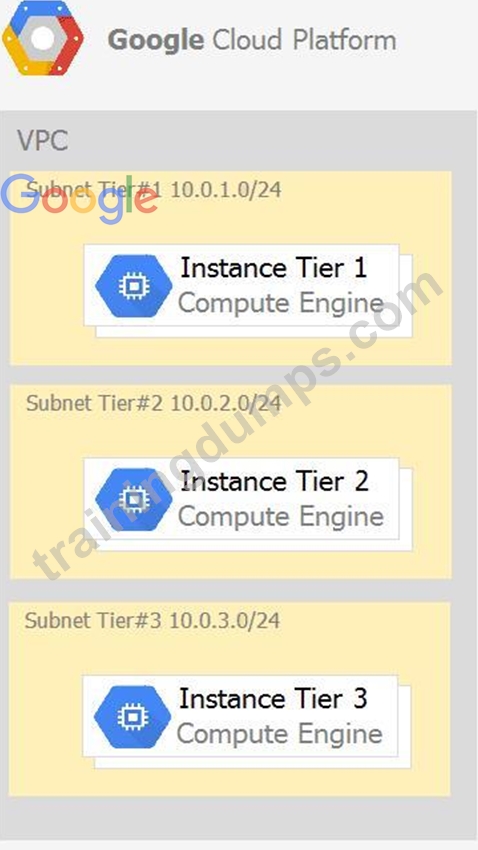
Each tier has a service account that is associated with all instances within it. You need to enable communication on TCP port 8080 between tiers as follows:
* Instances in tier #1 must communicate with tier #2.
* Instances in tier #2 must communicate with tier #3.
What should you do?
- A. 1. Create an ingress firewall rule with the following settings:* Targets: all instances* Source filter: IP ranges (with the range set to 10.0.2.0/24)* Protocols: allow all2. Create an ingress firewall rule with the following settings:* Targets: all instances* Source filter: IP ranges (with the range set to 10.0.1.0/24)* Protocols: allow all
- B. 1. Create an ingress firewall rule with the following settings:* Targets: all instances with tier #2 service account* Source filter: all instances with tier #1 service account* Protocols: allow TCP:80802. Create an ingress firewall rule with the following settings:* Targets: all instances with tier #3 service account* Source filter: all instances with tier #2 service account* Protocols: allow TCP: 8080
- C. 1. Create an egress firewall rule with the following settings:* Targets: all instances* Source filter: IP ranges (with the range set to 10.0.2.0/24)* Protocols: allow TCP: 80802. Create an egress firewall rule with the following settings:* Targets: all instances* Source filter: IP ranges (with the range set to
10.0.1.0/24)* Protocols: allow TCP: 8080 - D. 1. Create an ingress firewall rule with the following settings:* Targets: all instances with tier #2 service account* Source filter: all instances with tier #1 service account* Protocols: allow all2. Create an ingress firewall rule with the following settings:* Targets: all instances with tier #3 service account* Source filter: all instances with tier #2 service account* Protocols: allow all
Answer: B
Explanation:
1. Create an ingress firewall rule with the following settings: " Targets: all instances with tier #2 service account " Source filter: all instances with tier #1 service account " Protocols: allow TCP:8080 2. Create an ingress firewall rule with the following settings: " Targets: all instances with tier #3 service account " Source filter: all instances with tier #2 service account " Protocols: allow TCP: 8080
NEW QUESTION # 64
You are working with a Cloud SQL MySQL database at your company. You need to retain a month-end copy of the database for three years for audit purposes. What should you do?
- A. Save file automatic first-of-the- month backup for three years Store the backup file in an Archive class Cloud Storage bucket
- B. Convert the automatic first-of-the-month backup to an export file Write the export file to a Coldline class Cloud Storage bucket
- C. Set up an export job for the first of the month Write the export file to an Archive class Cloud Storage bucket
- D. Set up an on-demand backup tor the first of the month Write the backup to an Archive class Cloud Storage bucket
Answer: C
Explanation:
Explanation
https://cloud.google.com/sql/docs/mysql/backup-recovery/backups#can_i_export_a_backup
https://cloud.google.com/sql/docs/mysql/import-export#automating_export_operations
NEW QUESTION # 65
Your company wants to standardize the creation and management of multiple Google Cloud resources using Infrastructure as Code. You want to minimize the amount of repetitive code needed to manage the environment What should you do?
- A. Use curl in a terminal to send a REST request to the relevant Google API for each individual resource.
- B. Use the Cloud Console interface to provision and manage all related resources
- C. Create a bash script that contains all requirement steps as gcloud commands
- D. Develop templates for the environment using Cloud Deployment Manager
Answer: D
NEW QUESTION # 66
You built an application on Google Cloud Platform that uses Cloud Spanner. Your support team needs to monitor the environment but should not have access to table data. You need a streamlined solution to grant the correct permissions to your support team, and you want to follow Google-recommended practices. What should you do?
- A. Add the support team group to the roles/spanner.databaseUser role.
- B. Add the support team group to the roles/monitoring.viewer role
- C. Add the support team group to the roles/stackdriver.accounts.viewer role.
- D. Add the support team group to the roles/spanner.databaseReader role.
Answer: B
Explanation:
* roles/monitoring.viewer provides read-only access to get and list information about all monitoring data and configurations. This role provides monitoring access and fits our requirements. roles/monitoring.
viewer. is the right answer.
Ref: https://cloud.google.com/iam/docs/understanding-roles#cloud-spanner-roles
NEW QUESTION # 67
You have a batch workload that runs every night and uses a large number of virtual machines (VMs). It is fault-tolerant and can tolerate some of the VMs being terminated. The current cost of VMs is too high.
What should you do?
- A. Run a test using N1 standard VMs instead of N2.
If the test is successful, use N1 Standard VMs when running future jobs. - B. Run a test using simulated maintenance events.
If the test is successful, use N1 Standard VMs when running future jobs. - C. Run a test using a managed instance group.
If the test is successful, use N1 Standard VMs in the managed instance group when running future jobs. - D. Run a test using simulated maintenance events.
If the test is successful, use preemptible N1 Standard VMs when running future jobs.
Answer: B
Explanation:
https://cloud.google.com/compute/vm-instance-pricing
NEW QUESTION # 68
......
Exam Passing Guarantee Associate-Cloud-Engineer Exam with Accurate Quastions: https://www.trainingdumps.com/Associate-Cloud-Engineer_exam-valid-dumps.html
Test Engine to Practice Test for Associate-Cloud-Engineer Valid and Updated Dumps: https://drive.google.com/open?id=1iIWd47ZuV1ZIjsb2twX-laYeeO2itPhG
