

[Jan 07, 2022] Fully Updated Dumps PDF - Latest Associate-Cloud-Engineer Exam Questions and Answers
100% Free Associate-Cloud-Engineer Exam Dumps to Pass Exam Easily from TrainingDumps
Google Associate-Cloud-Engineer Exam Syllabus Topics:
| Topic | Details |
|---|---|
| Topic 1 |
|
| Topic 2 |
|
| Topic 3 |
|
| Topic 4 |
|
| Topic 5 |
|
| Topic 6 |
|
| Topic 7 |
|
| Topic 8 |
|
| Topic 9 |
|
| Topic 10 |
|
To get more details about it please visit:
Associate Cloud Engineer Exam Reference
Deploying & Implementing Cloud Solutions
- Deploy and implement Google Kubernetes Engine Resources: this domain includes skills in deploying Google Kubernetes Engine cluster, container application to Google Kubernetes Engine with pods, and configuring Google Kubernetes Engine Application logging and monitoring;
- Deploy and implement data solutions: the applicants should be able to initialize data systems with Google products and load data;
- Deploy solutions with Cloud Marketplace: the candidates must demonstrate the ability to browse the Cloud Marketplace catalog to check solution details; deploy Cloud Marketplace solutions;
- Deploy an application infrastructure with Cloud Deployment Manager with a focus on the development and launch of Deployment Manager templates.
- Deploy and implement networking resources: this will measure your ability to launch Compute Engine instances using custom network configuration; create egress and ingress firewall rule or VPC; create VPNs between the external network and Google VPC with Cloud VPN; create the load balancer to allocate the application network traffic for apps;
- Deploy and implement compute engine resources: the skills required for this area include launching compute instances with Cloud SDK and Cloud Console; creating auto-scaled managed instance groups with instance templates; uploading/generating custom SSH keys for instances; configuring virtual machines or Stackdriver logging and monitoring. It also requires that the students can assess compute quotas and request for increases; install a Stackdriver Agent for logging and monitoring;
- Deploy and implement App Engine, Cloud Functions, and Cloud Run resources: the learners will be required to demonstrate their skills in the deployment of applications, traffic splitting, updating scaling configuration, as well as deployment of applications that accept Google Cloud events;
NEW QUESTION 105
The core business of your company is to rent out construction equipment at a large scale. All the equipment that is being rented out has been equipped with multiple sensors that send event information every few seconds. These signals can vary from engine status, distance traveled, fuel level, and more. Customers are billed based on the consumption monitored by these sensors. You expect high throughput - up to thousands of events per hour per device - and need to retrieve consistent data based on the time of the event. Storing and retrieving individual signals should be atomic. What should you do?
- A. Create a file in Cloud Storage per device and append new data to that file.
- B. Ingest the data into Cloud Bigtable. Create a row key based on the event timestamp.
- C. Ingest the data into Datastore. Store data in an entity group based on the device.
- D. Create a file in Cloud Filestore per device and append new data to that file.
Answer: C
NEW QUESTION 106
You need to set up permissions for a set of Compute Engine instances to enable them to write data into a particular Cloud Storage bucket. You want to follow Google-recommended practices. What should you do?
- A. Create a service account and add it to the IAM role 'storage.objectCreator' for that bucket.
- B. Create a service account with an access scope. Use the access scope 'https://www.googleapis.com/auth/ devstorage.write_only'.
- C. Create a service account with an access scope. Use the access scope 'https://www.googleapis.com/auth/ cloud-platform'.
- D. Create a service account and add it to the IAM role 'storage.objectAdmin' for that bucket.
Answer: C
Explanation:
Explanation/Reference: https://towardsdatascience.com/enlightened-datalab-notebooks-35ce8ef374c0
NEW QUESTION 107
You want to configure autohealing for network load balancing for a group of Compute Engine instances that run in multiple zones, using the fewest possible steps. You need to configure re- creation of VMs if they are unresponsive after 3 attempts of 10 seconds each. What should you do?
- A. Create a managed instance group. Verify that the autoscaling setting is on.
- B. Create a managed instance group. Set the Autohealing health check to healthy (HTTP)
- C. Create an HTTP load balancer with a backend configuration that references an existing instance group.
Set the health check to healthy (HTTP) - D. Create an HTTP load balancer with a backend configuration that references an existing instance group.
Define a balancing mode and set the maximum RPS to 10.
Answer: A
NEW QUESTION 108
You have been asked to set up Object Lifecycle Management for objects stored in storage buckets. The objects are written once and accessed frequently for 30 days. After 30 days, the objects are not read again unless there is a special need. The object should be kept for three years, and you need to minimize cost. What should you do?
- A. Set up a policy that uses Standard storage for 30 days and then moves to Archive storage for three years.
- B. Set up a policy that uses Nearline storage for 30 days and then moves to Archive storage for three years.
- C. Set up a policy that uses Nearline storage for 30 days, then moves the Coldline for one year, and then moves to Archive storage for two years.
- D. Set up a policy that uses Standard storage for 30 days, then moves to Coldline for one year, and then moves to Archive storage for two years.
Answer: B
NEW QUESTION 109
You have an application that uses Cloud Spanner as a database backend to keep current state information about users. Cloud Bigtable logs all events triggered by users. You export Cloud Spanner data to Cloud Storage during daily backups. One of your analysts asks you to join data from Cloud Spanner and Cloud Bigtable for specific users. You want to complete this ad hoc request as efficiently as possible. What should you do?
- A. Create a dataflow job that copies data from Cloud Bigtable and Cloud Spanner for specific users.
- B. Create two separate BigQuery external tables on Cloud Storage and Cloud Bigtable.
Use the BigQuery console to join these tables through user fields, and apply appropriate filters. - C. Create a Cloud Dataproc cluster that runs a Spark job to extract data from Cloud Bigtable and Cloud Storage for specific users.
- D. Create a dataflow job that copies data from Cloud Bigtable and Cloud Storage for specific users.
Answer: A
NEW QUESTION 110
You are using Data Studio to visualize a table from your data warehouse that is built on top of BigQuery. Data is appended to the data warehouse during the day. At night, the daily summary is recalculated by overwriting the table. You just noticed that the charts in Data Studio are broken, and you want to analyze the problem. What should you do?
- A. Use Cloud Debugger to find out why the data was not refreshed correctly
- B. Use the BigQuery interface to review the nightly Job and look for any errors
- C. Review the Error Reporting page in the Cloud Console to find any errors.
- D. In Cloud Logging create a filter for your Data Studio report
Answer: A
NEW QUESTION 111
A company is migrating its data center to AWS. As part of this migration, there is a three-tier web application that has strict data-at-rest encryption requirements. The customer deploys this application on Amazon EC2 using Amazon EBS, and now must provide encryption at-rest.
How can this requirement be met without changing the application?
- A. Use encrypted EBS storage volumes with AWS-managed keys.
- B. Use AWS Key Management Service and move the encrypted data to Amazon S3.
- C. Use third-party tools to encrypt the EBS data volumes with Key Management Service Bring Your Own Keys.
- D. Use an application-specific encryption API with AWS server-side encryption.
Answer: A
NEW QUESTION 112
You have one GCP account running in your default region and zone and another account running in a non-default region and zone. You want to start a new Compute Engine instance in these two Google Cloud Platform accounts using the command line interface. What should you do?
- A. Create two configurations using gcloud config configurations create [NAME]. Run gcloud config configurations activate [NAME] to switch between accounts when running the commands to start the Compute Engine instances.
- B. Activate two configurations using gcloud configurations activate [NAME]. Run gcloud configurations list to start the Compute Engine instances.
- C. Activate two configurations using gcloud configurations activate [NAME]. Run gcloud config list to start the Compute Engine instances.
- D. Create two configurations using gcloud config configurations create [NAME]. Run gcloud configurations list to start the Compute Engine instances.
Answer: C
Explanation:
Reference:
https://cloud.google.com/sdk/gcloud/reference/config/configurations/activate
NEW QUESTION 113
You have an application on a general-purpose Compute Engine instance that is experiencing excessive disk read throttling on its Zonal SSD Persistent Disk. The application primarily reads large files from disk. The disk size is currently 350 GB. You want to provide the maximum amount of throughput while minimizing costs. What should you do?
- A. Migrate to use a Regional SSD on the instance.
- B. Migrate to use a Local SSD on the instance.
- C. Increase the allocated CPU to the instance.
- D. Increase the size of the disk to 1 TB.
Answer: B
Explanation:
https://cloud.google.com/compute/docs/disks/performance
NEW QUESTION 114
You've setup and tested several custom roles in your development project. What is the fastest way to create the same roles for your new production project?
- A. Recreate them in the new project.
- B. In the UI, select the roles and click the Export button.
- C. Use the gcloud iam roles copy command and set the destination project.
- D. Use the gcloud iam copy roles command and set the destination project.
Answer: C
NEW QUESTION 115
Your company has an existing GCP organization with hundreds of projects and a billing account. Your company recently acquired another company that also has hundreds of projects and its own billing account.
You would like to consolidate all GCP costs of both GCP organizations onto a single invoice. You would like to consolidate all costs as of tomorrow. What should you do?
- A. Migrate the acquired company's projects into your company's GCP organization. Link the migrated projects to your company's billing account.
- B. Link the acquired company's projects to your company's billing account.
- C. Configure the acquired company's billing account and your company's billing account to export the billing data into the same BigQuery dataset.
- D. Create a new GCP organization and a new billing account. Migrate the acquired company's projects and your company's projects into the new GCP organization and link the projects to the new billing account.
Answer: D
NEW QUESTION 116
An application publishes Amazon SNS messages in response to several events. An AWS Lambda function subscribes to these messages. Occasionally the function will fail while processing a message, so the original event message must be preserved for root cause analysis.
What architecture will meet these requirements without changing the workflow?
- A. Configure a Dead Letter Queue for the Amazon SNS topic.
- B. Configure the Amazon SNS topic to invoke the Lambda function synchronously.
- C. Subscribe an Amazon SQS queue to the Amazon SNS topic and trigger the Lambda function from the queue.
- D. Configure Lambda to write failures to an SQS Dead Letter Queue.
Answer: C
NEW QUESTION 117
You are given a project with a single virtual private cloud (VPC) and a single subnetwork in the us-central1 region. There is a Compute Engine instance hosting an application in this subnetwork. You need to deploy a new instance in the same project in the europe-west1 region.
This new instance needs access to the application. You want to follow Google-recommended practices. What should you do?
- A. 1. Create a subnetwork in the same VPC, in europe-west1.
2. Use Cloud VPN to connect the two subnetworks.
3. Create the new instance in the new subnetwork and use the first instance's private address as the endpoint. - B. 1. Create a VPC and a subnetwork in europe-west1.
2. Expose the application with an internal load balancer.
3. Create the new instance in the new subnetwork and use the load balancer's address as the endpoint. - C. 1. Create a VPC and a subnetwork in europe-west1.
2. Peer the 2 VPCs.
3. Create the new instance in the new subnetwork and use the first instance's private address as the endpoint. - D. 1. Create a subnetwork in the same VPC, in europe-west1.
2. Create the new instance in the new subnetwork and use the first instance's private address as the endpoint.
Answer: D
NEW QUESTION 118
The sales team has a project named Sales Data Digest that has the ID acme-data-digest You need to set up similar Google Cloud resources for the marketing team but their resources must be organized independently of the sales team. What should you do?
- A. Grant the Project Editor role to the Marketing learn for acme data digest
- B. Create a Project Lien on acme-data digest and then grant the Project Editor role to the Marketing team
- C. Create a new protect named Meeting Data Digest and use the ID acme-data-digest Grant the Project Editor role to the Marketing team.
- D. Create another protect with the ID acme-marketing-data-digest for the Marketing team and deploy the resources there
Answer: D
NEW QUESTION 119
Your company has a 3-tier solution running on Compute Engine. The configuration of the current infrastructure is shown below.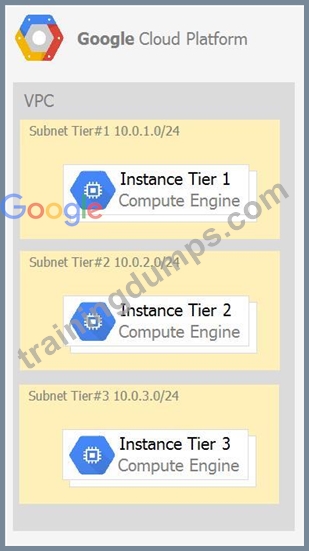
Each tier has a service account that is associated with all instances within it. You need to enable communication on TCP port 8080 between tiers as follows:
* Instances in tier #1 must communicate with tier #2.
* Instances in tier #2 must communicate with tier #3.
What should you do?
- A. 1. Create an ingress firewall rule with the following settings:* Targets: all instances* Source filter: IP ranges (with the range set to 10.0.2.0/24)* Protocols: allow all2. Create an ingress firewall rule with the following settings:* Targets: all instances* Source filter: IP ranges (with the range set to 10.0.1.0/24)* Protocols: allow all
- B. 1. Create an ingress firewall rule with the following settings:* Targets: all instances with tier #2 service account* Source filter: all instances with tier #1 service account* Protocols: allow TCP:80802. Create an ingress firewall rule with the following settings:* Targets: all instances with tier #3 service account* Source filter: all instances with tier #2 service account* Protocols: allow TCP: 8080
- C. 1. Create an egress firewall rule with the following settings:* Targets: all instances* Source filter: IP ranges (with the range set to 10.0.2.0/24)* Protocols: allow TCP: 80802. Create an egress firewall rule with the following settings:* Targets: all instances* Source filter: IP ranges (with the range set to
10.0.1.0/24)* Protocols: allow TCP: 8080 - D. 1. Create an ingress firewall rule with the following settings:* Targets: all instances with tier #2 service account* Source filter: all instances with tier #1 service account* Protocols: allow all2. Create an ingress firewall rule with the following settings:* Targets: all instances with tier #3 service account* Source filter: all instances with tier #2 service account* Protocols: allow all
Answer: B
NEW QUESTION 120
You are migrating a production-critical on-premises application that requires 96 vCPUs to perform its task.
You want to make sure the application runs in a similar environment on GCP. What should you do?
- A. When creating the VM, use machine type n1-standard-96.
- B. When creating the VM, use Intel Skylake as the CPU platform.
- C. Create the VM using Compute Engine default settings. Use gcloud to modify the running instance to have 96 vCPUs.
- D. Start the VM using Compute Engine default settings, and adjust as you go based on Rightsizing Recommendations.
Answer: C
NEW QUESTION 121
You need to configure IAM access audit logging in BigQuery for external auditors. You want to follow Google-recommended practices. What should you do?
- A. Add the auditors group to two new custom IAM roles.
- B. Add the auditor user accounts to two new custom IAM roles.
- C. Add the auditor user accounts to the `logging.viewer' and `bigQuery.dataViewer' predefined IAM roles.
- D. Add the auditors group to the `logging.viewer' and `bigQuery.dataViewer' predefined IAM roles.
Answer: D
Explanation:
As per google best practices it is recommended to use predefined roles and create groups to control access to multiple users with same responsibility
https://cloud.google.com/docs/enterprise/best-practices-for-enterprise-organizations#groups-and- service-accounts .
NEW QUESTION 122
You are using Container Registry to centrally store your company's container images in a separate project. In another project, you want to create a Google Kubernetes Engine (GKE) cluster. You want to ensure that Kubernetes can download images from Container Registry. What should you do?
- A. Configure the ACLs on each image in Cloud Storage to give read-only access to the default Compute Engine service account.
- B. Create a service account, and give it access to Cloud Storage. Create a P12 key for this service account and use it as an imagePullSecrets in Kubernetes.
- C. In the project where the images are stored, grant the Storage Object Viewer IAM role to the service account used by the Kubernetes nodes.
- D. When you create the GKE cluster, choose the Allow full access to all Cloud APIs option under 'Access scopes'.
Answer: D
NEW QUESTION 123
You have a virtual machine that is currently configured with 2 vCPUs and 4 GB of memory. It is running out of memory. You want to upgrade the virtual machine to have 8 GB of memory.
What should you do?
- A. Stop the VM, increase the memory to 8 GB, and start the VM.
- B. Use gcloud to add metadata to the VM. Set the key to required-memory-sizeand the value to 8 GB.
- C. Stop the VM, change the machine type to n1-standard-8, and start the VM.
- D. Rely on live migration to move the workload to a machine with more memory.
Answer: A
NEW QUESTION 124
You have a development project with appropriate IAM roles defined. You are creating a production project and want to have the same IAM roles on the new project, using the fewest possible steps. What should you do?
- A. In the Google Cloud Platform Console, use the `create role' functionality and select all applicable permissions.
- B. Use gcloud iam roles copy and specify your organization as the destination organization.
- C. In the Google Cloud Platform Console, use the `create role from role' functionality.
- D. Use gcloud iam roles copy and specify the production project as the destination project.
Answer: B
NEW QUESTION 125
You have deployed an application on a single Compute Engine instance. The application writes logs to disk. Users start reporting errors with the application. You want to diagnose the problem. What should you do?
- A. Install and configure the Cloud Logging Agent and view the logs from Cloud Logging.
- B. Configure a Health Check on the instance and set a Low Healthy Threshold value.
- C. Connect to the instance's serial console and read the application logs.
- D. Navigate to Cloud Logging and view the application logs.
Answer: A
Explanation:
Reference:
https://cloud.google.com/error-reporting/docs/setup/compute-engine
NEW QUESTION 126
You have production and test workloads that you want to deploy on Compute Engine. Production VMs need to be in a different subnet than the test VMs. All the VMs must be able to reach each other over Internal IP without creating additional routes. You need to set up VPC and the 2 subnets. Which configuration meets these requirements?
- A. Create a single custom VPC with 2 subnets. Create each subnet in a different region and with a different CIDR range.
- B. Create 2 custom VPCs, each with a single subnet. Create each subnet in the same region and with the same CIDR range.
- C. Create a single custom VPC with 2 subnets. Create each subnet in the same region and with the same CIDR range.
- D. Create 2 custom VPCs, each with a single subnet. Create each subnet in a different region and with a different CIDR range.
Answer: A
NEW QUESTION 127
You have a Dockerfile that you need to deploy on Kubernetes Engine. What should you do?
- A. Create a docker image from the Dockerfile and upload it to Container Registry. Create a Deployment YAML file to point to that image. Use kubectl to create the deployment with that file.
- B. Use gcloud app deploy <dockerfilename>.
- C. Use kubectl app deploy <dockerfilename>.
- D. Create a docker image from the Dockerfile and upload it to Cloud Storage. Create a Deployment YAML file to point to that image. Use kubectl to create the deployment with that file.
Answer: A
Explanation:
Reference:
https://cloud.google.com/kubernetes-engine/docs/tutorials/hello-app
NEW QUESTION 128
You have an instance group that you want to load balance. You want the load balancer to terminate the client SSL session. The instance group is used to serve a public web application over HTTPS. You want to follow Google-recommended practices. What should you do?
- A. Configure an internal TCP load balancer.
- B. Configure an external SSL proxy load balancer.
- C. Configure an external TCP proxy load balancer.
- D. Configure an HTTP(S) load balancer.
Answer: D
NEW QUESTION 129
......
Free Associate-Cloud-Engineer Exam Questions Associate-Cloud-Engineer Actual Free Exam Questions: https://www.trainingdumps.com/Associate-Cloud-Engineer_exam-valid-dumps.html
Verified Associate-Cloud-Engineer dumps and 245 unique questions: https://drive.google.com/open?id=1DKd6zg4NYKQDjY-D-BR2sZR-R_X2baG9
