

SAP C_AIG_2412 Deluxe Study Guide with Online Test Engine
C_AIG_2412 dumps review - Professional Quiz Study Materials
NEW QUESTION # 10
Which statement best describes the Chain-of-Thought (COT) prompting technique?
- A. Linking multiple Al models in sequence, where each model's output becomes the input for the next model in the chain.
- B. Writing a series of connected prompts creating a chain of related information.
- C. Connecting related concepts by having the LLM generate chains of ideas.
- D. Concatenating multiple related prompts to form a chain, guiding the model through sequential reasoning steps.
Answer: D
NEW QUESTION # 11
What does SAP recommend you do before you start training a machine learning model in SAP AI Core?
Note: There are 3 correct answers to this question.
- A. Configure the model deployment in SAP Al Launchpad.
- B. Configure the training pipeline using templates.
- C. Register the input dataset in SAP AI Core.
- D. Perform manual data integration with SAP HANA.
- E. Define the required infrastructure resources for training.
Answer: B,C,E
Explanation:
Before initiating the training of a machine learning model in SAP AI Core, SAP recommends the following steps:
* Configure the training pipeline using templates:Utilize predefined templates to set up the training pipeline, ensuring consistency and efficiency in the training process.
* Define the required infrastructure resources for training:Specify the computational resources, such as CPUs or GPUs, necessary for the training job to ensure optimal performance.
* Register the input dataset in SAP AI Core:Ensure that the dataset intended for training is properly registered within SAP AI Core, facilitating seamless access during the training process.
These preparatory steps are crucial for the successful training of machine learning models within the SAP AI Core environment.
NEW QUESTION # 12
Which of the following techniques uses a prompt to generate or complete subsequent prompts (streamlining the prompt development process), and to effectively guide Al model responses?
- A. Meta prompting
- B. Few-shot prompting
- C. One-shot prompting
- D. Chain-of-thought prompting
Answer: A
Explanation:
Meta prompting is a technique in prompt engineering where a prompt is designed to generate or refine subsequent prompts.
1. Definition and Purpose:
* Streamlining Prompt Development:Meta prompting automates the creation of effective prompts by utilizing AI to generate or enhance them, thereby streamlining the prompt development process.
* Guiding AI Model Responses:By generating refined prompts, meta prompting effectively guides AI models to produce more accurate and contextually relevant responses.
2. Application in SAP's Generative AI Hub:
* Prompt Engineering Tools:SAP's Generative AI Hub provides tools that support advanced prompt engineering techniques, including meta prompting, to enhance AI model interactions.
NEW QUESTION # 13
You want to assign urgency and sentiment categories to a large number of customer emails. You want to get a valid json string output for creating custom applications. You decide to develop a prompt for the same using generative Al hub.
What is the main purpose of the following code in this context?
prompt_test = """Your task is to extract and categorize messages. Here are some examples:
{{?technique_examples}}
Use the examples when extract and categorize the following message:
{{?input}}
Extract and return a json with the following keys and values:
- "urgency" as one of {{?urgency}}
- "sentiment" as one of {{?sentiment}}
"categories" list of the best matching support category tags from: {{?categories}} Your complete message should be a valid json string that can be read directly and only contains the keys mentioned in t import random random.seed(42) k = 3 examples random. sample (dev_set, k) example_template = """<example> {example_input} examples
'\n---\n'.join([example_template.format(example_input=example ["message"], example_output=json.dumps (example[ f_test = partial (send_request, prompt=prompt_test, technique_examples examples, **option_lists) response = f_test(input=mail["message"])
- A. Train a language model from scratch
- B. Generate random examples for language model training
- C. Evaluate the performance of a language model using few-shot learning
- D. Preprocess a dataset for machine learning
Answer: C
NEW QUESTION # 14
What must be defined in an executable to train a machine learning model using SAP AI Core? Note: There are 2 correct answers to this question.
- A. Infrastructure resources such as CPUs or GPUs
- B. Deployment templates for SAP AI Launchpad
- C. User scripts to manually execute pipeline steps
- D. Pipeline containers to be used
Answer: A,D
Explanation:
When training a machine learning model using SAP AI Core, defining an executable requires specifying certain key components to ensure the training process is efficient and effective.
1. Pipeline Containers to Be Used:
* Definition:Pipeline containers encapsulate the environments and dependencies necessary for each step of the machine learning workflow, including data preprocessing, model training, and evaluation.
* Specification in Executable:Within the executable, it's essential to define which pipeline containers will be utilized to ensure that each stage of the training process has the appropriate tools and libraries.
NEW QUESTION # 15
What are some components of the training pipeline in SAP AI Core? Note: There are 2 correct answers to this question.
- A. Automated deployment to Kubernetes clusters
- B. Input datasets stored in a hyperscaler object store
- C. The SAP HANA database for model storage
- D. Executables that define the training process
Answer: B,D
Explanation:
The training pipeline in SAP AI Core comprises several key components that facilitate the development and deployment of machine learning models.
1. Input Datasets Stored in a Hyperscaler Object Store:
* Data Storage:Input datasets are often stored in hyperscaler object stores, which provide scalable and secure storage solutions. These datasets serve as the foundational data for training machine learning models.
* Integration:SAP AI Core integrates with various hyperscaler object stores, allowing seamless access to training data during the model development process.
NEW QUESTION # 16
You want to use the orchestration service through SAP's generative-Al-hub-sdk. What does the following code do?
from gen_ai_hub.orchestration.models.11m import LLM 11m =
LLM(name="gpt-40", version="latest", parameters={"max_tokens": 256, "temperature": 0.2})
- A. Create the Orchestration Configuration
- B. Define the Template and Default Input Values
- C. Run the Orchestration Request
- D. Define the LLM
Answer: D
NEW QUESTION # 17
What are the applications of generative Al that go beyond traditional chatbot applications? Note: There are 2 correct answers to this question.
- A. To produce outputs based on software input.
- B. To interpret human instructions and control software systems always producing output for human consumption.
- C. To follow a specific schema - human input, Al processing, and output for human consumption.
- D. To interpret human instructions and control software systems without necessarily producing output for human consumption.
Answer: B,D
NEW QUESTION # 18
Why would a user include formatting instructions within a prompt?
- A. To force the model to separate relevant and irrelevant output
- B. To ensure the model's response follows a desired structure or style
- C. To increase the faithfulness of the output
- D. To redirect the output to another software program
Answer: B
NEW QUESTION # 19
What is Machine Learning (ML)?
- A. A technology that equips machines with human-like capabilities such as problem-solving, visual perception, and decision-making.
- B. A statistical method for data processing that does not involve any Al techniques.
- C. A form of Al that only focuses on creating new content, including text, images, sound, and videos.
- D. A subset of Al that focuses on enabling computer systems to learn and improve from experience or data.
Answer: D
Explanation:
Machine Learning (ML) is a branch of Artificial Intelligence (AI) that empowers computer systems to learn from data and experiences, enhancing their performance over time without explicit programming for each task.
1. Definition and Core Concept:
* Learning from Data:ML algorithms process and analyze large datasets to identify patterns and make informed decisions or predictions based on new, unseen data.
* Improvement Over Time:Through iterative processes, ML models refine their accuracy and efficiency as they are exposed to more data, leading to continuous performance enhancement.
2. Types of Machine Learning:
* Supervised Learning:Models are trained on labeled datasets, where the desired output is known, to make predictions or classifications.
* Unsupervised Learning:Models work with unlabeled data to identify inherent structures or patterns without predefined outcomes.
* Reinforcement Learning:Systems learn by interacting with an environment, receiving feedback in the form of rewards or penalties, and adjusting actions accordingly.
3. Applications in SAP's AI Solutions:
* SAP AI Core and AI Launchpad:SAP provides a unified framework for managing and deploying ML models, facilitating seamless integration into business processes.
* Generative AI Hub:This platform offers access to a variety of large language models (LLMs) and supports the orchestration of AI tasks, enabling the development of AI-driven applications.
NEW QUESTION # 20
What are some characteristics of the SAP generative Al hub? Note: There are 2 correct answers to this question.
- A. It ensures relevant, reliable, and responsible business Al.
- B. It provides instant access to a wide range of large language models (LLMs).
- C. It only supports traditional machine learning models.
- D. It operates independently of SAP's partners and ecosystem.
Answer: A,B
Explanation:
The SAP Generative AI Hub is designed to integrate generative AI into business processes, offering several key features:
1. Ensuring Relevant, Reliable, and Responsible Business AI:
* Trusted AI Integration:The Generative AI Hub consolidates access to large language models (LLMs) and foundation models, grounding them in business and context data. This integration ensures that AI solutions are pertinent, dependable, and adhere to responsible AI practices.
2. Providing Instant Access to a Wide Range of Large Language Models (LLMs):
* Diverse Model Access:The hub offers immediate access to a broad spectrum of LLMs fromvarious providers, such as GPT-4 by Azure OpenAI and open-source models like Falcon-40b. This variety enables developers to select models that best fit their specific use cases.
3. Integration with SAP AI Core and AI Launchpad:
* Seamless Orchestration:The Generative AI Hub is part of SAP AI Core and AI Launchpad, facilitating the incorporation of generative AI into AI tasks. It streamlines innovation and ensures compliance, benefiting both SAP's internal needs and its broader ecosystem of partners and customers.
NEW QUESTION # 21
Match the components of a Retrieval Augmented Generation architecture to the diagram.
Answer:
Explanation: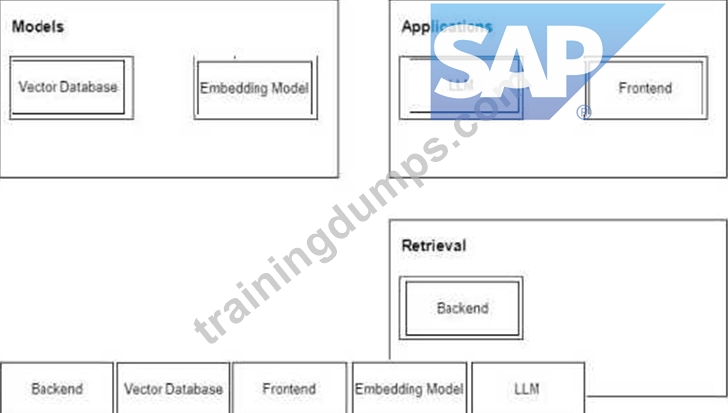
NEW QUESTION # 22
You want to use the orchestration service through SAP's generative-Al-hub-sdk.
What does the following code do?
from gen_ai_hub.orchestration.models.11m import LLM
11m =
LLM(name="gpt-40", version="latest", parameters={"max_tokens": 256, "temperature": 0.2})
- A. Create the Orchestration Configuration
- B. Define the Template and Default Input Values
- C. Run the Orchestration Request
- D. Define the LLM
Answer: D
NEW QUESTION # 23
What are some drivers for the rapid adoption of generative AI?
Note: There are 2 correct answers to this question.
- A. Ease of use
- B. Wide availability
- C. Significant hardware cost savings
- D. Availability of skilled developers
Answer: A,B
NEW QUESTION # 24
Which of the following statements accurately describe the RAG process? Note: There are 2 correct ans-wers to this question.
- A. The retrieved content is combined with the LLM's capabilities to generate a response.
- B. The LLM directly ans wers the user's question without accessing external information.
- C. The user's questi on is used to search a knowledge base or a set of documents.
- D. The embedding model stores the generated ans wers for future reference.
Answer: A,C
Explanation:
Retrieval-Augmented Generation (RAG) is a process that enhances the capabilities of Large Language Models (LLMs) by integrating external knowledge sources into the response generation process.
1. Understanding the RAG Process:
* User Query:The process begins with a user's question or prompt, which serves as the input for the system.
* Retrieval Step:The system uses the user's query to search a knowledge base or a set of documents, retrieving relevant information that can inform the response.
* Integration with LLM:The retrieved content is then combined with the LLM's inherent knowledge and language generation capabilities to produce a comprehensive and contextually relevant response.
2. Benefits of the RAG Process:
* Enhanced Accuracy:By incorporating up-to-date and domain-specific information from external sources, RAG improves the accuracy of AI-generated responses.
* Contextual Relevance:The integration of retrieved data ensures that the responses are more aligned with the specific context of the user's query.
3. Application in SAP's Generative AI Hub:
* Generative AI Hub SDK:SAP provides a Generative AI Hub SDK that facilitates the implementation of RAG by enabling seamless integration of retrieval mechanisms with LLMs.
* Tutorials and Resources:SAP offers tutorials, such as "Retrieval Augmented Generation using generative-ai-hub-sdk and HANA vector search," to guide developers in implementing RAG systems effectively.
NEW QUESTION # 25
Which technique is used to supply domain-specific knowledge to an LLM?
- A. Domain-adaptation training
- B. Fine-tuning the model on general data
- C. Retrieval-Augmented Generation
- D. Prompt template expansion
Answer: C
Explanation:
Retrieval-Augmented Generation (RAG) is a technique that enhances Large Language Models (LLMs) by integrating external domain-specific knowledge, enabling more accurate and contextually relevant outputs.
1. Understanding Retrieval-Augmented Generation (RAG):
* Definition:RAG combines the generative capabilities of LLMs with retrieval mechanisms that access external knowledge bases or documents. This integration allows the model to incorporate up-to-date and domain-specific information into its responses.
* Mechanism:When presented with a query, the RAG system retrieves pertinent information from external sources and uses this data to inform and generate a more accurate and contextually appropriate response.
2. Application in Supplying Domain-Specific Knowledge:
* Domain Adaptation:By leveraging RAG, LLMs can access specialized information without the need for extensive retraining or fine-tuning. This approach is particularly beneficial for domains with rapidly evolving information or where incorporating proprietary data is essential.
* Efficiency:RAG enables models to provide informed responses by referencing external data, reducing the necessity for large-scale domain-specific training datasets and thereby conserving computational resources.
3. Advantages of Using RAG:
* Up-to-Date Information:Since RAG systems can query current data sources, they are capable of providing the most recent information available, which is crucial in dynamic fields.
* Enhanced Accuracy:Incorporating external knowledge allows the model to produce more precise and contextually relevant outputs, especially in specialized domains.
NEW QUESTION # 26
What are some metrics to evaluate the effectiveness of a Retrieval Augmented Generation system?
Note: There are 2 correct answers to this question.
- A. Faithfulness
- B. Relevance
- C. Speed
- D. Carbon footprint
Answer: A,B
NEW QUESTION # 27
What is a significant risk associated with using LLMs?
- A. Unlimited processing power usage without cost control
- B. Inability to generate text in multiple languages
- C. Potential biases in generated content
- D. Complete elimination of human oversight in content creation
Answer: C
Explanation:
A significant risk of using LLMs is the potential for biases in generated content, stemming from biases present in their training data. Option A is incorrect because LLMs do not inherently eliminate human oversight; oversight is often maintained, especially in enterprise settings like SAP's. Option B is false as LLMs can generate text in multiple languages, as seen with models like GPT-4. Option D, while a concern in terms of resource management, is not the most significant risk compared to bias, and cost control can be implemented. Option C is correct because biased outputs can lead to unfair decisions or misinformation, a risk SAP mitigates through its AI Ethics framework, which includes principles like avoiding bias and discrimination, ensuring responsible AI deployment.
NEW QUESTION # 28
You want to assign urgency and sentiment categories to a large number of customer emails. You want to get a valid json string output for creating custom applications. You decide to develop a prompt for the same using generative Al hub.
What is the main purpose of the following code in this context?
prompt_test = """Your task is to extract and categorize messages. Here are some examples:
{{?technique_examples}}
Use the examples when extract and categorize the following message:
{{?input}}
Extract and return a json with the following keys and values:
-"urgency" as one of {{?urgency}}
-"sentiment" as one of {{?sentiment}}
"categories" list of the best matching support category tags from: {{?categories}} Your complete message should be a valid json string that can be read directly and only contains the keys mentioned in t import random random.seed(42) k = 3 examples random. sample (dev_set, k) example_template = """<example> {example_input} examples
'\n---\n'.join([example_template.format(example_input=example ["message"], example_output=json.dumps (example[ f_test = partial (send_request, prompt=prompt_test, technique_examples examples, **option_lists) response = f_test(input=mail["message"])
- A. Train a language model from scratch
- B. Generate random examples for language model training
- C. Evaluate the performance of a language model using few-shot learning
- D. Preprocess a dataset for machine learning
Answer: C
Explanation:
The provided code is designed to evaluate the performance of a language model in assigning urgency and sentiment categories to customer emails by utilizing few-shot learning within SAP's Generative AI Hub.
1. Few-Shot Learning in Prompt Engineering:
* Definition:Few-shot learning involves providing a language model with a limited number of examples to enable it to perform a specific task effectively. In this context, the model isgiven a few examples of categorized messages to learn how to assign urgency and sentiment to new, unseen emails.
2. Code Functionality:
* Prompt Template Creation:The prompt_test variable defines a template that instructs the model to extract and categorize messages, specifying the desired output format as a JSON string.
* Example Selection:The code randomly selects a subset of examples from a development set (dev_set) to include in the prompt, demonstrating the expected input-output pairs to the model.
* Model Interaction:The function f_test sends the constructed prompt, along with the input message, to the language model for processing.
* Response Handling:The model's response is expected to be a JSON string containing the assigned urgency, sentiment, and categories for the input message.
3. Purpose of the Code:
* Performance Evaluation:By using few-shot learning, the code evaluates how well the language model can generalize from the provided examples to accurately categorize new customer emails. This approach assesses the model's ability to understand and apply the categorization criteria based on minimal training data.
NEW QUESTION # 29
What is the goal of prompt engineering?
- A. To optimize hardware performance for Al computations
- B. To replace human decision-making with automated processes
- C. To craft inputs that guide Al systems in generating desired outputs
- D. To develop new neural network architectures for Al models
Answer: C
Explanation:
Prompt engineering involves designing and refining inputs, known as prompts, to effectively guide AI systems, particularly Large Language Models (LLMs), in producing desired outputs.
1. Understanding Prompt Engineering:
* Definition:Prompt engineering is the process of creating and optimizing prompts to elicit specific responses from AI models. It serves as a crucial interface between human intentions and machine- generated content.
* Purpose:The primary goal is to communicate the task requirements clearly to the AI model, ensuring that the generated output aligns with user expectations.
2. Importance in AI Systems:
* Guiding AI Behavior:Well-crafted prompts can direct AI models to perform a wide range of tasks, from answering questions to generating creative content, by setting the context and specifying the desired format of the output.
* Enhancing Output Quality:Effective prompt engineering can improve the relevance, coherence, and accuracy of AI-generated responses, making AI systems more useful and reliable in practical applications.
3. Application in SAP's Generative AI Hub:
* Prompt Management:SAP's Generative AI Hub provides tools for prompt management, allowing developers to create, edit, and manage prompts to interact with various AI models efficiently.
* Exploration and Development:The hub offers features like prompt editors and AI playgrounds, enabling users to experiment with different prompts and models to achieve optimal results for their specific use cases.
NEW QUESTION # 30
What are some metrics to evaluate the effectiveness of a Retrieval Augmented Generation system? Note: There are 2 correct answers to this question.
- A. Faithfulness
- B. Relevance
- C. Speed
- D. Carbon footprint
Answer: A,B
NEW QUESTION # 31
Which of the following techniques uses a prompt to generate or complete subsequent prompts (streamlining the prompt development process), and to effectively guide Al model responses?
- A. Meta prompting
- B. Few-shot prompting
- C. One-shot prompting
- D. Chain-of-thought prompting
Answer: A
NEW QUESTION # 32
You want to extract useful information from customer emails to augment existing applications in your company.
How can you use generative-ai-hub-sdk in this context?
- A. Generate random email content and send them to customers.
- B. Train custom models based on the mail data.
- C. Generate a new SAP application based on the mail data.
- D. Generate JSON strings based on extracted information.
Answer: D
NEW QUESTION # 33
Match the components of a Retrieval Augmented Generation architecture to the diagram.
Answer:
Explanation:
Explanation:
A screenshot of a computer Description automatically generated
NEW QUESTION # 34
What is one primary benefit of using LLMs in business applications?
- A. They eliminate all data privacy concerns in business operations
- B. They require no maintenance or updates once implemented
- C. They enhance automation and scalability of processes
- D. They replace the need for human decision-making entirely
Answer: C
Explanation:
The primary benefit of using LLMs in business applications is their ability to enhance automation and scalability, making processes more efficient and adaptable to large-scale needs. Option A is incorrect because LLMs augment, rather than fully replace, human decision-making-human oversight remains critical. Option B is false as LLMs do not inherently eliminate privacy concerns; data privacy must still be managed (e.g., through SAP's privacy-preserving techniques like differential privacy). Option C is inaccurate since LLMs require ongoing maintenance, updates, and monitoring to remain effective. Option D is correct because LLMs automate tasks like document processing, content generation, and customer interaction, while their scalability allows businesses to handle increasing data volumes and user demands efficiently, as seen in SAP's integration with tools like Joule and SAP Business AI.
NEW QUESTION # 35
......
SAP C_AIG_2412 Exam Syllabus Topics:
| Topic | Details |
|---|---|
| Topic 1 |
|
| Topic 2 |
|
| Topic 3 |
|
| Topic 4 |
|
Exam Questions Answers Braindumps C_AIG_2412 Exam Dumps PDF Questions: https://www.trainingdumps.com/C_AIG_2412_exam-valid-dumps.html
C_AIG_2412 Test Prep Training Practice Exam Questions Practice Tests: https://drive.google.com/open?id=1xL1Es9JmbpQfUeZnIbcqV_YJGeU0S2Nb
