

New 2024 CKA exam questions Welcome to download the newest TrainingDumps CKA PDF dumps (68 Q&As)
P.S. Free 2024 Kubernetes Administrator CKA dumps are available on Google Drive shared by TrainingDumps
NEW QUESTION # 39
List "nginx-dev" and "nginx-prod" pod and delete those pods
Answer:
Explanation:
See the solution below.
Explanation
kubect1 get pods -o wide
kubectl delete po "nginx-dev"kubectl delete po "nginx-prod"
NEW QUESTION # 40
List all persistent volumes sorted by capacity, saving the full kubectl output to
/opt/KUCC00102/volume_list. Use kubectl 's own functionality for sorting the output, and do not manipulate it any further.
Answer:
Explanation:
See the solution below.
Explanation
solution
F:\Work\Data Entry Work\Data Entry\20200827\CKA\2 C.JPG
NEW QUESTION # 41
Create a Pod nginx and specify a CPU request and a CPU limit of 0.5 and 1 respectively.
- A. // create a yml file
kubectl run nginx-pod --image=nginx --restart=Never --dry-run -
o yaml > nginx-pod.yml
// add the resources section and create
vim nginx-pod.yaml
apiVersion: v1
kind: Pod
metadata:
labels:
run: nginx
name: nginx
spec:
containers:
- image: nginx
name: nginx
resources:
requests:
cpu: "0.5"
limits:
cpu: "1"
restartPolicy: Always
kubectl apply -f nginx-pod.yaml
// verify
kubectl top pod - B. // create a yml file
kubectl run nginx-pod --image=nginx --restart=Never --dry-run -
o yaml > nginx-pod.yml
// add the resources section and create
vim nginx-pod.yaml
apiVersion: v1
kind: Pod
metadata:
labels:
run: nginx
name: nginx
spec:
containers:
- image: nginx
name: nginx
resources:
requests:
cpu: "0.4"
limits:
cpu: "1"
restartPolicy: Always
kubectl apply -f nginx-pod.yaml
// verify
kubectl top pod
Answer: A
NEW QUESTION # 42
Get IP address of the pod - "nginx-dev"
- A. Kubect1 get po -o wide
Using JsonPath
kubect1 get pods -o=jsonpath='{range
.items[*]}{.metadata.name}{"\t"}{.status.podIP}{"\n"}{end}' - B. Kubect1 get po -o wide
Using JsonPath
kubect1 get pods
.items[*]}{.metadata.name}{"\t"}{.status.podIP}{"\n"}{end}'
Answer: A
NEW QUESTION # 43
Get IP address of the pod - "nginx-dev"
Answer:
Explanation:
See the solution below.
Explanation
Kubect1 get po -o wide
Using JsonPath
kubect1 get pods -o=jsonpath='{range
items[*]}{.metadata.name}{"\t"}{.status.podIP}{"\n"}{end}'
NEW QUESTION # 44
Score: 4%
Task
Create a persistent volume with name app-data , of capacity 1Gi and access mode ReadOnlyMany. The type of volume is hostPath and its location is /srv/app-data .
Answer:
Explanation:
Solution:
#vi pv.yaml
apiVersion: v1
kind: PersistentVolume
metadata:
name: app-config
spec:
capacity:
storage: 1Gi
accessModes:
- ReadOnlyMany
hostPath:
path: /srv/app-config
#
kubectl create -f pv.yaml
NEW QUESTION # 45
To protect your firewall and network from single source denial of service (DoS) attacks that can overwhelm its packet buffer and cause legitimate traffic to drop, you can configure:
- A. BGP (Border Gateway Protocol)
- B. PGP (Packet Gateway Protocol)
- C. PBP (Protocol Based Protection)
- D. PBP (Packet Buffer Protection)
Answer: C
NEW QUESTION # 46
Schedule a pod as follows:
* Name: nginx-kusc00101
* Image: nginx
* Node selector: disk=ssd
Answer:
Explanation:
See the solution below.
Explanation
solution


NEW QUESTION # 47
Deploy a pod with image=redis on a node with label disktype=ssd
- A. // Get list of nodes
kubectl get nodes
//Get node with the label disktype=ssd
kubectl get no -l disktype=ssd
// Create a sample yaml file
kubectl run node-redis --generator=run-pod/v1 --image=redis --dry
run -o yaml > test-redis.yaml
// Edit test-redis.yaml file and add nodeSelector
vim test-redis.yaml
apiVersion: v1
- name: node-redis
image: redis
imagePullPolicy: IfNotPresent
kubectl apply -f test-redis.yaml
/ // Verify
K kubectl get po -o wide - B. // Get list of nodes
kubectl get nodes
//Get node with the label disktype=ssd
kubectl get no -l disktype=ssd
// Create a sample yaml file
kubectl run node-redis --generator=run-pod/v1 --image=redis --dry
run -o yaml > test-redis.yaml
// Edit test-redis.yaml file and add nodeSelector
vim test-redis.yaml
apiVersion: v1
kind: Pod
metadata:
name: redis
spec:
nodeSelector:
disktype: ssd
containers:
- name: node-redis
image: redis
imagePullPolicy: IfNotPresent
kubectl apply -f test-redis.yaml
/ // Verify
K kubectl get po -o wide
Answer: B
NEW QUESTION # 48
Perform the following tasks:
Add an init container to hungry-bear defined in spec file
/opt/KUCC00108/pod-spec-KUC
The init container should create /workdir/calm.txt
If /workdir/calm.txt is not
Once the spec file has been definition, the pod should be created
Answer:
Explanation:
See the solution below.
Explanation
solution
F:\Work\Data Entry Work\Data Entry\20200827\CKA\4 B.JPG
F:\Work\Data Entry Work\Data Entry\20200827\CKA\4 C.JPG
F:\Work\Data Entry Work\Data Entry\20200827\CKA\4 D.JPG
NEW QUESTION # 49
Ensure a single instance of pod nginx is running on each node of the Kubernetes cluster where nginx also represents the Image name which has to be used. Do not override any taints currently in place.
Use DaemonSet to complete this task and use ds-kusc00201 as DaemonSet name.
Answer:
Explanation:
solution


NEW QUESTION # 50
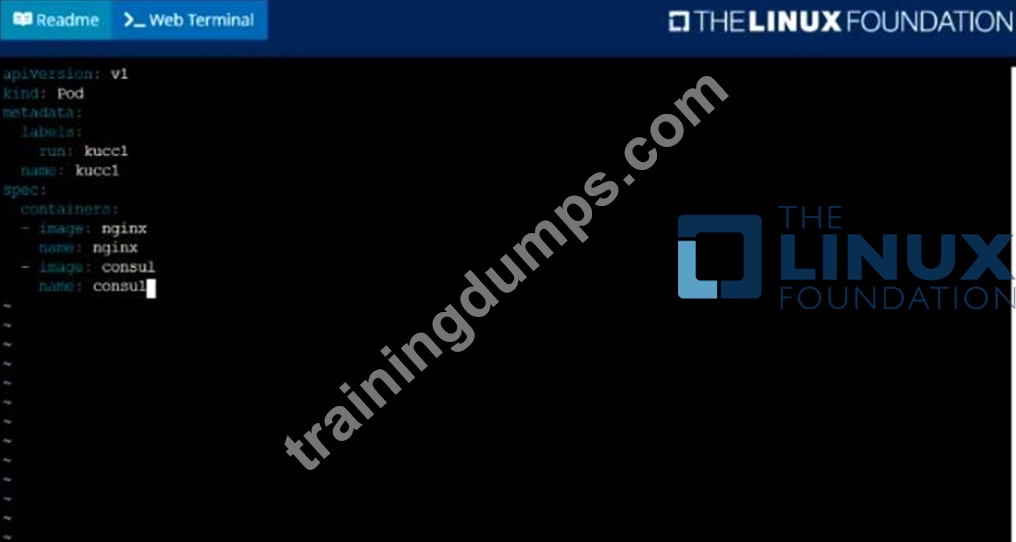
Task Weight: 4%
Task
Schedule a Pod as follows:
* Name: kucc1
* App Containers: 2
* Container Name/Images:
o nginx
o consul
Answer:
Explanation:
Solution:

NEW QUESTION # 51
Check the Image version of nginx-dev pod using jsonpath
Answer:
Explanation:
See the solution below.
Explanation
kubect1 get po nginx-dev -o
jsonpath='{.spec.containers[].image}{"\n"}'
NEW QUESTION # 52
Configure the kubelet systemd- managed service, on the node labelled with name=wk8s-node-1, to launch a pod containing a single container of Image httpd named webtool automatically. Any spec files required should be placed in the /etc/kubernetes/manifests directory on the node.
You can ssh to the appropriate node using:
[student@node-1] $ ssh wk8s-node-1
You can assume elevated privileges on the node with the following command:
[student@wk8s-node-1] $ | sudo -i
Answer:
Explanation:
See the solution below.
Explanation
solution
F:\Work\Data Entry Work\Data Entry\20200827\CKA\21 C.JPG
F:\Work\Data Entry Work\Data Entry\20200827\CKA\21 D.JPG
F:\Work\Data Entry Work\Data Entry\20200827\CKA\21 E.JPG
F:\Work\Data Entry Work\Data Entry\20200827\CKA\21 F.JPG
F:\Work\Data Entry Work\Data Entry\20200827\CKA\21 G.JPG
NEW QUESTION # 53
List all the pods showing name and namespace with a json path expression
Answer:
Explanation:
kubectl get pods -o=jsonpath="{.items[*]['metadata.name', 'metadata.namespace']}"
NEW QUESTION # 54
Resume the rollout of the deployment
Answer:
Explanation:
kubectl rollout resume deploy webapp
NEW QUESTION # 55
List all the pods sorted by name
Answer:
Explanation:
See the solution below.
Explanation
kubectl get pods --sort-by=.metadata.name
NEW QUESTION # 56
A Kubernetes worker node, named wk8s-node-0 is in state NotReady. Investigate why this is the case, and perform any appropriate steps to bring the node to a state, ensuring that any changes are made permanent.
You can ssh to the failed node using:
[student@node-1] $ | ssh Wk8s-node-0
You can assume elevated privileges on the node with the following command:
[student@w8ks-node-0] $ | sudo -i
Answer:
Explanation:
See the solution below.
Explanation
solution
F:\Work\Data Entry Work\Data Entry\20200827\CKA\20 C.JPG
F:\Work\Data Entry Work\Data Entry\20200827\CKA\20 D.JPG
F:\Work\Data Entry Work\Data Entry\20200827\CKA\20 E.JPG
NEW QUESTION # 57
Create a pod that having 3 containers in it? (Multi-Container)
Answer:
Explanation:
See the solution below.
Explanation
image=nginx, image=redis, image=consul
Name nginx container as "nginx-container"
Name redis container as "redis-container"
Name consul container as "consul-container"
Create a pod manifest file for a container and append container
section for rest of the images
kubectl run multi-container --generator=run-pod/v1 --image=nginx --
dry-run -o yaml > multi-container.yaml
# then
vim multi-container.yaml
apiVersion: v1
kind: Pod
metadata:
labels:
run: multi-container
name: multi-container
spec:
containers:
- image: nginx
name: nginx-container
- image: redis
name: redis-container
- image: consul
name: consul-container
restartPolicy: Always
NEW QUESTION # 58
List "nginx-dev" and "nginx-prod" pod and delete those pods
- A. kubect1 get pods -o wide
kubectl delete po "nginx-dev" kubectl delete po "nginx-prod" - B. kubect1 get pods -o wide
kubectl delete po "nginx-dev" kubectl delete po "nginx-prod"
Answer: B
NEW QUESTION # 59
Get list of all pods in all namespaces and write it to file "/opt/pods-list.yaml"
Answer:
Explanation:
See the solution below.
Explanation
kubectl get po -all-namespaces > /opt/pods-list.yaml
NEW QUESTION # 60
Create a Pod with main container busybox and which executes this
"while true; do echo 'Hi I am from Main container' >>
/var/log/index.html; sleep 5; done" and with sidecar container
with nginx image which exposes on port 80. Use emptyDir Volume
and mount this volume on path /var/log for busybox and on path
/usr/share/nginx/html for nginx container. Verify both containers
are running.
- A. // create an initial yaml file with this
kubectl run multi-cont-pod --image=busbox --restart=Never --
dry-run -o yaml > multi-container.yaml
// edit the yml as below and create it
kubectl create -f multi-container.yaml
vim multi-container.yaml
apiVersion: v1
kind: Pod
metadata:
labels:
run: multi-cont-pod
name: multi-cont-pod
spec:
volumes:
- name: var-logs
emptyDir: {}
containers:
- image: busybox
command: ["/bin/sh"]
args: ["-c", "while true; do echo 'Hi I am from Main
container' >> /var/log/index.html; sleep 5;done"]
name: main-container
volumeMounts:
- name: var-logs
mountPath: /var/log
- image: nginx
name: sidecar-container
ports:
- containerPort: 80
volumeMounts:
- name: var-logs
mountPath: /usr/share/nginx/html
restartPolicy: Never
// Create Pod
kubectl apply -f multi-container.yaml
//Verify
kubectl get pods - B. // create an initial yaml file with this
kubectl run multi-cont-pod --image=busbox --restart=Never --
dry-run -o yaml > multi-container.yaml
// edit the yml as below and create it
kubectl create -f multi-container.yaml
vim multi-container.yaml
apiVersion: v1
kind: Pod
metadata:
labels:
run: multi-cont-pod
name: multi-cont-pod
spec:
volumes:
- image: busybox
command: ["/bin/sh"]
args: ["-c", "while true; do echo 'Hi I am from Main
container' >> /var/log/index.html; sleep 5;done"]
name: main-container
volumeMounts:
- name: var-logs
mountPath: /var/log
- image: nginx
name: sidecar-container
ports:
mountPath: /usr/share/nginx/html
restartPolicy: Never
// Create Pod
kubectl apply -f multi-container.yaml
//Verify
kubectl get pods
Answer: A
NEW QUESTION # 61
......
CKA exam questions from TrainingDumps dumps: https://www.trainingdumps.com/CKA_exam-valid-dumps.html (68 Q&As)
Free 2024 Kubernetes Administrator CKA dumps are available on Google Drive shared by TrainingDumps: https://drive.google.com/open?id=1WyqaUnEcJ7tRrtISuXtdIja5HgPmOZVm
