

The Realest Study Materials KCNA Dumps Updated Jan 04, 2026
LATEST KCNA Exam Practice Material
Linux Foundation has been providing certification exams to individuals who want to demonstrate their expertise in open source technologies. One of their newest offerings is the KCNA (Kubernetes and Cloud Native Associate) Certification Exam. KCNA exam is designed for individuals who want to prove their knowledge and skills in cloud native computing and Kubernetes.
The KCNA exam is an excellent way for individuals to validate their knowledge and understanding of Kubernetes and cloud-native technologies. It is a valuable credential for anyone looking to work with these technologies in their current or future roles, and can help to demonstrate their expertise to potential employers. If you are interested in taking the KCNA exam, you can find more information on the Linux Foundation website.
NEW QUESTION # 46
Consider the following Dockerfile:
FROM ubuntu: latest
COPY . /
RUN apt-get update && apt-get install -y nginx
CMD ["nginx", "g", "daemon off; ' ' ]
What is the primary function of the "COPY" instruction in this Dockerfile?
- A. Copies all files from the current directory to the container's /etc/nginx directory.
- B. Copies all files from the current directory to the container's root directory.
- C. Copies the Dockerfile to the container's Ivar/lib/docker directory.
- D. Copies only the Dockerfile to the container's /etc/nginx directory.
- E. Copies the entire Dockerfile to the container's filesystem.
Answer: B
Explanation:
The *COPY' instruction in a Dockerfile copies files from the context of the build (usually the current directory) to the container's filesystem. In this case, 'COPY . P copies all files and directories from the build context to the container's root directory (the '/' directory).
NEW QUESTION # 47
Which style of operations are preferred for K8S and cloud native applications?
- A. Imperative
- B. JSON
- C. Declarative
Answer: C
Explanation:
https://kubernetes.io/docs/tasks/manage-kubernetes-objects/declarative-config/#trade-offs
NEW QUESTION # 48
What does the 'kops' acronym means?
- A. Kubernetes Operation Policy Specification
- B. Kubernetes Open Platform Specification
- C. Kubernetes Operations
- D. Kubernetes Operators
Answer: C
Explanation:
https://github.com/kubernetes/kops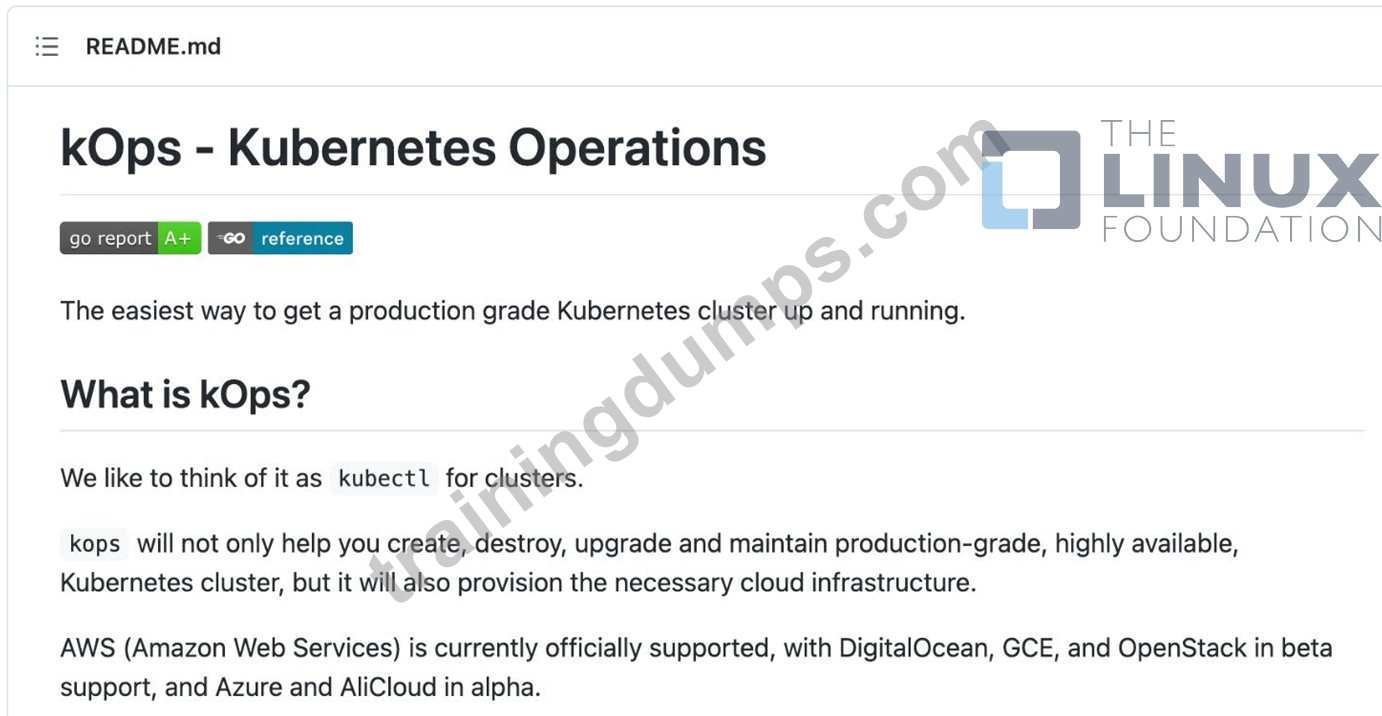
NEW QUESTION # 49
Consider the following Kubernetes pod YAML definition: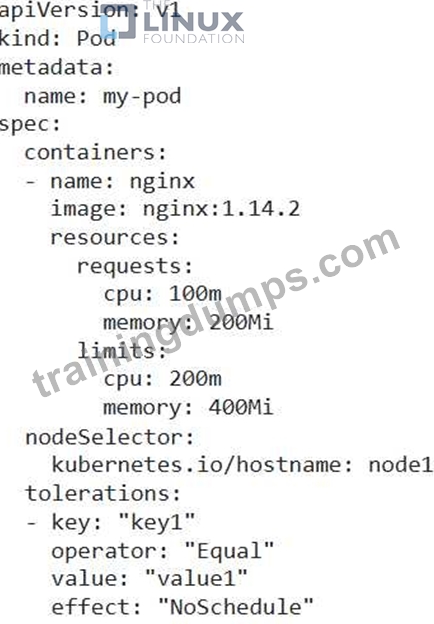
Which of the following statements is TRUE about this pod's scheduling behavior?
- A. The pod will only be scheduled on a node that has at least 100m CPU and 200Mi memory available.
- B. The pod will only be scheduled on a node with the label 'kubernetes.io/hostname: nodel , regardless of available resources.
- C. The pod will be scheduled on any node that meets the •nodeSelector• and •tolerations* conditions, but it may be evicted if resources become scarce.
- D. The pod will only be scheduled on a node with the label 'keyl: valuel s, regardless of available resources.
- E. The pod will not be scheduled on any node that has the taint *keyl: valuel: NoSchedule• , as long as the •nodeselector• condition is met.
Answer: E
Explanation:
The 'nodeselector• field instructs Kubernetes to schedule the pod ONLY on a node labeled with 'kubernetes.io/hostname: nodel*. However, the •tolerations' field specifies that the pod can tolerate a taint with the key 'keyl • , the value 'valuel • , and the effect 'NoSchedule'. This means that the pod will NOT be scheduled on a node that has that taint applied, even if the node meets the •nodeSelector• condition. The •requests' and 'limits' fields specify resource requirements for the pod, but they are not the primary factor determining the pod's scheduling in this case. The •tolerations* field takes precedence due to its 'NoSchedule• effect.
NEW QUESTION # 50
You are implementing a new security policy for your Kubernetes cluster. The policy requires that all pods running in the cluster must authenticate with a specific identity provider before they are allowed to access any resources. Which Kubernetes component is responsible for enforcing this authentication policy?
- A. etcd
- B. kubelet
- C. kube-apiserver
- D. kubectl
- E. kube-proxy
Answer: C
Explanation:
The kube-apiserver component acts as the central control plane for Kubernetes. It handles all communication and requests from other components, including authentication and authorization. It enforces security policies by verifying credentials and granting access based on configured rules.
NEW QUESTION # 51
Which kubernetes object do deployments use behind the scenes when they need to scale pods?
- A. Replication controller
- B. Horizontal pod autoscaler
- C. kubectl
- D. ReplicaSets
Answer: D
Explanation:
https://kubernetes.io/docs/concepts/workloads/controllers/replicaset/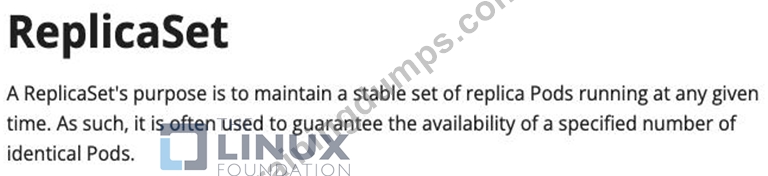
NEW QUESTION # 52
You're using a CI/CD pipeline to deploy a Node.js application to Kubernetes. The application requires environment variables for configuring database connections and API keys. How would you manage these environment variables in a secure and efficient manner?
- A. Pass the environment variables as command-line arguments during container startup.
- B. Use Kubernetes Secrets to store and inject sensitive environment variables.
- C. Use Kubernetes ConfigMaps to manage and inject environment variables.
- D. Hardcode the environment variables into the Node.js application code.
- E. Store the environment variables as plain text files within the Docker image.
Answer: B
Explanation:
Kubernetes Secrets provide a secure and robust solution for managing sensitive data like environment variables, API keys, and database credentials. By using Secrets, you ensure that these values are stored securely within the cluster and only accessible by authorized components.
NEW QUESTION # 53
Which of the following features is NOT a primary benefit of using a service mesh like Istio in a Kubernetes environment?
- A. Improved security through mutual TLS authentication between services
- B. Enhanced observability with metrics, tracing, and logging
- C. Simplified service discovery and load balancing across pods
- D. Dynamic traffic routing and fault tolerance capabilities
- E. Direct access to the underlying Kubernetes API for granular control
Answer: E
Explanation:
Service meshes like Istio are designed to abstract away the complexities of managing microservices in Kubernetes, providing a layer of abstraction above the Kubernetes API. While they offer enhanced security, observability, and traffic management, they do not provide direct access to the Kubernetes API. This allows developers to focus on application logic rather than infrastructure management.
NEW QUESTION # 54
Which kubernetes object do deployments use behind the scenes when they need to scale pods?
- A. POD
- B. Replicasets
- C. Horizontal pod autoscaler
- D. Api Scheduler
- E. Deployment
Answer: B
Explanation:
https://kubernetes.io/docs/concepts/workloads/controllers/replicaset/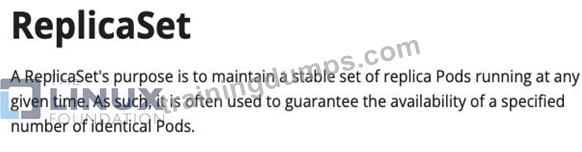
NEW QUESTION # 55
You are running a highly sensitive application in Kubernetes. Which of the following security measures is MOST effective in preventing unauthorized access to your application's secrets?
- A. Employing a secrets management solution like HashiCorp Vault or AWS Secrets Manager.
- B. Deploying your application in a private Kubernetes cluster.
- C. Using the '-privileged' flag for your application's container.
- D. Disabling Kubernetes RBAC and granting full access to all users.
- E. Configuring strong passwords for all Kubernetes users.
Answer: A
Explanation:
Using a secrets management solution like HashiCorp Vault or AWS Secrets Manager is the most effective approach to securely storing and managing secrets in a Kubernetes environment. These solutions offer strong encryption, access control, and audit logging, providing comprehensive protection for your application's sensitive data.
NEW QUESTION # 56
How does service logical group set of pods?
- A. Using hostname
- B. Using label and selectors
- C. Using IP address
Answer: B
Explanation:
https://kubernetes.io/docs/concepts/services-networking/service/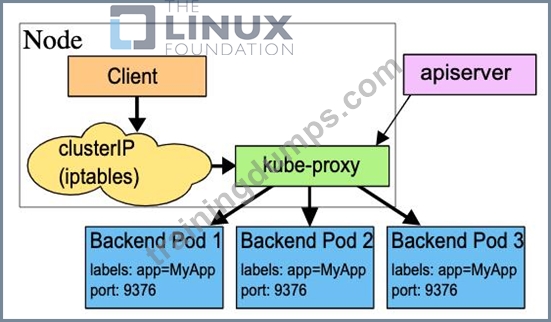
NEW QUESTION # 57
What kubectl command is used to edit a resource on the server?
- A. kubectl edit
- B. kubectl update resource
- C. kubectl resource modify
- D. kubectl resource edit
Answer: A
Explanation:
https://kubernetes.io/docs/reference/generated/kubectl/kubectl-commands#edit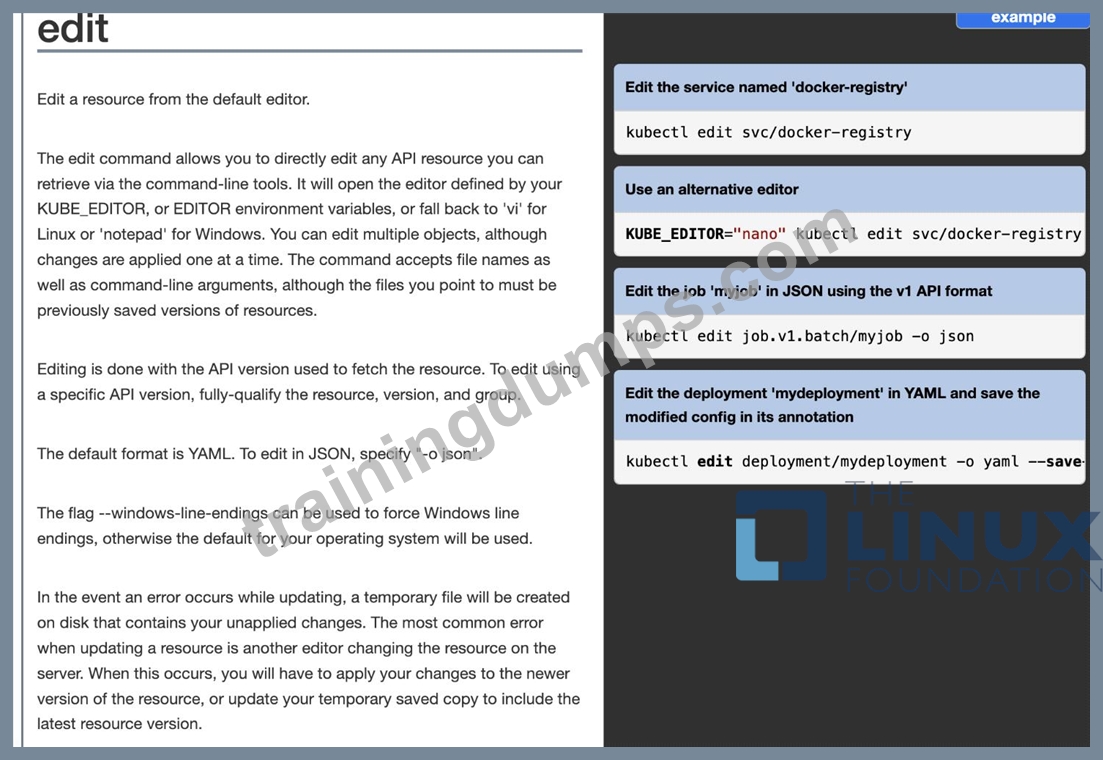
NEW QUESTION # 58
You have a Kubernetes cluster with multiple worker nodes. Nodel has a label •role: web', Node2 has a label *role: database* , and Node3 has no labels. You deploy a pod with a 'nodeSelectoN set to 'role: web'. Which node(s) is/are eligible for the pod to be scheduled on?
- A. only Node2.
- B. Any of the nodes.
- C. Only Nodel.
- D. Only Node3.
- E. Nodel and Node2.
Answer: C
Explanation:
The •nodeSelector• field explicitly specifies that the pod must be scheduled on a node with the label •role: web'. Only Nodel has this label, so it is the only eligible node. The absence of labels or the presence of different labels on other nodes does not satisfy the pod's scheduling requirements.
NEW QUESTION # 59
You are running a sensitive application in Kubernetes that requires access to the host network. Which of the following security measures is MOST important to mitigate the risk of potential security breaches?
- A. Employing a secrets management solution like HashiCorp Vault or AWS Secrets Manager.
- B. Using Network Policies to restrict access to the host network.
- C. Deploying the application in a private Kubernetes cluster.
- D. Using a container security scanner to identify and fix vulnerabilities.
- E. Configuring strong passwords for all Kubernetes users.
Answer: B
Explanation:
While accessing the host network can be necessary for some applications, it introduces security risks. Using Network Policies to restrict access to the host network for your sensitive application is crucial. This allows you to control which pods can communicate with the host network, reducing the risk of unauthorized access and potential security breaches.
NEW QUESTION # 60
Explain the difference between a Kubernetes Deployment and a ReplicaSet. When would you use each of these resources?
- A. ReplicaSet is a low-level resource that manages the lifecycle of Deployments, while Deployment is a high-level resource that manages a set of Pods with the same template-
- B. Deployment and ReplicaSet are interchangeable, and both manage the lifecycle of Pods with the same template.
- C. Deployment is a high-level resource that manages the lifecycle of ReplicaSets, while ReplicaSet is a low-level resource that manages a set of Pods with the same template.
- D. ReplicaSet is a high-level resource that manages the lifecycle of Deployments, while Deployment is a low-level resource that manages a set of Pods with the same template.
- E. Deployment is a low-level resource that manages the lifecycle of ReplicaSets, while ReplicaSet is a high-level resource that manages a set of Pods with the same template.
Answer: C
Explanation:
A Deployment is a high-level resource that manages the lifecycle of ReplicaSets. It defines the desired number of replicas, the pod template, and handles updates and rollbacks. A ReplicaSet is a low-level resource that manages a set of Pods with the same template. It ensures that the desired number of Pods are running based on the defined selector and ensures that pods are replaced when needed. You would use a Deployment for managing updates, rollbacks, and scaling of your applicatiom You would use a ReplicaSet if you only need to manage a set of Pods with the same template and don't require the features provided by a Deployment.
NEW QUESTION # 61
Which role is responsible of creating service level indicator 'SLI', service level objective 'SLO', & Service Level Agreements 'SLA'
- A. GitOps
- B. DevOps
- C. Site reliability engineer 'SRE'
- D. Developer
- E. Security and compliance engineer
Answer: C
Explanation:
https://www.atlassian.com/incident-management/kpis/sla-vs-slo-vs-sli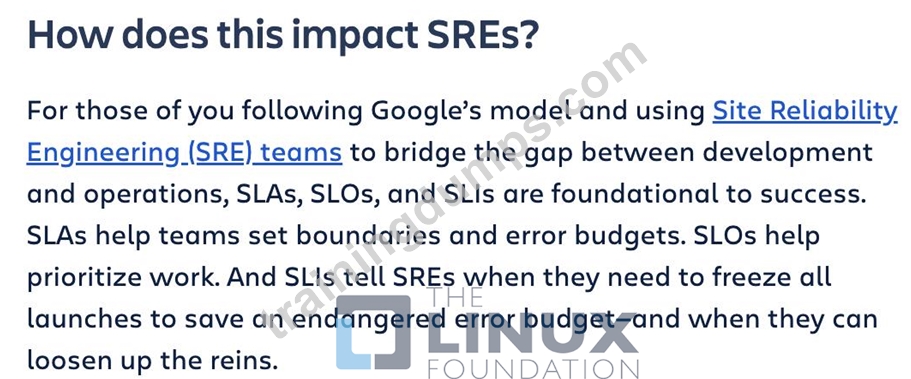
NEW QUESTION # 62
What are default kubernetes namespaces?
- A. default, kube-public, kube-system, kube-node-lease
- B. default, kube-public, kube-systems, kube-node-lease
- C. kube-default, kube-public, kube-system, kube-node-lease
- D. default, kube-public, kube-system, kube-node-leases
Answer: A
Explanation:
https://kubernetes.io/docs/concepts/overview/working-with-objects/namespaces/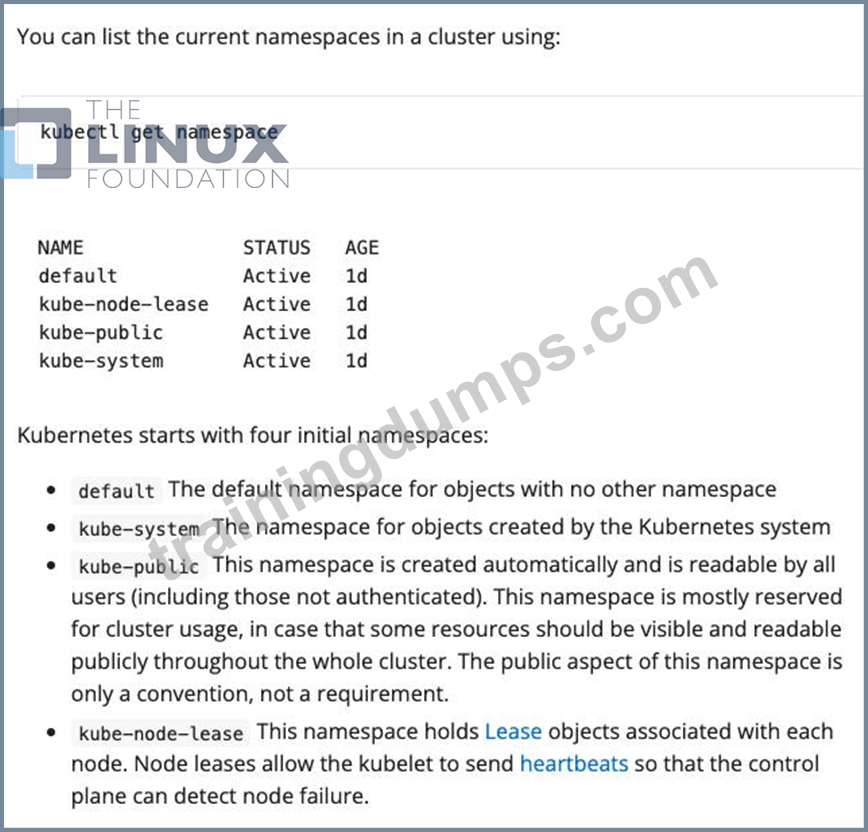
NEW QUESTION # 63
......
Study HIGH Quality KCNA Free Study Guides and Exams Tutorials: https://www.trainingdumps.com/KCNA_exam-valid-dumps.html
New KCNA Actual Exam Dumps, Linux Foundation Practice Test: https://drive.google.com/open?id=1QrDDuHLJYTmq6JnuhF_9B3RbSbPXu_CM
