

Salesforce Arch-303 Dumps - The Sure Way To Pass Exam
Arch-303 Exam Questions (Updated 2026) 100% Real Question Answers
NEW QUESTION # 10
A developer is validating the pipeline cache and noticed that the PDP page is very low cached. The one parameter is snowing the position on the product fisting page upon checking the site and code.
What should the developer adjust in order to improve the page cache hit ratio, keeping in mind that the client is Insisting on the parameter for their analytics?
- A. Rework the Implementation so it doesn't depend on that parameter.
- B. Rework the implementation so it reads the parameter on client-side, passesit to the analytics and exclude It from cache parameters.
- C. Rework the Implementation so the parameter is not passed In the URL and isread from the URL hash.
- D. Add the key to the cache exclude parameters.
Answer: D
NEW QUESTION # 11
Northern Trail Outfitters uses an Order Management system (OMS), which creates an order tracking number for every order 24 hours after receiving it. The OMS provides only a web-service interface to get this tracking number. There is a job that updates this tracking number for exported orders, which were last modified yesterday.
Part of this jobs code looks like the following:
Based on the above description and code snippet, which coding best practice should theArchitect enforce?
- A. Configure circuit breaker and timeout for theOMS web service call to prevent thread exhaustion.
- B. Standard order import should be used instead of modifying multiple order objects with custom code.
- C. The transaction for updating of orders needs to be rewritten to avoid problems with transaction size.
- D. Post-processing of search results is a bad practice that needs to be corrected.
Answer: A
Explanation:
Given that the OMS provides a web-service interface and updates tracking numbers for orders modified the previous day, it is crucial to manage the potential risks of service unavailability or delays that could lead to thread exhaustion in Salesforce Commerce Cloud. Implementing a circuit breaker pattern helps to manage failures gracefully by halting the interaction with the OMS if it becomes unresponsive, thereby preventing the service from impacting the entire system. Additionally, configuring timeouts ensures that the service calls do not hold up resources indefinitely. These strategies help maintain system stability and responsiveness, particularly when dealing with external systems over which there may be limited control.
NEW QUESTION # 12
The Client has just acquired a new brand and wants toIntegrate the new brand s current ecommerce site into a current realm as a new site. The acquisition has its own Enterprise Resource Planning (ERP) system for product data and inventory. The new site will use the existing realm's Order Management System (OHS) and Customer Relationship Management (CRM) system.
What two requirements does the Architect need to keep in mind when creating the technical specification document?
Choose 2 answers
- A. Anew product Import Job must be created to manage products.
- B. A new order export job must be created to export orders.
- C. A new customer export Job must be created to export customers.
- D. A new inventory Import Job must be created to manage inventory.
Answer: A,D
Explanation:
When integrating a new brand's ecommerce site into an existing realm, the architect needs to ensure that product data and inventory from the new brand's Enterprise Resource Planning (ERP) system are correctly managed within the realm. Therefore, creating new import jobs for products (Answer B) and inventory (Answer C) is essential. These import jobs will facilitate the synchronization of the new brand's product catalog and inventory levels with the existing Order Management System (OMS) and Customer Relationship Management (CRM) systems of the realm. Such integration is crucial for maintaining up-to-date product and inventory information across the systems, ensuring seamless operations and data consistency.
NEW QUESTION # 13
The Client has requested an Architect's help in documenting the architectural approach to a new home page.
The requirements provided by the business are:
* Multiple areas of static image content, some may need text shown at well
* The content page must be Realizable
* A carousel of featured products must be shown below a banner 101191
* Recommended categories will be featured based on the time of year
Which two solutions would fulfil these requirements?
Choose 2 answers
- A. Leverage B2C Commerce Page Designer with a dynamic layout.
- B. Leverage B2C Commerce ContentManagement Service
- C. Leverage B2C Commerce locales in Business Manager
- D. Leverage B2C Commerce content slots and assets
Answer: A,D
Explanation:
To fulfill the requirements of having multiple static image content areas, a carousel of featured products, and dynamic content adjustments based on the time of year:
* Option C (Leverage B2C Commerce content slots and assets): This solution allows for dynamic content management where different assets and slots can be used to manage and display static images, text overlays, and other content variations effectively.
* Option D (Leverage B2C Commerce Page Designer with a dynamic layout): Using the Page Designer with a dynamic layout enables the easy assembly of complex page designs, including carousels and responsive elements that adjust based on viewing device or other criteria like time of year. This tool provides the flexibility required for real-time customization and resizability of page elements.
These solutions provide robust and flexible management of site content that meets the business's needs for a visually engaging and adaptable homepage.
NEW QUESTION # 14
A third party survey provider offers both an API endpoint for individual survey data and an SFTP server endpoint that can accept batch survey data. The initial implementation of the integration includes
1.Marking the order as requiring a survey before order placement
2. On the order confirmation pace, the survey form is displayed for the customer to fill
3. The data is sent to the survey provider API, and the order it marked as not requiring a survey Later it was identified that this solution is not fit for purpose as the following issues and additional requirements were identified:
1. If the API call fails, the corresponding survey data is lost. The Business requires to avoid data loss.
2. Some customers skipped the form. The Business require sending a survey email to such customers.
3. The Order Management System (OMS) uses a non-standard XML parser it did not manage to parse orders with the survey, until the survey attribute was manually removedfrom the xml.
How should the Architect address the issues and requirements described above?
- A. Create a custom session attribute when the survey is required. Send to the API endpoint in real-time. On failure, capture the survey data in the session and reprocess, use me session attribute to send emails for the cases when survey was skipped.
- B. Create a custom object to store the survey data. Send to the API endpoint using a job. On success, remove the custom object. On failure, send the survey data with APIfrom the next execution of the same job. Use the custom object to send emails for the cases when the survey was skipped.
- C. Create a custom object when the survey is required Send to the API endpoint in real-time. On success, remove the object. Onfailure, capture the survey data in the custom object and later reprocess with a job. Use the custom object to send emails for the cases when survey was skipped.
- D. Send the survey data to the API endpoint in real-time until the survey data is successfullycaptured.Instruct the OMS development team to update their XML parser, use the Order survey attribute to send emails for the cases when the survey was skipped.
Answer: C
Explanation:
This approach addresses all concerns: data retention, reattempt on failure, and follow-up communication. By storing survey data in a custom object, data is preserved even if the API call fails, allowing for reprocessing.
This method also facilitates sending follow-up emails by querying custom objects for surveys that were skipped, ensuring comprehensive coverage and reliability in data handling and customer engagement.
NEW QUESTION # 15
A company manages its regional operations asseparate businesses. The regional sites (Site A and Site B) operate with:
* Separate realms
* Deferent code bates
* Different category navigation menus
* Frequent updates on category structure
The requirement from the business is to provide hreflang link tags on category pages pointing to the same category on the other regional site. Example MTML for one of these links as displayed on Site A is:
Which solution should the Architect choose while keeping performance in mind?
- A. Create a new customattribute on the Category. Populate the attribute with the other entire site URLs corresponding to locales In JSON Format. Use the attribute to display the hreflang link tag.
- B. Create a new custom object type Populate the hreflang mapping for each category and locale in this custom object. Use the custom object to display the hreflang link tag.
- C. Create additional locales in al realms create a new custom attribute on the category that is localized.
Populate the attribute with the other site URLs and use it to display the hreflang tag. - D. Create a custom Business Manager module. Ask the business to maintain the hreflang link tags for each regional site in this Business Manager module.
Answer: B
Explanation:
For a multi-regional setup with different realms and frequent updates, using a custom object to manage hreflang mappings offers flexibility and scalability. Custom objects can efficiently store URL mappings for each category across different locales, making it easier to manage and update as category structures change.
This method allows for centralized control over hreflang mappings and simplifies maintenance compared to other options which might involve more complex integrations or manual updates.
NEW QUESTION # 16
A developer is remotely fetching the reviews for a product.
Assume that it's an HTTP GET request and caching needs to be implemented, what consideration should the developer keep in mind for building the caching strategy?
- A. Cached remote include with cache of the HTTP service
- B. Remote include with caching only the reviews
- C. Use custom cache
- D. Cache the HTTP service request
Answer: A
Explanation:
For efficient caching of HTTP GET requests used to fetch product reviews, the best practice is to use a cached remote include combined with caching of the HTTP service itself (Answer D). This method involves caching the output of the remote service call at the service layer and reusing it for subsequent requests. This approach minimizes the number of calls to the remote service, reduces load times, and ensures that the displayed reviews are up-to-date as per the cache's freshness settings. It optimally balances the performance benefits of caching with the need to keep content like reviews current.
NEW QUESTION # 17
There Is an Issue with the site when the domain Is opened from Google search results. After researching the problem. It turns out that the site returns * 404 page error when accessedwith a parameter in the URL.
What should the Architect recommend to fix that issue?
- A. Add dynamic catch-all rule to redirect to home page.
- B. Add this snippet to the aliases configurationfor the domain
- C. Add dynamic redirect if the URL contains parameter to Home Show.Add this snippet to the aliases configuration for the domain
- D. Add this snippet to the aliases configuration for the domain:
Answer: A
Explanation:
To address the issue of the site returning a 404 error when accessed with a parameter from Google search results, a dynamic catch-all rule to redirect such requests to the homepage is an effective solution (Answer A).
This approach ensures that users landing from external links with appended parameters, which might not match any configured route or alias, are redirected to a valid page instead of seeing an error page. This improves the user experience and minimizes potential bounce rates caused by broken links or outdated URLs.
NEW QUESTION # 18
During code review, the Architect found that there is a service call on every visit of the product detail woe (PDP).
What best practices should the Architect ensure are followed for the service configuration?
Choose 2 answers
- A. Service mock up call is configured.
- B. Service logging is disabled.
- C. Service timeout is set.
- D. Circuit breaker is enabled.
Answer: A
Explanation:
For logging practices in a complex LINK cartridge integration, the recommendation is:
* Get logger for cartridge-specific category (C): This practice allows for more precise and relevant logging by focusing on the specific cartridge, making troubleshooting more efficient.
* Report debug level message for the back-end asynchronous communication: This ensures that all detailed interactions are logged, providing valuable data for diagnosing issues.
* Report all errors at error level message: This categorizes all critical issues under error logs, which is essential for quick identification and resolution of problems affecting the system's operations.
This structured logging strategy enhances the ability to monitor and troubleshoot the system effectively, especially in complex integrations where multiple components interact asynchronously.
NEW QUESTION # 19
A company that is a shoe-producer is doing Salesforce B2C Commerce implementation. In their Enterprise Resource Warning (ERP) system, the products are marked as being one of three types: boots, sandals, and sneakers. The business requirements based on the type are:
* The messaging on Product Detail page is different
* Customers are able to filler their Product Search Results
The customer's operations team asks about the format in which to send this value in the catalog.
Which data type should the Architect specify for this attribute In the Data Mapping document?
- A. A custom attribute of type string containing comma separated values.
- B. A custom attribute of type enum-of-string (single selectable value)
- C. A custom attribute of type enum-of-string (multiselect able value).
- D. A custom attribute type set-of-string containing multiple values.
Answer: B
Explanation:
For the shoe producer implementing Salesforce B2C Commerce, the attribute used to specify the type of shoes (boots, sandals, sneakers) should be set as a single selectable value, hence the use of an enum-of-string type. This data type allows for the selection of one option from a predefined list, which is ideal for cases where each product can only be categorized into one type. This ensures that data integrity is maintained while providing clear and distinct categorization that can easily be used for filtering on the Product Search Results page and for customized messaging on the Product Detail page.
NEW QUESTION # 20
An Architect has been approached by the Business with a request to create a custom product finder. The finder would initially be available ononly one site, and would eventually be extended to be available on all sites the Business maintains. There is a requirement that these wrings art also available to be used in a Job context for export to other systems.
Each site will have a differentcategory avertable for use by the product finder.
Where should the Architect store the custom settings for use on both the storefront and in a job context?
- A. Custom Object with a Site Scope
- B. Category custom attributes
- C. Custom Object with an Organizational Scope
- D. Jobs Framework parameters
Answer: C
Explanation:
To manage custom settings for a product finder that needs to be accessible both on the storefront and in a job context, storing these settings in a Custom Object with an Organizational Scope is most appropriate. This allows the settings to be centralized and accessible across different sites and job contexts, ensuring consistency and reusability of the configurations:
* Organizational Scope: Enables settings to be shared across multiple sites without duplicating data, maintaining a single source of truth for configurations that affect various parts of the organization.
* Custom Object: Provides the flexibility to define specific attributes and values that are unique to the business requirements of the product finder and other integrations.
NEW QUESTION # 21
An ecommerce site has dynamic shipping cost calculation. it allows the customers to see their potential shipping costs on the Product Detail Page before adding an item to the cart.
For this feature, shipping touts are calculated using the following logic:
* Set the shipping method on the Basket
* Add the item to the basket, calculate the basket total and get the shipping cost for this method
* Remove the item from the Basket to restore the original state
* The above process is repeated for each shipping method
During the testing it was discovered that the above code violates the spi.basket.addResolveInSameResquest quota.
What should the Architect do to resolve this issue and maintain the business requirement?
- A. Wrap the adding of product and shipping cost calculation in a transaction which Is then rolled back to restore the original state
- B. Omit the removal of the Item and speed up the process for the customer by adding the product to the basket for them.
- C. Wrap each Individual step of the process its own transaction Instead of using one transaction for all steps.
- D. Omit the calculation of shipping cost until the customer is ready to check out and has chosen the shipping method they want to
Answer: A
Explanation:
To resolve the issue of violating the spi.basket.addResolveInSameRequest quota and to maintain the functionality of dynamically calculating shipping costs for items before they are added to the basket, the best approach is:
* Option D: Wrapping the adding of product and shipping cost calculation in a transaction, which is then rolled back to restore the original state. This method ensures that the system can calculate potential shipping costs without permanently altering the state of the basket. This approach keeps the basket's original state intact while allowing for multiple shipping calculations, effectively managing the load on system resources and adhering to platform quotas.
NEW QUESTION # 22
The Client is Crowing and decided to migrate its ecommerce website to B2C Commerce. The Client provided the Architect with the f metrics for its existing website over the past 12 months and forecasted into the next year: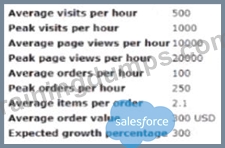
Noting these historical metrics and the forecasted growth of 300%, which load test targets meet best practices for testing the new B2C Commerce site?
- A. 150000 visits per hour, 3000000 page views per hour, and 37500 orders per hour
- B. 15000 visits per hour, 300000 page views per hour, and 3750 orders per hour
- C. 1500 visits per hour, 30000 page views per hour, and 375 orders per hour
- D. 3000 visits per hour, 60000 page views per hour, and 750 orders per hour
Answer: B
Explanation:
Considering the existing metrics and forecasted 300% growth, the appropriate load testing targets for the new B2C Commerce site would be:
* 15000 visits per hour: This figure is calculated by applying the expected growth to the peak visits per hour (1000 visits), resulting in 4000 visits. The choice of 15000 provides a higher buffer to accommodate unforeseen spikes in traffic.
* 300000 page views per hour: Similarly, this is scaled up from the peak page views per hour (20000) considering the growth, ensuring the site can handle high demand and interactions.
* 3750 orders per hour: This target is based on the peak orders per hour (250) with the growth applied, allowing testing of the system's ability to handle transactions under significant load.
These targets ensure that the system is robust enough to handle increased traffic and transactions without performance degradation, crucial for maintaining customer satisfaction and operational stability.
NEW QUESTION # 23
Northern Trail Outfitters (NTO) wants to migrate its online shoo from a custom ecommerce platform to B2CCommerce. NTO needs to migrate several thousands of customer records profile information, address book). WTO can provide a B2C Commerce feed. It is currently using SHA-256 as an encryption mechanism for the customer passwords.
What approach can the Architect propose?
- A. Import the customer records, excluding the password field, and B2C Commerce will automatically require a password reset the first time a customer logs m to the storefront.
- B. Do not import customer records and asks customers to create new accounts the firstfame they try to log in to the B2C Commerce storefront.
- C. Import the customer records, including the hashed password, as B2C Commerce supports SHA-2S6, and they will be able to login with their existing password.
- D. Import the customer records, with the hashed password as a custom attribute, and during the login compare the entered password with the hashed password and save it in the password field.
Answer: A
Explanation:
B2C Commerce does not directly support the import of hashed passwords for use in authentication due to security protocols and the platform's password management system. The best approach is to import customer records without the password field. Upon their first login attempt on the new system, customers would be prompted to reset their password. This method ensures that password security is maintained according to B2C Commerce standards and that customer data remains secure during the transition from the old platform.
NEW QUESTION # 24
A new version of the Page Show controller is required for implementation of Page Deserter specific look. It requires implementation of a specific, cache period for Page Designer pages, which b not currently available in the base Storefront Reference Architecture (SFRA) cache.js module What two steps should the Architect instruct the developer to implement?
Choose 2 answers
- A. Create new Page.js controller in client s cartridge. Copy code from base and modify the Page-Show route to include the new cache middleware function.
- B. Create new ceche,js client's cartridge. Copy cache,js from app_storefront_base and add a function for the Page Designer caching.
- C. Create new Page,js controller in client's cartridge. Extend the code from base and prepend the new cache middleware function to Page-Show route.
- D. Create new cache,js in client's cartridge. Extend cache,js from app_storefront_baseand add a function for the Page Designer caching.
Answer: A,D
Explanation:
To implement a specific cache period for Page Designer pages in SFRA:
* Option A involves creating a new Page.js controller in the client's cartridge, where the existing Page- Show route can be modified to include a custom caching logic. This ensures that the specific caching requirements for Page Designer pages are met without altering the base functionality for other pages.
* Option D calls for extending the existing cache.js module in the client's cartridge to include a function specifically for Page Designer caching. This allows for reusing the existing caching logic while adding enhancements specific to the Page Designer pages, thus maintaining efficiency and clarity in the codebase.
Both options provide a clean, maintainable approach to customizing caching for specific requirements in SFRA, avoiding disruptions in other areas of the site functionality.
NEW QUESTION # 25
The Client is planning to switch to a new Payment Service Provider (PSP). They have approached an Architect to understand the time and effort to Integrate the new PSP The PSP offers a LINK cartridge compatible with SiteGenesisPipelines, but the Client's website is build on Controllers.
Which two options should the Architect take into consideration before starting analysis? Choose 2 answers
- A. Estimate the effort and risk to convert the LINK cartridge from pipelines to controllers.
- B. Produce a proof of concept converting the most essential pipelines into controllers and integrate the cartridge.
- C. Reach out to the PSP development team and ask if a new cartridge version that supports controllers is under development
- D. Look fora different PSP that supports controllers and would not require conversion efforts.
Answer: A,C
Explanation:
When integrating a new Payment Service Provider (PSP) LINK cartridge designed for SiteGenesis Pipelines into a site built on Controllers, consider these options:
* Option A (Estimate the effort and risk to convert the LINK cartridge from pipelines to controllers): Assessing the effort involved in converting the cartridge provides insight into the project scope, helping to manage risk and allocate resources effectively.
* Option B (Reach out to the PSP development team and ask if a new cartridge version that supports controllers is under development): This can potentially save significant development time and resources if a compatible version is already planned or in progress.
These approaches help in making an informed decision on integration strategies, balancing between customization efforts and leveraging existing solutions.
NEW QUESTION # 26
a B2C Commerce developer has Implemented a job that connects to an SFTP, loops through a specific number of .csv rtes. and Generates a generic mapping for every file. In order to keep track of the mappingsimported, if a generic mapping is created successfully, a custom object instance w created with the .
csv file name. After running the job in the Development instance, the developer checks the Custom Objects m Business Manager and notices there Isn't a Custom Object for each csv file that was on SFTP.
What are two possible reasons that some generic mappings were not created? Choose 2 answers
- A. The maximum number of generic mappings was reached.
- B. Invalid format in one or more of the .csv files.
- C. The job needs to run on Staging and then replicate the generic mappings and custom objects on Development
- D. The generic mappings definition need to be replicated fromStaging before running the job.
Answer: A,B
Explanation:
Two plausible reasons for some generic mappings not being created despite the SFTP job running are: A) the system reached its limit for the maximum number of generic mappings allowed, and C) there was an invalid format in one or more of the .csv files processed. When the maximum threshold for mappings is reached, the system cannot create additional mappings, thus stopping any further imports from being registered as custom objects. Additionally, if .csv files are incorrectly formatted, the job would fail to create mappings for those files, leading to the absence of corresponding custom objects in Business Manager. It's crucial to ensure that file formats adhere to expected specifications and that system limits are adequately managed to avoid such issues.
NEW QUESTION # 27
An Architect has been asked by the Business to integrate a newpayment LINK cartridge. As part of the integration, the Architect has created four new services to access various endpoints in the integration.
How can the Architect move the new services to Production when the integration is ready for launch?
- A. The new services will be moved to Production with a Code Replication.
- B. The new services must be manually exported from staging and Imported into Production.
- C. The new services will be moved to production with a Site Import.
- D. The new services will be moved to Production with a Data Replication.
Answer: A
Explanation:
For deploying new services related to a payment LINK cartridge to Production, the correct method is through Code Replication (D). This approach ensures that all new code changes, including the integration services, are consistently applied across different environments. Code replication covers deploying all changes made in code, scripts, and service configurations from a staging or development environment to the production environment. This process ensures that all new functionalities are tested in a controlled environment before being moved to production, reducing the risk of errors affecting the live site.
NEW QUESTION # 28
The Client currently manages Customers, Inventory, and Product Information with dedicated backend systems as shown In the Systems Diagram below. There is also an external Email Marketing System (EMS) in place.
The EMS needs order data to email recommendations to customers using an existing email campaign. These recommendations should be to only send for products that are in stock. The EMS has no access to the backend systems so this data should come from the Salesforce B2C Commerce site.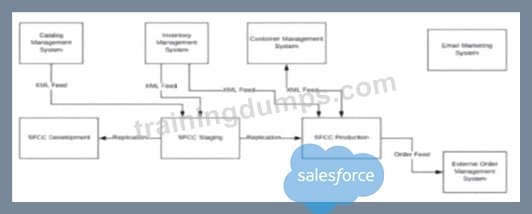
Which relationships should be added to the Systems Diagram to complete it and fulfill the chant requirements necessary for the email campaign?
- A. Order, Customer, and Product data should be exported from Staging. Inventory data should be exported from Production.
- B. Order andInventory should be exported from Production. Products should be exported from Staging.Customers should be exported from the external Customer Management System.
- C. Order, Customer, and Inventory data should be exported from Production. Product data should be exported from staging.
- D. Order and Customer data should be exported from Production. Product and Inventory data should be exported from Staging.
Answer: D
Explanation:
In the given scenario, where the Email Marketing System (EMS) requires order data to send product recommendations based on stock availability, it is crucial that the most up-to-date and relevant data is used.
Here's why the chosen data sources are appropriate:
* Order and Customer Data from Production: Since order and customer interactions occur in real- time, exporting this data from the Production environment ensures that the most current information is used for the email marketing campaigns. This accuracy is vital for personalization and timeliness of the communications sent to customers.
* Product and Inventory Data from Staging: Given that the staging environment is typically one step behind production and is used for testing before changes go live, it provides a stable dataset that reflects what is currently live without the risk of including any unvetted changes. This setup is suitable for inventory and product data, which are less susceptible to minute-by-minute changes compared to order data and can be pre-validated before use in marketing efforts.
This configuration helps ensure that the EMS has access to reliable data reflecting current stock levels and product details, which is essential for crafting accurate marketing messages based on product availability.
NEW QUESTION # 29
a clientuses an external marketing toot to manage promotions and coupons for its multiple brands. They currently have only one brand on B2C Commerce and thev get Import-ready feeds created by this tool on en SFTP location.
The marketing team completes the data preparation by the end of the work day.
How should the Architect handle this import?
- A. Create a job and define three steps: one custom step to download the files from SFTP, and two standard steps to import the promotion and coupons.
- B. Create a Job and define three custom steps: download the files from SFTP, import promotions, import coupons
- C. Create a Job and define three steps: one standard step to download files from sftp end two steps that use Execute Script Module to import the promotion end coupons.
- D. Create a Job and define three steps: one step uses ExecuteScriptModule to download the files from SFTP, end two standard steps to Import the promotion end coupons.
Answer: A
Explanation:
To handle the import of promotion and coupon data from an SFTP location, the best approach is to create a job consisting of three steps as described in option C. The first step involves a custom script to download the files from the SFTP server-this is necessary because file retrieval from external servers typically requires specific connectivity and security configurations that are best handled in a custom-coded step. The subsequent two steps would utilize standard Salesforce B2C Commerce job steps to import the downloaded promotion and coupon data into the platform. This method ensures that the data flow is streamlined, from retrieval through to integration into the Commerce platform.
NEW QUESTION # 30
The Architect has been presented with a requirement from the business to implement a new LINK cartridge.
The current site is built on the Storefront Reference Architecture, and the LINK cartridge is certified for Pipelines and Controllers. On review, the Architect notes that the Jobs are all created in Pipelines.
How should the Architect implement that cartridge to make sure the required jobs runs property?
- A. The job Pipelines must be updated to useSFRA Controllers.
- B. The job Pipelines must be updated to work as custom job steps.
- C. The Job Pipelines must be updated to use SiteGenesis Controllers.
- D. The job Pipelines must be removed and recreated with scripts.
Answer: B
Explanation:
For integrating a LINK cartridge that is certified for pipelines and controllers into a system using the Storefront Reference Architecture (SFRA), which primarily uses scripts instead of the older pipeline technology, the architect should update the job pipelines to work as custom job steps. This approach allows the existing LINK cartridge functionalities to be maintained while making them compatible with the SFRA framework. Custom job steps enable more flexibility and the ability to leverage the full capabilities of SFRA, ensuring that the jobs run correctly within the newer architecture.
NEW QUESTION # 31
The Client wishes to implement a third party integration that allows for free shipping If the customer Is a member of the third party service. When the customer's order is exported to the Order Management System (OMS) it also creates a custom object in order to track additional data before sending that order data to the third-party service as well.
What technical concern should the Architect raise to protect performance and stability of the site1?
- A. The customer order quota and related retention or deletion needs.
- B. The custom object quota and related retentionor deletion needs.
- C. The OMS having order data sent to a thud party and related security needs.
- D. The customer's order data sent to a third-party and related security needs.
Answer: B
Explanation:
When integrating a third-party service that relies on custom objects in B2C Commerce, the primary technical concern is the impact on performance and site stability related to the usage of these objects. Important considerations include:
* Custom object quota: Ensuring that the use of custom objects does not exceed platform limits, which could impact performance or even prevent new data from being stored.
* Retention or deletion needs: Proper management of custom object lifecycle is crucial to prevent data bloat and maintain database performance, including strategies for timely deletion or archiving of old data.
Addressing these concerns is critical to maintaining the performance and stability of the site while integrating third-party services that require extensive data handling.
NEW QUESTION # 32
......
Pass Salesforce Arch-303 Exam Quickly With TrainingDumps: https://www.trainingdumps.com/Arch-303_exam-valid-dumps.html
Prepare Arch-303 Question Answers - Arch-303 Exam Dumps: https://drive.google.com/open?id=1thKEyO20R6aazpPsw5-VhPo8JEciz4k8
