

Exam Questions and Answers for FCP_FCT_AD-7.2 Study Guide Questions and Answers!
FCP—FortiClient EMS 7.2 Administrator Certification Sample Questions and Practice Exam
Fortinet FCP_FCT_AD-7.2 Exam Syllabus Topics:
| Topic | Details |
|---|---|
| Topic 1 |
|
| Topic 2 |
|
| Topic 3 |
|
| Topic 4 |
|
NEW QUESTION # 38
ZTNA Network Topology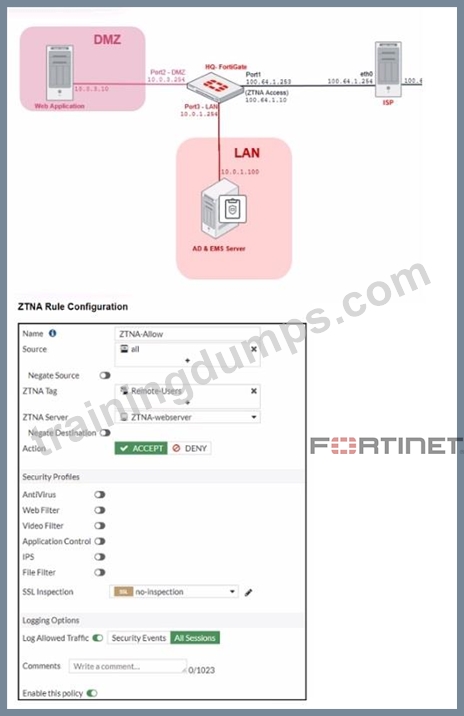
Refer to the exhibits, which show a network topology diagram of ZTNA proxy access and the ZTNA rule configuration.
An administrator runs the diagnose endpoint record list CLI command on FortiGate to check Remote-Client endpoint information, however Remote-Client is not showing up in the endpoint record list.
What is the cause of this issue?
- A. Remote-Client provided an invalid certificate to connect to the ZTNA access proxy.
- B. Remote-Client has not initiated a connection to the ZTNA access proxy.
- C. Remote-Client provided an empty client certificate to connect to the ZTNA access proxy.
- D. Remote-Client failed the client certificate authentication.
Answer: D
NEW QUESTION # 39
Which two statements are true about the ZTNA rule? (Choose two.)
- A. It enforces access control.
- B. It applies security profiles to protect traffic
- C. It defines the access proxy.
- D. It applies SNAT to protect traffic.
Answer: A,B
Explanation:
* Understanding ZTNA Rule Configuration:
* The ZTNA rule configuration shown in the exhibit defines how traffic is managed and controlled based on specific tags and conditions.
* Evaluating Rule Components:
* The rule includes security profiles to protect traffic by applying various security checks (A).
* The rule also enforces access control by determining which endpoints can access the specified resources based on the ZTNA tag (D).
* Eliminating Incorrect Options:
* SNAT (Source Network Address Translation) is not mentioned as part of this ZTNA rule.
* The rule does not define the access proxy but uses it to enforce access control.
* Conclusion:
* The correct statements about the ZTNA rule are that it applies security profiles to protect traffic (A) and enforces access control (D).
References:
* ZTNA rule configuration documentation from the study guides.
NEW QUESTION # 40
Which two statements are true about the ZTNA rule? (Choose two.)
- A. It enforces access control.
- B. It applies security profiles to protect traffic
- C. It defines the access proxy.
- D. It applies SNAT to protect traffic.
Answer: A,B
Explanation:
Understanding ZTNA Rule Configuration:
The ZTNA rule configuration shown in the exhibit defines how traffic is managed and controlled based on specific tags and conditions.
Evaluating Rule Components:
The rule includes security profiles to protect traffic by applying various security checks (A).
The rule also enforces access control by determining which endpoints can access the specified resources based on the ZTNA tag (D).
Eliminating Incorrect Options:
SNAT (Source Network Address Translation) is not mentioned as part of this ZTNA rule.
The rule does not define the access proxy but uses it to enforce access control.
Conclusion:
The correct statements about the ZTNA rule are that it applies security profiles to protect traffic (A) and enforces access control (D).
NEW QUESTION # 41
Refer to the exhibit, which shows the output of the ZTNA traffic log on FortiGate.
What can you conclude from the log message?
- A. The remote user connection does not match the ZTNA rule configuration.
- B. The remote user connection does not match the local-in policy.
- C. The remote user connection does not match the ZTNA firewall policy.
- D. The remote user connection does not match the ZTNA server configuration.
Answer: A
Explanation:
* Observation of ZTNA Traffic Log:
* The log message indicates that the remote user connection was denied due to failure to match a proxy policy.
* Evaluating Log Message:
* The message suggests that the connection does not match the existing ZTNA rule configuration, leading to the denial.
* Conclusion:
* The correct conclusion from the log message is that the remote user connection does not match the ZTNA rule configuration (B).
References:
* ZTNA traffic log analysis and configuration documentation from the study guides.
NEW QUESTION # 42
Refer to the exhibit.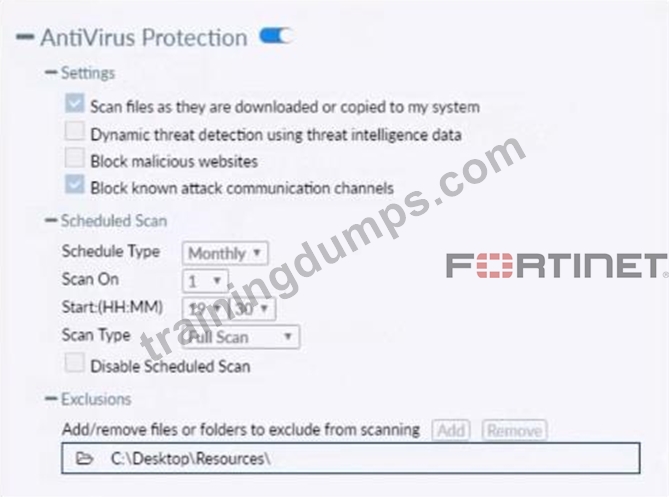
Based on the settings shown in the exhibit which statement about FortiClient behavior is true?
- A. FortiClient copies infected files to the Resources folder without scanning them.
- B. FortiClient quarantines infected files and reviews later, after scanning them.
- C. FortiClient scans infected files when the user copies files to the Resources folder
- D. FortiClient blocks and deletes infected files after scanning them.
Answer: B
Explanation:
Action On Virus Discovery Warn the User If a Process Attempts to Access Infected Files Quarantine Infected Files. You can use FortiClient to view, restore, or delete the quarantined file, as well as view the virus name, submit the file to FortiGuard, and view logs. Deny Access to Infected Files Ignore Infected Files
NEW QUESTION # 43
Why does FortiGate need the root CA certificate of FortiCient EMS?
- A. To trust certificates issued by FortiClient EMS
- B. To update FortiClient client certificates
- C. To sign FortiClient CSR requests
- D. To revoke FortiClient client certificates
Answer: A
Explanation:
Understanding the Need for Root CA Certificate:
The root CA certificate of FortiClient EMS is necessary for FortiGate to trust certificates issued by FortiClient EMS.
Evaluating Use Cases:
FortiGate needs the root CA certificate to establish trust and validate certificates issued by FortiClient EMS.
Conclusion:
The primary reason FortiGate needs the root CA certificate of FortiClient EMS is to trust certificates issued by FortiClient EMS.
NEW QUESTION # 44
What is the function of the quick scan option on FortiClient?
- A. It allows users to select a specific file folder on their local hard disk drive (HDD), to scan for threats.
- B. It performs a full system scan including all files, executable files. DLLs, and drivers for throats.
- C. It scans executable files. DLLs, and drivers that are currently running, for threats.
- D. It scans programs and drivers that are currently running, for threats
Answer: C
Explanation:
Understanding Quick Scan Function:
The quick scan option on FortiClient is designed to scan certain elements of the system quickly for threats.
Evaluating Scan Scope:
The quick scan specifically targets executable files, DLLs, and drivers that are currently running, providing a rapid assessment of the active components of the system.
Conclusion:
The correct answer is D, as it accurately describes the function of the quick scan option on FortiClient.
Reference:
FortiClient scanning options documentation from the study guides.
NEW QUESTION # 45
Exhibit.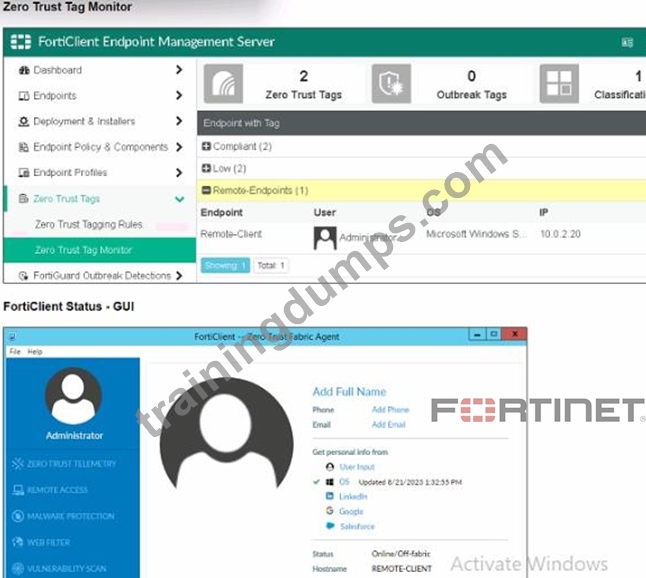
Refer to the exhibits, which show the Zero Trust Tag Monitor and the FortiClient GUI status.
Remote-Client is tagged as Remote-User* on the FortiClient EMS Zero Trust Tag Monitor.
What must an administrator do to show the tag on the FortiClient GUI?
- A. Change the FortiClient system settings to enable lag visibility.
- B. Change the endpoint alerts configuration to enable tag visibility.
- C. Change the FortiClient EMS shared settings to enable tag visibility.
- D. Update tagging rule logic to enable tag visibility.
Answer: B
Explanation:
Observation of Exhibits:
The exhibits show the Zero Trust Tag Monitor on FortiClient EMS and the FortiClient GUI status.
Remote-Client is tagged as "Remote-Endpoints" on the FortiClient EMS Zero Trust Tag Monitor.
Enabling Tag Visibility:
To show the tag on the FortiClient GUI, the endpoint alerts configuration must be adjusted to enable tag visibility.
Verification:
The correct action is to change the endpoint alerts configuration to enable tag visibility, ensuring that the tag appears in the FortiClient GUI.
Reference:
FortiClient EMS and FortiClient configuration documentation from the study guides.
NEW QUESTION # 46
Which three types of antivirus scans are available on FortiClient? (Choose three )
- A. Quick scan
- B. Full scan
- C. Proxy scan
- D. Custom scan
- E. Flow scan
Answer: A,B,D
Explanation:
FortiClient offers several types of antivirus scans to ensure comprehensive protection:
Full scan: Scans the entire system for malware, including all files and directories.
Custom scan: Allows the user to specify particular files, directories, or drives to be scanned.
Quick scan: Scans the most commonly infected areas of the system, providing a faster scanning option.
These three types of scans provide flexibility and thoroughness in detecting and managing malware threats.
NEW QUESTION # 47
Refer to the exhibit.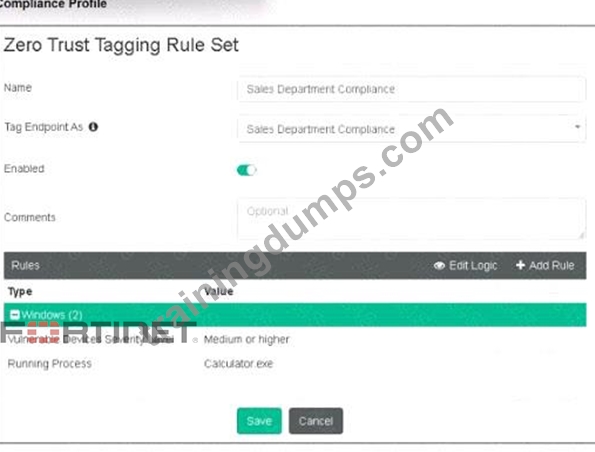
Based on the settings shown in the exhibit, which two actions must the administrator take to make the endpoint compliant? (Choose two.)
- A. Enable the web filter profile.
- B. Run Calculator application on the endpoint.
- C. Patch applications that have vulnerability rated as high or above.
- D. Integrate FortiSandbox tor infected file analysis
Answer: B,C
Explanation:
* Observation of Compliance Profile:
* The compliance profile shown in the exhibit includes rules for vulnerability severity level and running process (Calculator.exe).
* Evaluating Actions for Compliance:
* To make the endpoint compliant, the administrator needs to ensure that the vulnerability severity level is medium or higher is patched (D).
* Additionally, the Calculator.exe application must be running on the endpoint (B).
* Eliminating Incorrect Options:
* Enabling the web filter profile (A) is not related to the compliance rules shown.
* Integrating FortiSandbox (C) is not a requirement in the given compliance profile.
* Conclusion:
* The correct actions are to run the Calculator application on the endpoint (B) and patch applications with vulnerabilities rated as high or above (D).
References:
* FortiClient EMS compliance profile configuration documentation from the study guides.
NEW QUESTION # 48
Refer to the exhibit.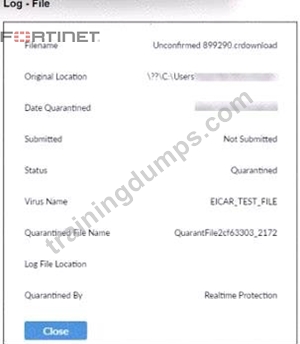
Based on the FortiClient tog details shown in the exhibit, which two statements ace true? (Choose two.)
- A. The file status is Quarantined
- B. The filename is sent to FortiSandbox for further inspection.
- C. The filename Is Unconfirmed 899290.crdovnload.
- D. The file location is \??\D:\Users\.
Answer: A,C
NEW QUESTION # 49
Refer to the exhibit. Based on the Security Fabric automation settings, what action will be taken on compromised endpoints?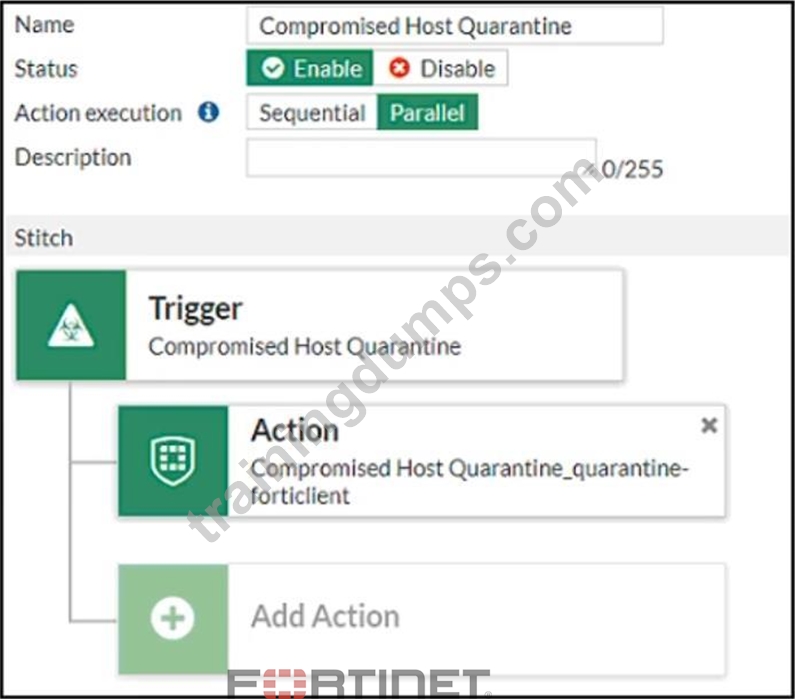
- A. Endpoints will be quarantined through FortiSwitch
- B. Endpoints will be quarantined through EMS
- C. Endpoints will be banned on FortiGate
- D. An email notification will be sent for compromised endpoints
Answer: B
Explanation:
Based on the Security Fabric automation settings shown in the exhibit:
The automation stitch is configured with a trigger for a "Compromised Host." The action specified for this trigger is "Quarantine FortiClient via EMS." This indicates that when an endpoint is detected as compromised, FortiClient EMS will quarantine the endpoint as part of the automation process.
Therefore, the action taken on compromised endpoints will be to quarantine them through EMS.
NEW QUESTION # 50
Refer to the exhibit. Based on the FortiClient logs shown in the exhibit which application is blocked by the application firewall?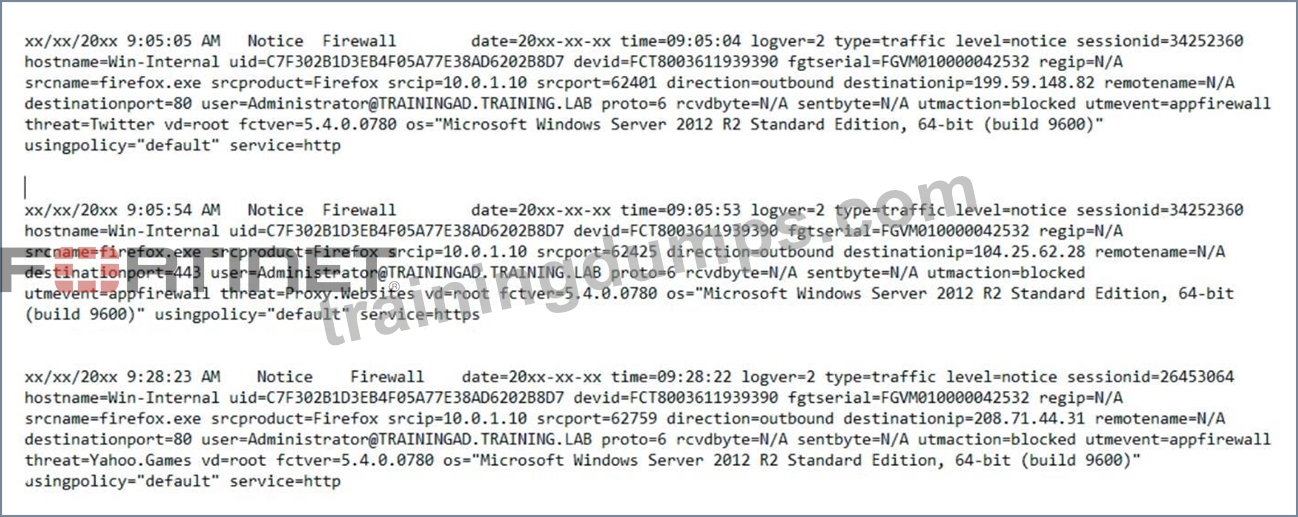
- A. Facebook
- B. Internet Explorer
- C. Firefox
- D. Twitter
Answer: D
Explanation:
Based on the FortiClient logs shown in the exhibit:
The first log entry shows the application "firefox.exe" trying to access a destination IP, with the threat identified as "Twitter." The action taken by the application firewall is "blocked" with the event type "appfirewall." This indicates that the application firewall has blocked access to Twitter.
NEW QUESTION # 51
Which three features does FortiClient endpoint security include? (Choose three.)
- A. lPsec
- B. DLP
- C. Vulnerability management
- D. L2TP
- E. Real-lime protection
Answer: A,C,E
Explanation:
Understanding FortiClient Features:
FortiClient endpoint security includes several features aimed at protecting and managing endpoints.
Evaluating Feature Set:
Vulnerability management is a key feature of FortiClient, helping to identify and address vulnerabilities (B).
IPsec is supported for secure VPN connections (D).
Real-time protection is crucial for detecting and preventing threats in real-time (E).
Eliminating Incorrect Options:
Data Loss Prevention (DLP) (A) is typically managed by FortiGate or FortiMail.
L2TP (C) is a protocol used for VPNs but is not specifically a feature of FortiClient endpoint security.
NEW QUESTION # 52
What does FortiClient do as a fabric agent? (Choose two.)
- A. Provides IOC verdicts
- B. Creates dynamic policies
- C. Provides application inventory
- D. Automates Responses
Answer: C,D
NEW QUESTION # 53
Refer to the exhibit, which shows FortiClient EMS deployment, profiles.
When an administrator creates a deployment profile on FortiClient EMS. which statement about the deployment profile is true?
- A. Deployment-2 will install FortiClient on both the AD group and workgroup.
- B. Deployment-2 will upgrade FortiClient on both the AD group and workgroup.
- C. Deployment-1 will install FortiClient on new AO group endpoints.
- D. Deployment-1 will upgrade FortiClient only on the workgroup.
Answer: B
Explanation:
Deployment Profiles Analysis:
Deployment-1 has the "First-Time-Installation" package and is assigned to "All Groups" with a priority of 1 but is not enabled.
Deployment-2 has the "To-Upgrade" package, is assigned to both "All Groups" and "trainingAD.training.lab," with a priority of 2 and is enabled.
Evaluating Deployment-2:
Deployment-2 will upgrade FortiClient on both "All Groups" and "trainingAD.training.lab" since it is enabled and assigned to these groups. This includes both AD (Active Directory) groups and workgroups.
Conclusion:
Since Deployment-2 is set to upgrade FortiClient on all the assigned groups and workgroups, the correct answer is A.
Reference:
FortiClient EMS deployment and profile documentation from the study guides.
NEW QUESTION # 54
An administrator is required to maintain a software vulnerability on the endpoints, without showing the feature on the FortiClient. What must the administrator do to achieve this requirement?
- A. Select the vulnerability scan feature in the deployment package, but disable the feature on the endpoint profile
- B. Use the default endpoint profile
- C. Disable select the vulnerability scan feature in the deployment package
- D. Click the hide icon on the vulnerability scan profile assigned to endpoint
Answer: D
Explanation:
Requirement Analysis:
The administrator needs to maintain a software vulnerability scan on endpoints without showing the feature on FortiClient.
Evaluating Options:
Disabling the feature in the deployment package or endpoint profile would remove the functionality entirely, which is not desired.
Using the default endpoint profile may not meet the specific requirement of hiding the feature.
Clicking the hide icon on the vulnerability scan profile assigned to the endpoint will keep the feature active but hidden from the user's view.
Conclusion:
The correct action is to click the hide icon on the vulnerability scan profile assigned to the endpoint (C).
Reference:
FortiClient EMS feature configuration and management documentation from the study guides.
NEW QUESTION # 55
What is the function of the quick scan option on FortiClient?
- A. It allows users to select a specific file folder on their local hard disk drive (HDD), to scan for threats.
- B. It performs a full system scan including all files, executable files. DLLs, and drivers for throats.
- C. It scans executable files. DLLs, and drivers that are currently running, for threats.
- D. It scans programs and drivers that are currently running, for threats
Answer: C
Explanation:
* Understanding Quick Scan Function:
* The quick scan option on FortiClient is designed to scan certain elements of the system quickly for threats.
* Evaluating Scan Scope:
* The quick scan specifically targets executable files, DLLs, and drivers that are currently running, providing a rapid assessment of the active components of the system.
* Conclusion:
* The correct answer is D, as it accurately describes the function of the quick scan option on FortiClient.
References:
* FortiClient scanning options documentation from the study guides.
NEW QUESTION # 56
Which component or devicedefines ZTNA lag information in the Security Fabric integration?
- A. FortiClient EMS
- B. FortiClient
- C. FortiGate Access Proxy
- D. FortiGate
Answer: A
Explanation:
* Understanding ZTNA:
* Zero Trust Network Access (ZTNA) requires defining tags for identifying and managing endpoint access.
* Evaluating Components:
* FortiClient EMS is responsible for managing and defining ZTNA tag information within the Security Fabric.
* Conclusion:
* The correct component that defines ZTNA tag information in the Security Fabric integration is FortiClient EMS.
References:
* ZTNA and FortiClient EMS configuration documentation from the study guides.
NEW QUESTION # 57
Refer to the exhibit, which shows the Zero Trust Tagging Rule Set configuration.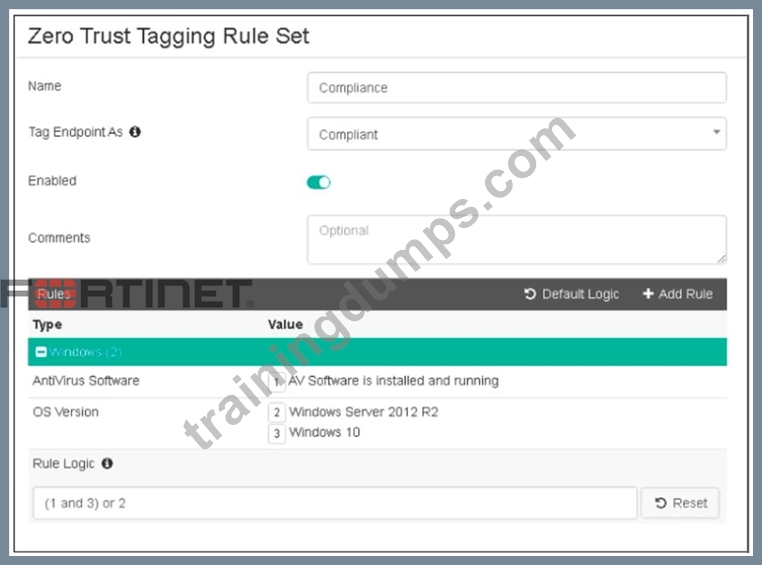
Which two statements about the rule set are true? (Choose two.)
- A. The endpoint must satisfy that only Windows 10 is running.
- B. The endpoint must satisfy that only AV software is installed and running.
- C. The endpoint must satisfy that only Windows Server 2012 R2 is running.
- D. The endpoint must satisfy that antivirus is installed and running and Windows 10 is running.
Answer: C,D
Explanation:
Based on the Zero Trust Tagging Rule Set configuration shown in the exhibit:
The rule set includes two conditions:
AV Software is installed and running
OS Version is Windows Server 2012 R2 or Windows 10
The Rule Logic is specified as "(1 and 3) or 2," meaning:
The endpoint must have antivirus software installed and running and must be running Windows 10.
Alternatively, the endpoint must be running Windows Server 2012 R2.
Therefore, the endpoint must satisfy either:
Antivirus is installed and running and Windows 10 is running.
Windows Server 2012 R2 is running.
Reference
FortiClient EMS 7.2 Study Guide, Zero Trust Tagging Rule Set Configuration Section Fortinet Documentation on Configuring Zero Trust Tagging Rules and Logic
NEW QUESTION # 58
Refer to the exhibit, which shows FortiClient EMS deployment, profiles.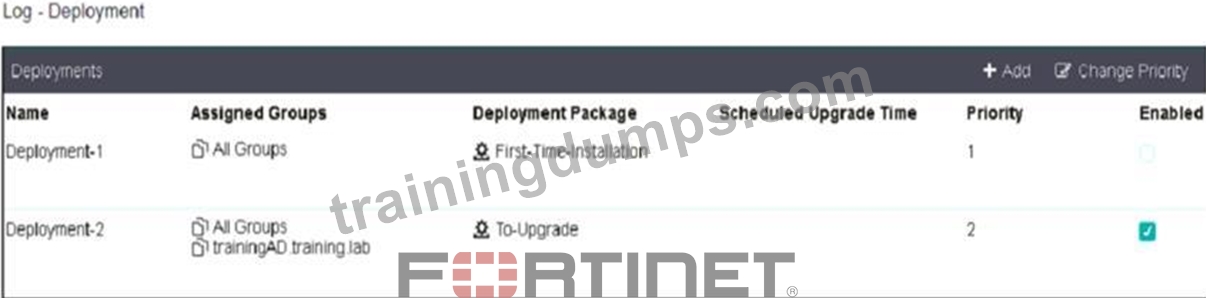
When an administrator creates a deployment profile on FortiClient EMS.
Which statement about the deployment profile is true?
- A. Deployment-2 will install FortiClient on both the AD group and workgroup.
- B. Deployment-2 will upgrade FortiClient on both the AD group and workgroup.
- C. Deployment-1 will install FortiClient on new AO group endpoints.
- D. Deployment-1 will upgrade FortiClient only on the workgroup.
Answer: B
Explanation:
Deployment Profiles Analysis:
Deployment-1 has the "First-Time-Installation" package and is assigned to "All Groups" with a priority of 1 but is not enabled.
Deployment-2 has the "To-Upgrade" package, is assigned to both "All Groups" and
"trainingAD.training.lab," with a priority of 2 and is enabled.
Evaluating Deployment-2:
Deployment-2 will upgrade FortiClient on both "All Groups" and "trainingAD.training.lab" since it is enabled and assigned to these groups. This includes both AD (Active Directory) groups and workgroups.
Conclusion:
Since Deployment-2 is set to upgrade FortiClient on all the assigned groups and workgroups, the correct answer is A.
NEW QUESTION # 59
Refer to the exhibit.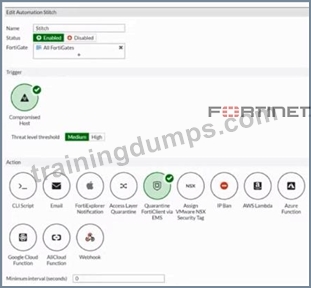
Based on the Security Fabric automation settings, what action will be taken on compromised endpoints?
- A. Endpoints will be quarantined through FortiSwitch
- B. Endpoints will be quarantined through EMS
- C. Endpoints will be banned on FortiGate
- D. An email notification will be sent for compromised endpoints
Answer: B
Explanation:
Based on the Security Fabric automation settings shown in the exhibit:
The automation stitch is configured with a trigger for a "Compromised Host." The action specified for this trigger is "Quarantine FortiClient via EMS." This indicates that when an endpoint is detected as compromised, FortiClient EMS will quarantine the endpoint as part of the automation process.
Therefore, the action taken on compromised endpoints will be to quarantine them through EMS.
Reference
FortiGate Security 7.2 Study Guide, Automation Stitches and Actions Section Fortinet Documentation on Configuring Automation Stitches and Quarantine Actions
NEW QUESTION # 60
Refer to the exhibit.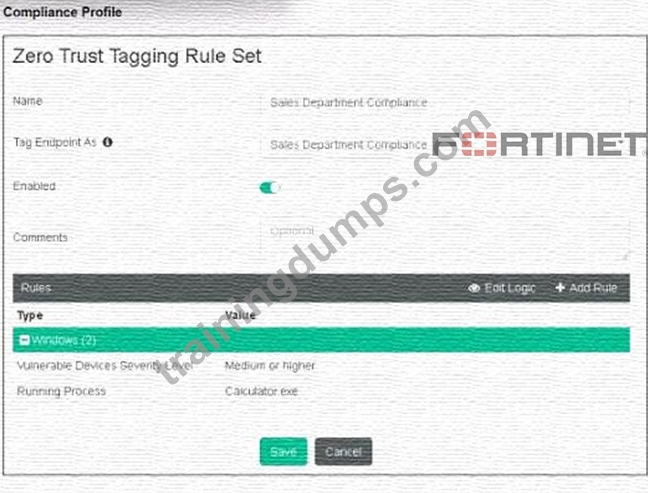
Based on the settings shown in the exhibit, which two actions must the administrator take to make the endpoint compliant? (Choose two.)
- A. Enable the web filter profile.
- B. Run Calculator application on the endpoint.
- C. Patch applications that have vulnerability rated as high or above.
- D. Integrate FortiSandbox tor infected file analysis
Answer: B,C
Explanation:
* Observation of Compliance Profile:
* The compliance profile shown in the exhibit includes rules for vulnerability severity level and running process (Calculator.exe).
* Evaluating Actions for Compliance:
* To make the endpoint compliant, the administrator needs to ensure that the vulnerability severity level is medium or higher is patched (D).
* Additionally, the Calculator.exe application must be running on the endpoint (B).
* Eliminating Incorrect Options:
* Enabling the web filter profile (A) is not related to the compliance rules shown.
* Integrating FortiSandbox (C) is not a requirement in the given compliance profile.
* Conclusion:
* The correct actions are to run the Calculator application on the endpoint (B) and patch applications with vulnerabilities rated as high or above (D).
References:
* FortiClient EMS compliance profile configuration documentation from the study guides.
NEW QUESTION # 61
Refer to the exhibit. Based on The settings shown in The exhibit, which statement about FortiClient behaviour is Hue?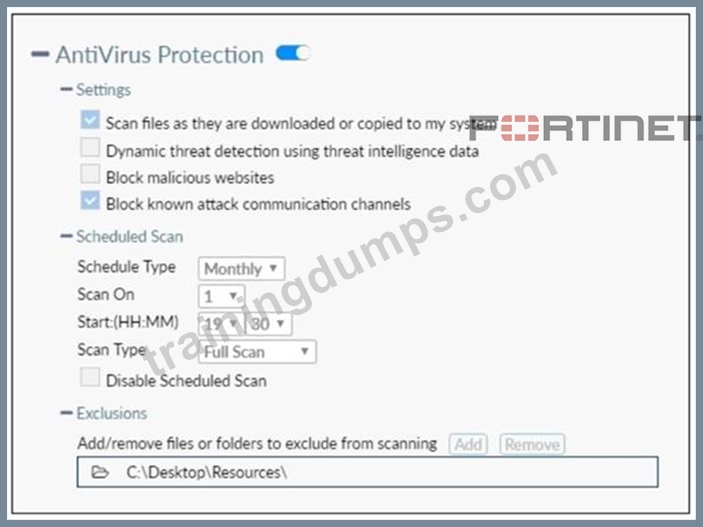
- A. FortiClient copies infected files to the Resources folder without scanning them.
- B. FortiClient quarantines infected ties and reviews later, after scanning them.
- C. FortiClient scans infected files when the user copies files to the Resources folder.
- D. FortiClient blocks and deletes infected files after scanning them.
Answer: C
Explanation:
Based on the settings shown in the exhibit, FortiClient is configured to scan files as they are downloaded or copied to the system. This means that if a user copies files to the "Resources" folder, which is not listed under exclusions, FortiClient will scan these files for infections. The exclusion path mentioned in the settings, "C:\Users\Administrator\Desktop\Resources", indicates that any files copied to this specific folder will not be scanned, but since the question implies that the "Resources" folder is not the same as the excluded path, FortiClient will indeed scan the files for infections.
NEW QUESTION # 62
An administrator needs to connect FortiClient EMS as a fabric connector to FortiGate What is the prerequisite to get FortiClient EMS lo connect to FortiGate successfully?
- A. Import and verify the FortiClient client certificate on FortiGate.
- B. Import and verify the FortiClient EMS tool CA certificate on FortiGate.
- C. Revoke and update the FortiClient EMS root CA.
- D. Revoke and update the FortiClient client certificate on EMS.
Answer: B
Explanation:
* Connecting FortiClient EMS to FortiGate:
* The administrator needs to establish a connection between FortiClient EMS and FortiGate as a fabric connector.
* Prerequisites for Connection:
* A key prerequisite is the import and verification of the FortiClient EMS tool CA certificate on FortiGate to ensure a trusted connection.
* Conclusion:
* The correct prerequisite for a successful connection is to import and verify the FortiClient EMS tool CA certificate on FortiGate.
References:
* FortiClient EMS and FortiGate connection and certificate management documentation from the study guides.
NEW QUESTION # 63
......
FCP_FCT_AD-7.2 certification dumps - Fortinet Certified Professional Network Security FCP_FCT_AD-7.2 guides - 100% valid: https://www.trainingdumps.com/FCP_FCT_AD-7.2_exam-valid-dumps.html
100% Pass Your FCP_FCT_AD-7.2 at First Attempt with TrainingDumps: https://drive.google.com/open?id=1a0mKCrB5UxOCgNj0lIYfcbBQ4inUW5nZ
