

Get Ready to Pass the NS0-528 exam with Network Appliance Latest Practice Exam
Get Prepared for Your NS0-528 Exam With Actual Network Appliance Study Guide!
Network Appliance NS0-528 Exam Syllabus Topics:
| Topic | Details |
|---|---|
| Topic 1 |
|
| Topic 2 |
|
| Topic 3 |
|
| Topic 4 |
|
| Topic 5 |
|
NEW QUESTION # 10
What is the role of data classification in a data protection solution?
- A. It helps determine the storage location of data
- B. It helps determine the backup frequency of data
- C. It helps determine the availability of data
- D. It helps determine the sensitivity of data
Answer: D
NEW QUESTION # 11
Your customer wants to create application-aware backups of their SAP HANA databases, which are running on VMware vSphere.
What two steps must be completed to create these backups? (Choose two.)
- A. Install the plug-in for VMware vSphere in SnapCenter software.
- B. Create a policy when given the retention requirements by the customer.
- C. Install the plug-in for Unix file systems.
- D. Install the plug-in for SAP HANA in SnapCenter software.
Answer: B,D
Explanation:
To create application-aware backups of SAP HANA databases:
* You must install the SnapCenter Plug-in for SAP HANA, which provides database-consistent backup and restore operations.
* You must also create a backup policy that aligns with the customer's retention requirements to manage how long backups are kept and how often they're performed.
NEW QUESTION # 12
Which product delivers application-consistent recovery across local and remote sites?
- A. OnCommand Unified Manager
- B. OnCommand System Manager
- C. SnapCenter
- D. SnapDrive
Answer: D
NEW QUESTION # 13
Your customer wants to use tamper-proof Snapshot copies on a SnapMirror destination volume only.
You successfully created a SnapMirror relationship using a SnapMirror policy that contains the following rules:
After initializing, you are able to delete a daily Snapshot copy.
Which command did you need to modify to enable the tamper-proof Snapshot copies as specified in the policy?
- A. volume modify -snapshot-locking-enabled
- B. volume snapshot modify -expiry-time
- C. volume snaplock modify -privileged-delete
- D. vserver modify -snapshot-policy
Answer: A
Explanation:
Although the SnapMirror policy includes rules for retaining Snapshot copies, the ability to make them tamper-proof (i.e., locked) depends on enabling snapshot locking on the destination volume. You must explicitly run:
volume modify -volume <vol_name> -snapshot-locking-enabled true
Without this setting, SnapMirror-created Snapshot copies can still be deleted manually. Enabling snapshot-locking ensures that retention rules (like the 5-day daily rule in your policy) are enforced and Snapshots are immutable.
NEW QUESTION # 14
Which NetApp technology would you use to physically separate non-routable SnapMirror network traffic?
- A. IPspaces
- B. broadcast domains
- C. lfgrps
- D. cluster peer encryption
Answer: A
NEW QUESTION # 15
Your disaster recovery strategy requires a mirror, an archive, and a tape backup.
Which software would you recommend for this scenario?
- A. OnCommand Unified Manager
- B. OnCommand Workflow Automation
- C. OnCommand System Manager
- D. SnapProtect
Answer: D
NEW QUESTION # 16
A customer has deployed an 8-Node Fabric MetroCluster solution.
In this scenario, what information is replicated by the Configuration Replication Service (CRS) in ONTAP 9.3? (Choose two.)
- A. user created job schedules
- B. SVM configuration
- C. disk assignments
- D. IPspaces
Answer: A,B
NEW QUESTION # 17
You have successfully deployed a primary and a secondary ONTAP cluster. You want to set up an intercluster SnapMirror relationship between your primary and secondary sites.
In this scenario, which two actions are required before accomplishing this task? (Choose two.)
- A. The primary and secondary clusters must be peered.
- B. The Snapshot schedule must be configured.
- C. The SVMs must be peered.
- D. NDMP must be enabled.
Answer: A,C
NEW QUESTION # 18
After deploying a new on-premises AFF cluster, you have been tasked with backing it up to StorageGRID. You have requested the NetApp ONTAP One licenses.
To successfully deploy this solution, what else needs to be deployed through NetApp ONTAP System Manager?
- A. NetApp SnapMirror Cloud API license
- B. NetApp BlueXP tiering
- C. NetApp Cloud Backup service
- D. NetApp BlueXP observability
Answer: A
Explanation:
To back up data from an on-premises AFF cluster to StorageGRID, you must use SnapMirror Cloud, which requires the SnapMirror Cloud API license to be deployed through ONTAP System Manager - even when using ONTAP One. This license enables integration with object storage like StorageGRID for cloud backup.
NEW QUESTION # 19
A customer that is running 100% SAN workloads wants to begin tiering cold data from their AFF ONTAP-based systems using a FabricPool.
Using NetApp best practices, what should be configured to accomplish this task?
- A. Azure cool Blob storage
- B. NetApp Element
- C. Amazon S3 Glacier
- D. NetApp StorageGRID
Answer: A,D
NEW QUESTION # 20
You asked a colleague tocreate a new SnapMirror replication relationship of type "Vault" between two SVMs on separate clusters. You want to verify that the SVMs are healthy and updating on a particular schedule.
What are two ways to accomplish this task? (Choose two.)
- A. Use OnCommand System Manager on the destination cluster for verification.
- B. Use the ONTAP CLI on the destination cluster and issue the snapmirror show Cfields healthy, schedule command.
- C. Use the ONTAP CLI on the source cluster and issue the snapmirror show Cfields healthy, schedule command.
- D. Use OnCommand System Manager on the source cluster for verification.
Answer: C,D
NEW QUESTION # 21
What are two reasons why the status of the SnapMirror relationship is showing ~Healthy: false~? (Choose two.)
- A. A manual update has failed.
- B. It has missed a scheduled transfer.
- C. The lag time has exceeded the threshold.
- D. A transfer operation is in progress.
Answer: A,B
NEW QUESTION # 22
Before issuing a MetroCluster disaster-recovery switchback, you must execute the MetroCluster ~heal~ command on the data and root aggregates.
In this scenario, what happens when issuing the ~metrocluster heal -phase root-aggregates~ command?
- A. This command heals root aggregates by resynchronizing the mirrored plexes.
- B. The MetroCluster ~heal~ command is issued on only data aggregates.
- C. This command heals root aggregates by switching them back to the failed site and allowing the site to boot up.
- D. The MetroCluster ~heal~ command resynchronizes all aggregates with mirrored plexes.
Answer: C
NEW QUESTION # 23
A customer wants to upgrade to ONTAP 9.7P3 from their current version running on their AFF All SAN Array A220. This upgrade must be completed non-disruptively.
In this scenario, which statement is correct?
- A. Plug in the HA cabling and mirror the NVRAM, then carry out the upgrade.
- B. Migrate the LIFs and use the ~vol move~ command, then carry out the upgrade.
- C. The upgrade process is non-disruptive, no further action is required.
- D. Shut down access to all the volumes, then carry out the upgrade.
Answer: C
NEW QUESTION # 24
What is a cloud tiering policy in NetApp ONTAP?
- A. A set of rules for optimizing data access
- B. A set of rules for encrypting data to protect it from unauthorized access
- C. A set of rules for moving data between on-premises and cloud storage
- D. A set of rules for compressing data to reduce storage space
Answer: C
NEW QUESTION # 25
A company has a 4-node FAS9000 fabric MetroCluster cluster separated by 101 km. Site A has an unmirrored HDD aggregate. An FC-VI card fails in one of the nodes in site A and a switchover occurs.
Which statement is correct in this scenario?
- A. The distance is not supported.
- B. Only SSD aggregates are accessible.
- C. The aggregateis accessible using Site A's surviving node.
- D. The aggregate is accessible using Site B's cluster.
Answer: D
NEW QUESTION # 26
A customer wants to enable tamper-proof Snapshot copies on volume LockingVolume, which is hosted on SVM LockingSVM. They have created the Snapshot policy, including the required retention set. However, when they apply the policy to a volume, the Snapshot copies are not locked.
Which command must the customer issue before tamper-proof Snapshot copies can be enabled?
- A. snaplock compliance-clock initialize -node *
- B. volume modify -volume LockingVolume -anti-ransomware-state enable
- C. snaplock event-retention apply -vserver LockingSVM
- D. volume modify -volume LockingVolume -snapdir-access false
Answer: A
Explanation:
To enable tamper-proof (locked) Snapshot copies using SnapLock, the SnapLock Compliance Clock must be initialized on all nodes in the cluster. Without initializing this clock, locked Snapshots cannot be created, even if the policy and retention settings are configured.
NEW QUESTION # 27
What is SVM-DR in NetApp ONTAP?
- A. A method for compressing data to reduce storage space
- B. A method for encrypting data to protect it from unauthorized access
- C. A method for optimizing data access
- D. A solution for replicating data between SVMs within the same cluster or between clusters
Answer: D
NEW QUESTION # 28
You want to set up SnapLock to meet regulatory requirements and to help safeguard the authenticity of the archived data.
In this scenario, which two statements are correct? (Choose two.)
- A. A SnapLock license is deployed at a cluster level and not required for every node.
- B. SnapLock Compliance and SnapLock Enterprise use different licenses to enable SnapLock functionality.
- C. Only a single SnapLock license is required to use both SnapLock Compliance and SnapLock Enterprise functionality.
- D. All nodes in a cluster must have the SnapLock license for the cluster to be compliant.
Answer: C,D
NEW QUESTION # 29
Exhibit: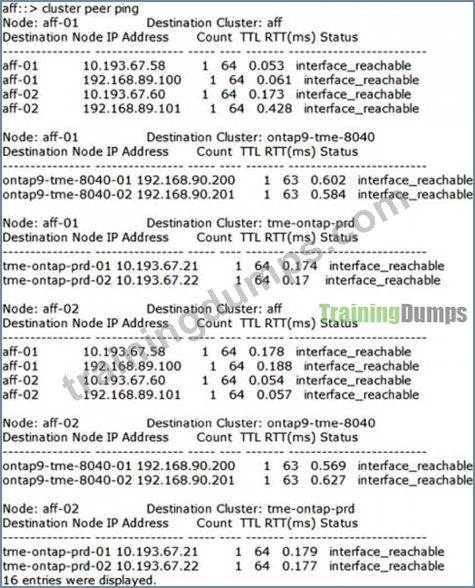
You are asked to set up a SnapMirror relationship to protect some Oracle DB volumes on both nodes of the aff-01 and aff-02 clusters. You are using the 1 Gb network and the other nodes all have free space to support the mirror.
Referring to the exhibit, which two nodes would provide the least network transfer time for the relationship? (Choose two.)
- A. aff-02 to ontap9-tme-8040-01
- B. aff-01 to tme-ontap-prd-01
- C. aff-02 to tme-ontap-prd-02
- D. aff-02 to ontap9-tme-8040-02
Answer: C,D
NEW QUESTION # 30
......
Pass Your Next NS0-528 Certification Exam Easily & Hassle Free: https://www.trainingdumps.com/NS0-528_exam-valid-dumps.html
Free Network Appliance NS0-528 Exam Question Practice Exams: https://drive.google.com/open?id=1eSb5pVY8vlZxEVNeel2pRQGMD_oT8eRC
