

Civil-Engineering-Technology Exam Dumps - Try Best Civil-Engineering-Technology Exam Questions from Training Expert TrainingDumps
Practice Examples and Dumps & Tips for 2026 Latest Civil-Engineering-Technology Valid Tests Dumps
NEW QUESTION # 32
According to Occupational Health and Safety legislation, who is responsible for safety in the workplace?
- A. Employees and employers
- B. Supervisors and employers
- C. Employees
- D. Employees and supervisors
Answer: A
Explanation:
Workplace safety is ashared responsibilityframework: employers must establish systems, provide training, supervision, and hazard controls, while employees must follow procedures, use PPE, and work safely. Safety manuals used on construction projects reflect this shared-duty approach by requiring employer-provided programs and controls and worker compliance and participation. For example, project safety planning requires hazard identification, training, PPE compliance, and exposure monitoring processes-elements that depend on both management implementation and worker adherence. In multi-employer construction environments, prime contractors coordinate compliance, but this does not eliminate the duties of employers and workers; rather, responsibilities are distributed across roles. Therefore, among the options, the most accurate statement aligned with typical OHS legislative principles is thatemployees and employersare responsible for safety in the workplace.
NEW QUESTION # 33
A 500 mm diameter corrugated steel culvert conveys storm water under a road. The inlet end projects from the road embankment fill. How much flow (m³/s) can the culvert handle before the headwater depth is greater than the culvert diameter?
- A. 2.0 m³/s
- B. 200 m³/s
- C. 20 m³/s
- D. 0.2 m³/s
Answer: D
Explanation:
For a projecting inlet, the controlling condition is typicallyinlet controlat relatively low headwater ratios.
Using the FHWA/HDS-5 style inlet-control nomographs reproduced in the Minnesota DOT Drainage Manual (Chart 2: "Headwater depth for C.M. pipe culverts with inlet control"), a corrugated metal pipe (CMP) with a diameter near500 mm (# 20 in.)and aprojectingentrance type corresponds to a discharge on the order of~7 cfs whenHW/D # 1.0(headwater approximately equal to the culvert diameter). Converting 7 cfs to SI givesm³/s.
This magnitude is consistent with the inlet-control relationship that headwater increases with discharge for a given culvert diameter and entrance configuration, and that small culverts (0.5 m) carry flows measured in tenths of m³/s, not multiple m³/s at HW/D # 1.
NEW QUESTION # 34
What would be the best step for an engineering team to propose to a client when reviewing a concept before a project is initiated?
- A. Preliminary design
- B. Detailed design
- C. Life cycle cost analysis
- D. Feasibility study
Answer: D
Explanation:
Before a project is initiated, the essential decision is whether the concept isviable-technically, economically, and in terms of risks, constraints, and stakeholder needs. Afeasibility studyis the recognized pre-initiation step that evaluates alternatives at a high level, confirms the problem/need, examines constraints, and establishes whether moving into design is justified. In civil engineering systems development, feasibility is treated as an early stage that precedes planning and detailed design, with early cost and uncertainty considerations explicitly tied to the feasibility stage. Life cycle cost analysis is valuable, but it is typically one component used within feasibility/planning decisions rather than the primary "best step" to propose before initiation. Preliminary and detailed design occur after feasibility confirms the concept should proceed.
Therefore, the best step to propose at concept review before initiation is afeasibility study.
NEW QUESTION # 35
A civil engineering technologist is completing quality control for a municipal design. When checking design calculations, the technologist notices errors in the design and final design drawings made by a senior structural engineer. The technologist suspects that the errors may result in the failure of a suspended slab/roof car parking area. What should be the primary consideration in this situation?
- A. Responsibility for professional assignments is undertaken only after sufficient training and experience has been obtained.
- B. Conflict of interest should be disclosed to the client.
- C. Safety, health, and welfare of the public are of most importance.
- D. Experience of a senior structural engineer should be considered.
Answer: C
Explanation:
Engineering ethics and professional duty prioritizepublic protectionover hierarchy, convenience, or reputational concerns. Civil engineering ethics guidance explicitly states that engineers shallhold paramount the safety, health, and welfare of the public, and that when professional judgment is overruled under circumstances endangering public welfare, the engineer is expected to notify the client or appropriate authority. This principle is repeated in civil engineering professional canons (e.g., ASCE Fundamental Canon
1) and is treated as the primary criterion even when it conflicts with other pressures. In this scenario, suspected structural failure risk for a public parking slab/roof is a direct life-safety concern; therefore the technologist's primary consideration must be ensuring the issue is elevated and addressed to prevent unsafe construction or operation. Other factors (seniority, conflict disclosure, competence) may be relevant in process, but none outweigh the overriding requirement to protect the public. Hence,Option Cis correct.
NEW QUESTION # 36
A civil engineering technologist asked an engineer in training (EIT) to write a deficiency report. After a few revisions, the report is still disorganized and has errors. What would be an appropriate action to take for the technologist?
- A. Assist the EIT in re-writing the report.
- B. Explain to the EIT the importance of meeting deadlines.
- C. Report the EIT to the supervisor and recommend training.
- D. Complete the document on behalf of the EIT.
Answer: A
Explanation:
Deficiency reports are project records that must be clear, accurate, and professionally defensible because they can affect acceptance, payment, corrective work, and potential disputes. When an EIT's report remains disorganized after multiple revisions, the appropriate next step is active coaching to bring the document to an acceptable standard while building the EIT's competence. Civil engineering practice emphasizes truthful, objective professional reporting founded on adequate knowledge and careful documentation. In construction- phase administration, effective project performance depends on frequent communication and monitoring, and the quality of project documentation directly supports decisions and follow-up actions. Assisting the EIT in rewriting preserves accountability (the EIT learns and improves), strengthens the quality of the final record, and supports timely resolution of deficiencies without escalating prematurely. Simply finishing the document on their behalf removes the learning opportunity and can mask competency gaps; reporting them immediately to a supervisor is disproportionate when a direct corrective mentorship step is available. Therefore, the technologist shouldassist the EIT in re-writing the report.
NEW QUESTION # 37
A civil engineering technologist has been asked to check the following foundation plan drawing. How many different sizes of concrete piles are required in this project?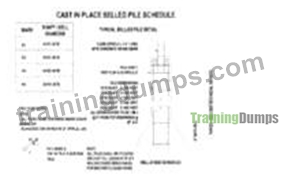
- A. Two
- B. One
- C. Three
- D. Four
Answer: D
Explanation:
Pile sizing on a foundation plan is determined by thepile schedule/legendand callouts that specify different pile types or diameters (and sometimes lengths/capacities) used in different locations to suit varying loads or subsurface conditions. Reviewing a foundation plan for "how many pile sizes" means identifying the distinct pile designations listed in the schedule (e.g., P1, P2, P3, P4), each corresponding to a different concrete pile size/specification. Engineering drawing practice requires reading the schedule and matching symbols/marks to their definitions to count unique sizes, not simply counting total piles on the plan. In the provided drawing, the pile schedule indicatesfourdistinct pile sizes/designations, so the project requiresfourdifferent sizes of concrete piles.
NEW QUESTION # 38
For a land development project to be initiated, which of the following documents must be submitted to the municipality for approval?
- A. Transportation network analysis
- B. Area Structure Plan
- C. Historical resources overview
- D. Neighbourhood Structure Plan
Answer: D
Explanation:
Municipal land development commonly requires an approvedstatutory planthat establishes the framework for land use, servicing, staging, and transportation within the development area before detailed subdivision
/engineering can proceed. In many Alberta municipalities (e.g., Edmonton), aNeighbourhood Structure Plan (NSP)is the statutory neighbourhood-level plan used to initiate and guide new neighbourhood development, and municipal documents describe NSPs as beinginitiated by landowners/developersand prepared in cooperation with municipal administration for council consideration/approval. While Area Structure Plans (ASPs) can also be used in some contexts, the document explicitly associated with initiating a new neighbourhood-level land development project in the referenced municipal framework is theNeighbourhood Structure Plan. A historical resources overview and transportation network analysis may be required supporting studies, but they are not the primary statutory plan used to initiate the development. Therefore, the correct answer isNeighbourhood Structure Plan.
NEW QUESTION # 39
Concrete thrust block measures 0.6 m by X m in the diagram. If the test pressure is 1034 kPa and the bearing pressure of the soil is 239 kPa, what is the minimum value of X?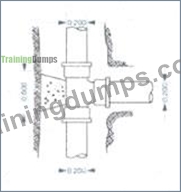
- A. 0.226 m
- B. 0.030 m
- C. 0.304 m
- D. 0.136 m
Answer: A
Explanation:
Thrust blocks resist unbalanced pressure forces at fittings (tees/bends/caps) by mobilizing bearing against undisturbed soil. The basic thrust relationship isForce = Pressure × Areaacting on the pipe's internal cross- sectional area. DIPRA's thrust restraint guide states that internal hydrostatic pressure acts on any plane with a force equal toP times A.
From the diagram, the pipe diameter is0.200 m, so pipe area. Thrust. Required soil bearing area. Given block face area, solve. Thus the minimumis0.226 m (Option C).
NEW QUESTION # 40
What type of concrete structural element is shown in the image below?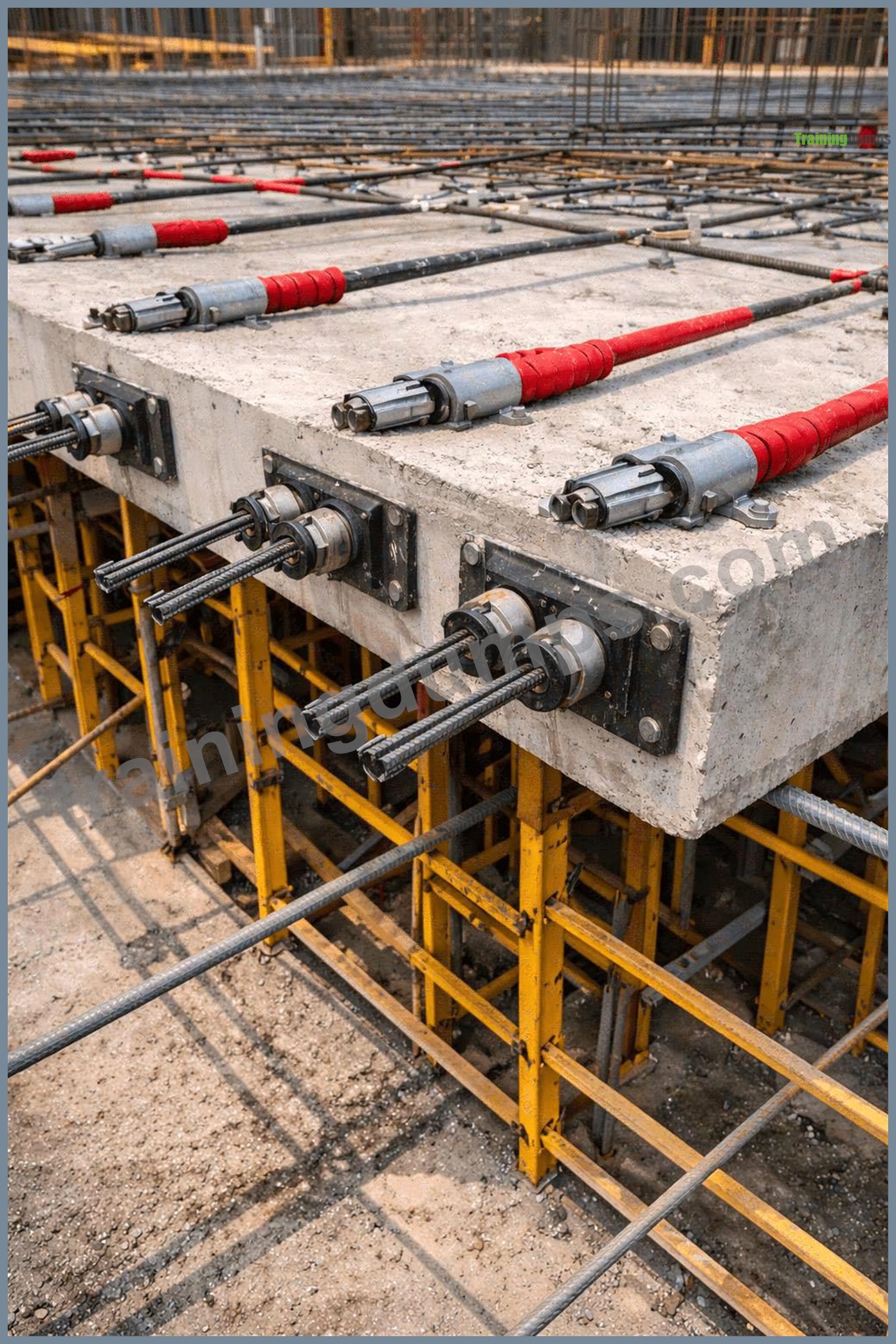
- A. Post-tensioned
- B. Precast
- C. Prestressed
- D. Cast in place
Answer: A
NEW QUESTION # 41
A cologist is required to inspect the installation of a sanitary service pipe to confirm the slope. The technologist measures an elevation of 705.667 at the end of the service and 705.202 at the main. The horizontal measurement from the main to the end of the service is 22.10 m. What is the slope of the pipe?
- A. 2.5%
- B. 2.0%
- C. 2.1%
- D. 1.5%
Answer: C
Explanation:
Pipe slope is computed asrise (or fall) divided by run, expressed as a percent:
This matches standard civil engineering definitions of grade/slope as elevation change over horizontal distance.
Here, the elevation drop from the service end to the ma5.202 =0.465 m.
Horizontal distance (run) =22.10 m.
Slope = 0.465 / 22.10 = 0.02104 =2.104%, which rounds to2.1%.
This calculation reflects standard practice used in roadway and pipeline work for checking grades, confirming that installed utilities meet design slopes for gravity flow. The answer choice that matches the computed slope is2.1% (Option C).
NEW QUESTION # 42
The road cross sections shown have chainage (CH) 1+100 and 1+200. What is the volume of sub-grade material if an averaging method is applied?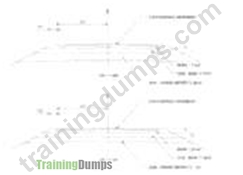
- A. 850 m³
- B. 425 m³
- C. 131 m³
- D. 213 m³
Answer: D
Explanation:
The averaging method for earthworks between two stations is theAverage End Areamethod:
whereandare the end areas at the two cross sections andis the station spacing. Here, CH 1+100 to 1+200 givesm. From the cross-section labels in the figure, the two sub-grade areas sum to4.26 m²(e.g., approximately 1.31 m² and 2.95 m²), so the average area ism². Multiply by length:m³. This is the standard approach used for roadway cut/fill and subgrade volume computations between surveyed sections.
NEW QUESTION # 43
A project manager is aware of a faulty fall protection railing. The safety issue is reported but not remedied or documented. In the event of an incident, what is the maximum penalty for the first offence under the Occupational Health and Safety Act?
- A. Imprisonment of not less than five years
- B. Loss of business licence
- C. Loss of position and/or five years' imprisonment
- D. $500,000 fine and/or six months' imprisonment
Answer: D
Explanation:
Under Alberta's Occupational Health and Safety (OHS) legislation, enforcement includes significant penalties for contraventions, especially where hazards like fall protection are involved and an incident occurs. Alberta's official guidance on convictions under OHS legislation states that for afirst offenceunder the OHS Act, fines can beup to $500,000and/orup to 6 months in prisonper violation (with additional daily fines possible if the offence continues). This directly matches the option describing a$500,000 fine and/or six months' imprisonment. The other options (loss of business licence, mandatory five-year imprisonment, etc.) are not the stated maximum first-offence penalty in the cited OHS information. Therefore, the correct maximum penalty for the first offence isOption C.
NEW QUESTION # 44
A civil engineering technologist is installing offset stakes for centreline at 25-metre stations. What information is typically found on the stakes?
- A. Centreline elevation and offset distance
- B. Depth of ditch and offset to top of cut
- C. Top of cut and offset to ditch
- D. Sub-grade elevation and depth of the ditch
Answer: A
Explanation:
Offset stakes are used to carry alignment control when the true centreline point is impractical to occupy (e.g., within excavation, traffic, or unstable ground). Standard field staking practice marks the station and identifies theoffset distanceto the actual centreline so crews can pull the correct perpendicular distance back to the design line. Because construction also needs grade control, the stake commonly includes thecentreline elevation (or cut/fill to grade)at that station to guide grading or excavation. Surveying and construction layout practice emphasize that stakes should communicate the essential geometry:wherethe design line is (by station and offset) andwhat elevation/gradeapplies at that location. Options involving ditch depth or top-of- cut are specific to slope/ditch staking rather than centreline offset stakes. Therefore, the typical information on centreline offset stakes iscentreline elevation and offset distance.
NEW QUESTION # 45
Which of the following situations would cause the most serious delay on a project?
- A. A gas service line to a residence was hit, causing the line to rupture.
- B. A severe storm flooded a trench before it could be backfilled.
- C. A worker suffered a broken arm on the work site.
- D. Several bones, ranging in size from 10 cm to 60 cm, were found during excavation operations.
Answer: D
Explanation:
Unexpected discovery ofhuman remains/burials(or suspected remains) during excavation can trigger immediate legal and procedural requirements that typically halt work in the affected area. Environmental and regulatory guidance for construction sites commonly instructs contractors tostop workand notify appropriate authorities (e.g., police/coroner and archaeological authorities) when human skeletal remains are found. This can lead to investigations, permitting/licensing, archaeological excavation, and documentation, all of which may significantly disrupt sequencing and access and can extend for days to months depending on findings and jurisdictional requirements. In contrast, a single non-fatal injury, a flooded trench, or a ruptured gas service line can be serious and may cause delays, but they are often addressed through emergency response and repair
/restoration measures within defined operational procedures. Because discoveries of bones/remains can impose mandatory stoppages and third-party involvement before work can resume, they are typically among the most serious schedule impacts.
NEW QUESTION # 46
A civil engineering technologist is designing a sanitary collection system that is being constructed below the groundwater table. The owner requested that the system be pressure tested in order to minimize the infiltration into the collection system. Which of the following would be a major design consideration for the collection system?
- A. Pipe diameter
- B. Pipe material
- C. Manhole material
- D. Manhole type
Answer: D
Explanation:
When sanitary infrastructure is installedbelow the groundwater table, a primary risk isinfiltration- groundwater entering the system through joints, defects, and especiallyappurtenances. Even if pipe joints are specified as watertight and pipes can pass leakage testing, manholes are frequent infiltration pathways due to multiple penetrations (service connections), interfaces (frame-to-cone), and exposure to groundwater head.
Civil engineering references identify infiltration/inflow sources that include "holes in manhole covers" and other manhole-related entry paths, highlighting that manholes are critical control points in sanitary systems.
Therefore, a major design consideration-particularly whessure/leakage testing to reduce infiltration-is specifying awatertight manhole type(e.g., gasketed/booted connections, sealed sections, appropriate access components) suitable for submerged conditions. Pipe diameter primarily affects hydraulic capacity, and
"manhole material" alone does not fully address leakage performance unless paired with watertight design features. The best answer ismanhole type.
NEW QUESTION # 47
......
Latest 100% Passing Guarantee - Brilliant Civil-Engineering-Technology Exam Questions PDF: https://www.trainingdumps.com/Civil-Engineering-Technology_exam-valid-dumps.html
Civil-Engineering-Technology Certification – Valid Exam Dumps Questions Study Guide: https://drive.google.com/open?id=1q8-uqR7V2bzZT7m24isrl78OfLT-cGvF
