

Ace Fortinet FCSS_SDW_AR-7.4 Certification with Actual Questions Jun 14, 2026 Updated
2026 The Most Effective FCSS_SDW_AR-7.4 with 75 Questions Answers
NEW QUESTION # 33
The SD-WAN overlay template helps to prepare SD-WAN deployments. To complete the tasks performed by the SD-WAN overlay template, the administrator must perform some post-run tasks.
What are three mandatory post-run tasks that must be performed? (Choose three.)
- A. Assign an sdwan_id metadata variable to each device (branch and hub).
- B. Configure routing through overlay tunnels created by the SD-WAN overlay template.
- C. Assign a branch_id metadata variable to each branch device.
- D. Configure SD-WAN rules.
- E. Create policy packages for branch devices.
Answer: B,C,D
NEW QUESTION # 34
When you use the command diagnose sys session list, how do you identify the sessions that correspond to traffic steered according to SD-WAN rules?
- A. You identify sessions steered according to SD-WAN rules with the data sdwan_service_id.
- B. You cannot identify SD-WAN sessions. You must use the sdwar. session filter.
- C. You identify sessions steered according to SD-WAN rules with the data vwl_mbr_seq.
- D. You identify sessions steered according to SD-WAN rules with the flag vwl.
Answer: A
Explanation:
The sdwan_service_id field in the output of diagnose sys session list indicates that the session was selected based on an SD-WAN rule, allowing administrators to trace which SD-WAN service (rule) steered the traffic.
NEW QUESTION # 35
When a customer delegate the installation and management of its SD-WAN infrastructure to an MSSP, the MSSP usually keeps the hub within its infrastructure for ease of management and to share costly resources.
In which two situations will the MSSP install the hub in customer premises? (Choose two.)
- A. The customer requires SIA with centralized breakout.
- B. The customer expects a large amount of VoIP traffic.
- C. The administrator expects a large volume of traffic between the branches.
- D. The majority of the branch traffic is directed to a corporate data center.
Answer: C,D
Explanation:
A large volume of inter-branch traffic benefits from a local hub to avoid backhauling and reduce latency.
If most traffic is destined for a corporate data center, placing the hub on-premises ensures efficient routing and improved performance.
NEW QUESTION # 36
Refer to the exhibit.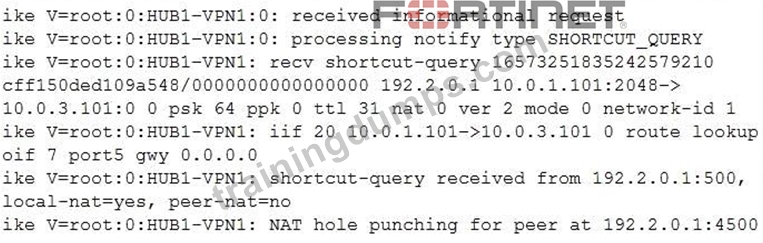
Which statement best describe the role of the ADVPN device in handling traffic?
- A. This is a hub that has received a shortcut query from a spoke and has forwarded it to another spoke.
- B. This is a spoke that has received a shortcut query from a remote hub.
- C. This is a spoke that has received a direct shortcut query from a remote spoke.
- D. This is a hub, and two spokes, 192.2.0.1 and 10.0.3.101, establish a shortcut.
Answer: D
Explanation:
The log shows messages on HUB1-VPN1 where the device processes a SHORTCUT_QUERY and performs NAT hole punching (peer at 192.2.0.1:4500). This indicates that the device is acting as a hub, helping two spokes (192.2.0.1 and 10.0.3.101) establish a direct ADVPN shortcut tunnel between each other, instead of routing their traffic through the hub.
NEW QUESTION # 37
Your FortiGate is in production. To optimize WAN link use and improve redundancy, you enable and configure SD-WAN.
What must you do as part of this configuration update process?
- A. Purchase and install the SD-WAN license, and reboot the FortiGate device.
- B. Replace references to interfaces used as SD-WAN members in the firewall policies.
- C. Replace references to interfaces used as SD-WAN members in the routing configuration.
- D. Disable the interface that you want to use as an SD-WAN member.
Answer: C
Explanation:
When you enable SD-WAN and add interfaces as SD-WAN members, those interfaces are no longer referenced directly in routing. You must replace routing configuration references (e.g., static routes, policy routes) with the SD-WAN zone. Firewall policies, however, can still point to the SD-WAN zone without requiring replacement of individual member interfaces.
NEW QUESTION # 38
Refer to the exhibits. The exhibits show the source NAT (SNAT) global setting. port2 interface settings, and the routing table on FortiGate.
The administrator increases the member priority on port2 to 20. Upon configuration changes and the receipt of new packets, which two actions does FortiGate perform on existing sessions established over port2? (Choose two.)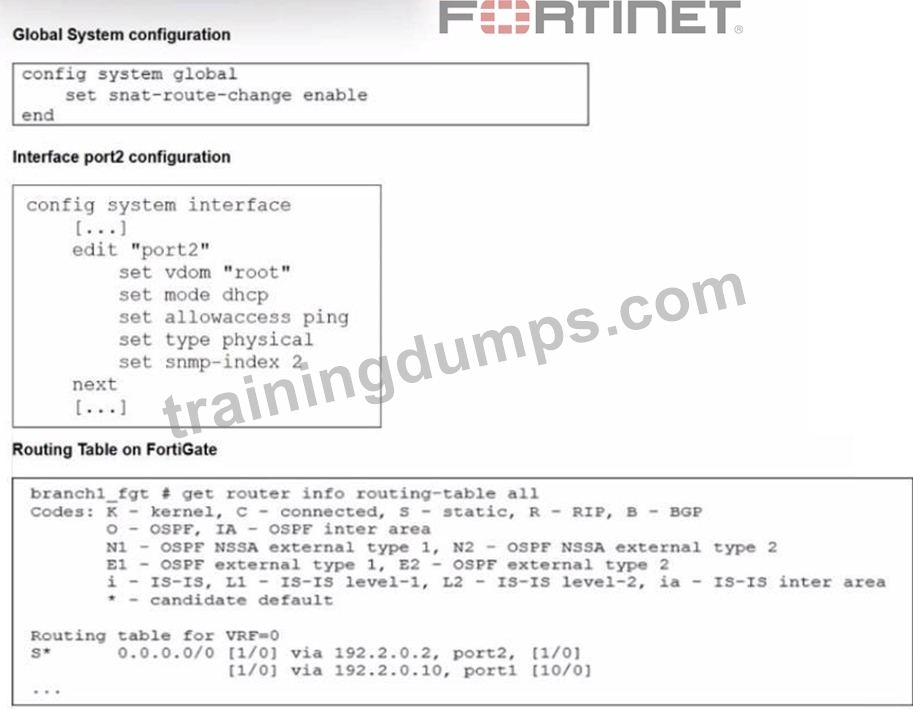
- A. FortiGate routes only new sessions over port2.
- B. FortiGate flags the SNAT session as dirty only if the administrator has assigned an IP pool to the firewall policies with NAT.
- C. FortiGate flags the sessions as dirty.
- D. FortiGate continues routing all existing sessions over port2.
- E. FortiGate updates the gateway information of the sessions with SNAT so that they use port1 instead of port2.
Answer: C,E
NEW QUESTION # 39
An SD-WAN member is no longer used to steer SD-WAN traffic. The administrator updated the SD-WAN configuration and deleted the unused member. After the configuration update, users report that some destinations are unreachable. You confirm that the affected flow does not match an SD-WAN rule.
What could be a possible cause of the traffic interruption?
- A. FortiGate administratively brings down interfaces when they are removed from the SD-WAN configuration.
- B. FortiGate, with SD-WAN enabled, cannot route traffic through interfaces that are not SD-WAN members.
- C. FortiGate removes the layer 3 settings for interfaces that are removed from the SD-WAN configuration.
- D. FortiGate can remove some static routes associated with an interface when the member is removed from SD-WAN.
Answer: D
Explanation:
When an SD-WAN member is deleted, FortiGate can also remove static routes that were tied to that interface.
If those routes are needed for destinations not covered by SD-WAN rules, traffic to those networks becomes unreachable. This explains why flows not matching SD-WAN rules are interrupted after the member was removed.
NEW QUESTION # 40
The FortiGate devices are managed by ForliManager, and are configured for direct internet access (DIA). You confirm that DIA is working as expected for each branch, and check the SD- WAN zone configuration and firewall policies shown in the exhibits.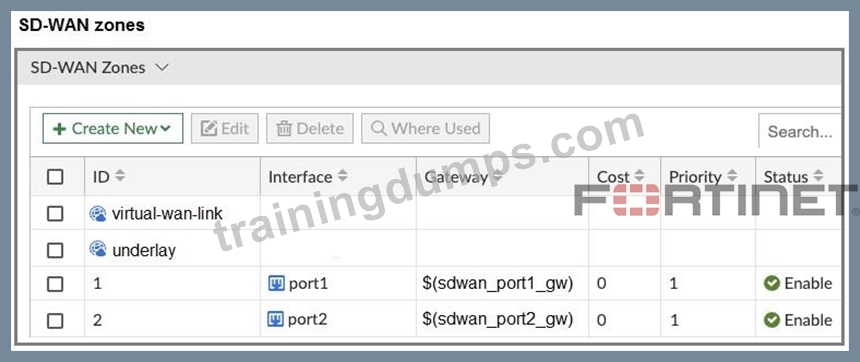

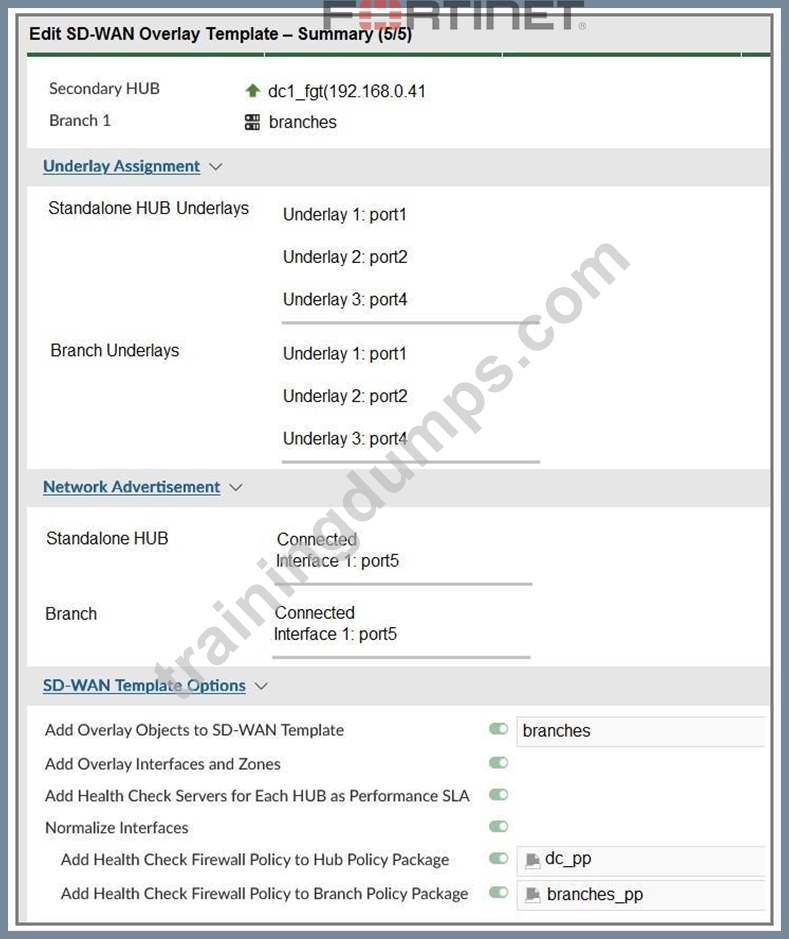
Then, you use the SD-WAN overlay template to configure the IPsec overlay tunnels. You create the associated SD-WAN rules to connect existing branches to the company hub device and apply the changes on the branches.
After those changes, users complain that they lost internet access. DIA is no longer working.
Based on the exhibit, which statement best describes the possible root cause of this issue?
- A. The SD-WAN overlay template redefines the interface gateway addresses if they are defined with metadata variables.
- B. The SD-WAN overlay template updates the SD-WAN template and the rules.
- C. The SD-WAN overlay template defines a zone for each underlay interface and moves the interfaces into those zones.
- D. The SD-WAN overlay template didn't configure a firewall policy to allow traffic through the overlay.
Answer: C
Explanation:
The SD-WAN overlay template defines a zone for each underlay interface and moves the interfaces into those zones. This statement perfectly describes the likely sequence of events. The template, when applied, re-organizes the interfaces and zones, causing the existing firewall policy that relies on the old zone configuration to fail. This is the most plausible root cause.
NEW QUESTION # 41
Refer to the exhibit.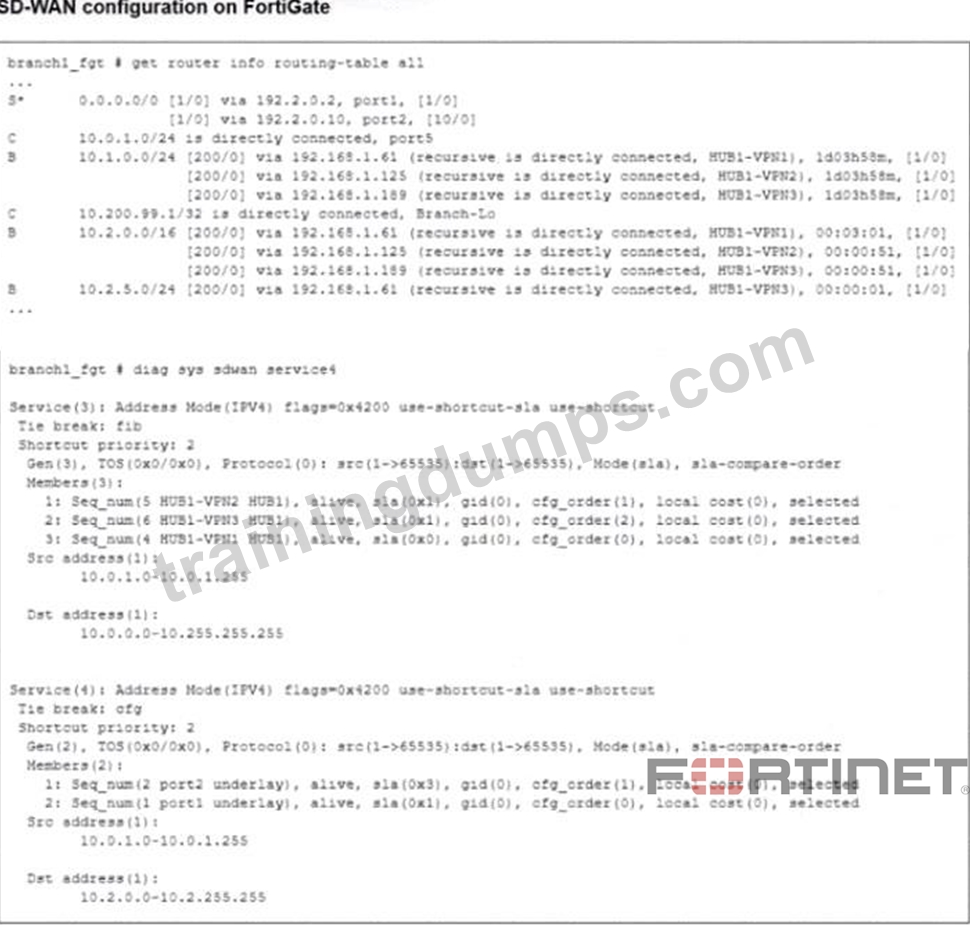
Which SD-WAN rule and interface uses FortiGate to steer the traffic from the LAN subnet 10.0.1.0/24 to the corporate server 10.2.5.254?
- A. SD-WAN service rule 3 and interface HUB1-VPN2.
- B. SD-WAN service rule 3 and interface HUB1-VPN3.
- C. SD-WAN service rule 4 and port1 or port2.
- D. SD-WAN service rule 4 and interface port2.
Answer: D
Explanation:
Traffic steering in Fortinet SD-WAN is based on defined rules and the corresponding outgoing interfaces. The exhibit (not shown here) would indicate that the traffic from the LAN subnet 10.0.1.0/24 to the server
10.2.5.254 is matched by SD-WAN rule 3 and sent out via the HUB1-VPN3 interface.
References:
[FCSS_SDW_AR-7.4 1-0.docx Q2]
FortiOS 7.4 SD-WAN Concept Guide - Rule Matching
NEW QUESTION # 42
Refer to the exhibits. The exhibits show two IPsec templates to define Branch IPsec 1 and Branch_IPsec_2. Each template defines a VPN tunnel. The error message that FortiManager displayed when the administrator tried to assign the second template to the FortiGate device is also shown. Which statement best describes the cause of the issue?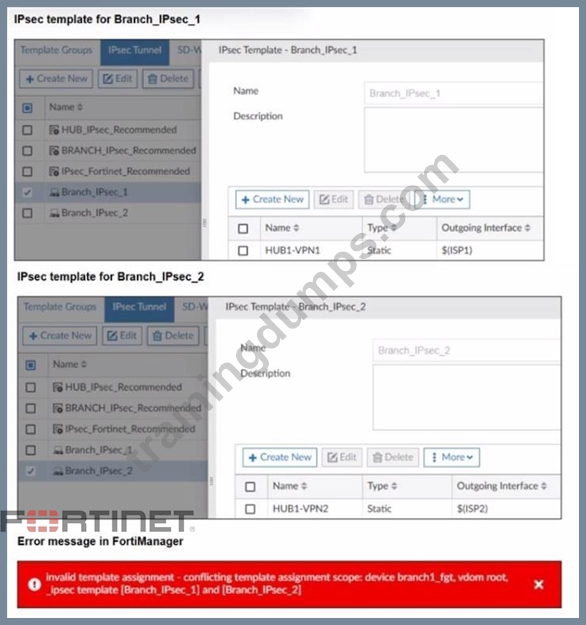
- A. You should use the same outgoing interface of both templates.
- B. You should review the branch1_fgt configuration for configured tunnels in the rootVDOM.
- C. You can assign only one IPsec template to each FortiGate device.
- D. You can assign only one template with a tunnel type of static to each FortiGate device.
Answer: C
NEW QUESTION # 43
Which three characteristics apply to provisioning templates available on FortiManager? (Choose three.)
- A. A template group can include a system template and an SD-WAN template.
- B. A CLI template group can contain CLI templates of both types.
- C. A CLI template can be of type CLI script or Perl script.
- D. CLI templates are applied in order, from top to bottom
- E. Each template group can contain up to three IPsec tunnel templates.
Answer: A,B,D
NEW QUESTION # 44
Refer to the exhibit.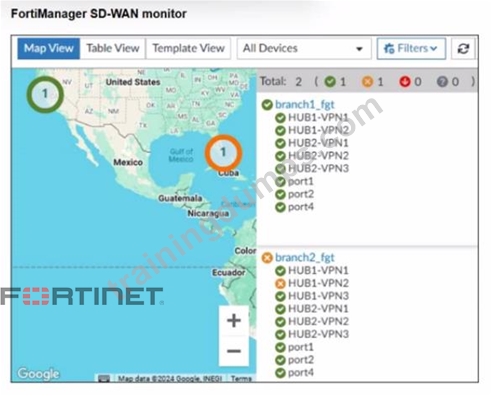
An administrator checks the status of an SD-WAN topology using the FortiManager SD-WAN monitor menus. All members are configured with one or two SLAs.
Which two conclusions can you draw from the output shown? (Choose two.)
- A. This SD-WAN topology contains only two branch devices.
- B. One member of branch2_fgt is missing the SLAs.
- C. branch2_fgt establishes six tunnels to the hubs and they are all up.
- D. The template view should be used to see the hub devices.
Answer: A,B
NEW QUESTION # 45
You are tasked with configuring ADVPN 2.0 on an SD-WAN topology already configured for ADVPN. What should you do to implement ADVPN 2.0 in this scenario?
- A. Update the IPsec tunnel configuration on the branches.
- B. Update the IPsec tunnel configurations on the hub.
- C. Update the SD-WAN configuration on the branches.
- D. Delete the existing ADVPN configuration and configure ADVPN 2.0.
Answer: C
NEW QUESTION # 46
You are tasked with configuring ADVPN 2.0 on an SD-WAN topology already configured for ADVPN. What should you do to implement ADVPN 2.0 in this scenario?
- A. Update the IPsec tunnel configuration on the branches.
- B. Update the IPsec tunnel configurations on the hub.
- C. Delete the existing ADVPN configuration and configure ADVPN 2.0.
- D. Update the SD-WAN configuration on the branches.
Answer: B
Explanation:
To implement ADVPN 2.0 on an existing ADVPN topology, you only need to update the IPsec tunnel configuration on the hub to support the enhanced capabilities. Branch configurations remain unchanged.
NEW QUESTION # 47
Refer to the exhibits.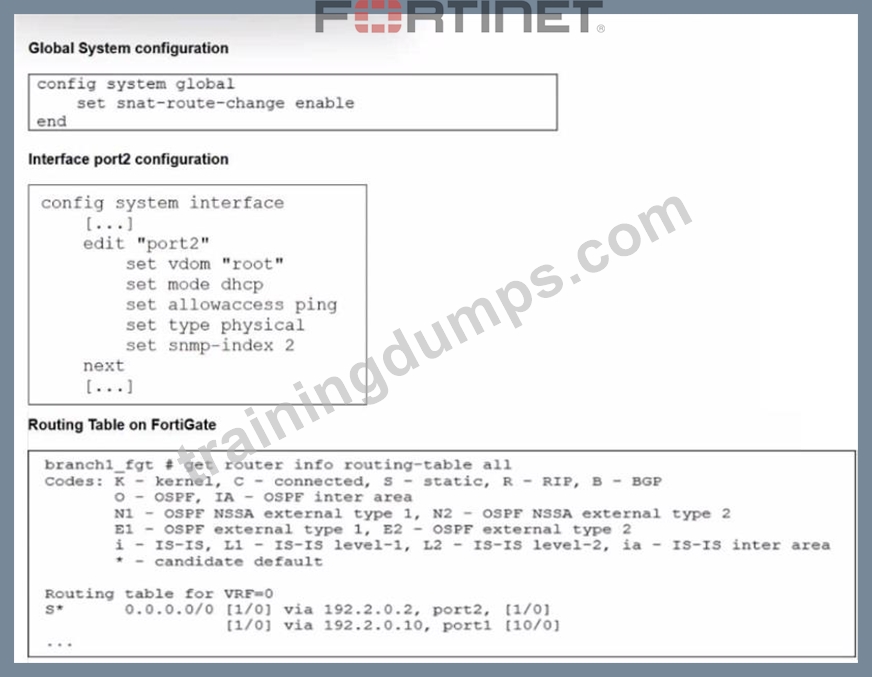
The exhibits show the source NAT (SNAT) global setting. port2 interface settings, and the routing table on FortiGate.
The administrator increases the member priority on port2 to 20.
Upon configuration changes and the receipt of new packets, which two actions does FortiGate perform on existing sessions established over port2? (Choose two.)
- A. FortiGate routes only new sessions over port2.
- B. FortiGate flags the SNAT session as dirty only if the administrator has assigned an IP pool to the firewall policies with NAT.
- C. FortiGate flags the sessions as dirty.
- D. FortiGate continues routing all existing sessions over port2.
- E. FortiGate updates the gateway information of the sessions with SNAT so that they use port1 instead of port2.
Answer: C,E
NEW QUESTION # 48
Refer to the exhibit.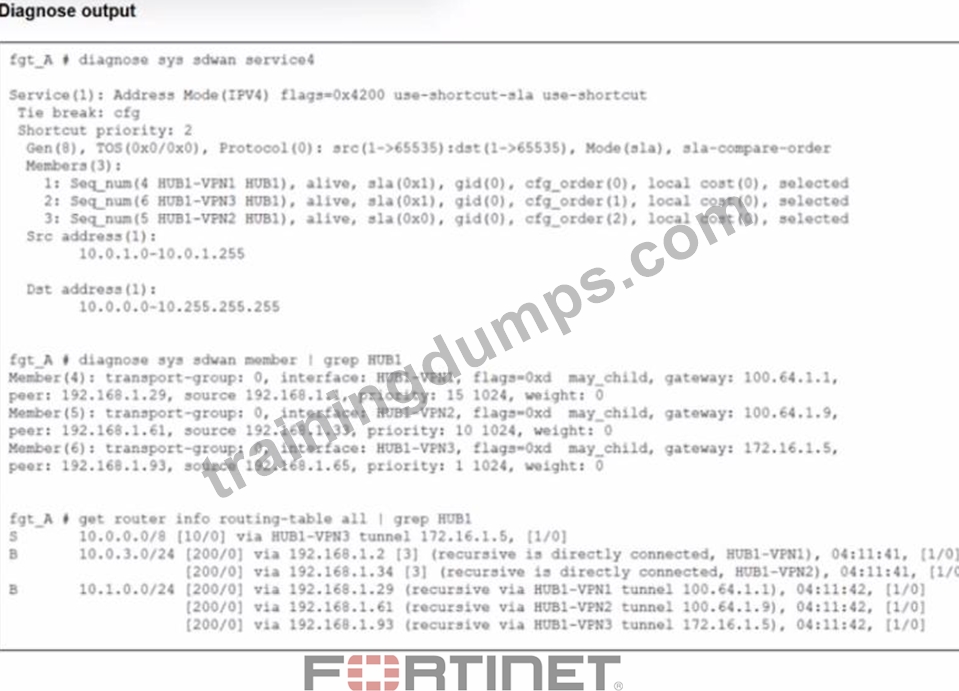
An administrator is troubleshooting SD-WAN on FortiGate. A device behind branch1_fgt generates traffic to the 10.0.0.0/8 network.
The administrator expects the traffic to match SD-WAN rule ID 1 and be routed over HUB1-VPN1. However, the traffic is routed over HUB1-VPN3.
Based on the output shown in the exhibit, which two reasons, individually or together, could explain the observed behavior? (Choose two.)
- A. HUB1-VPN1 does not have a valid route to the destination
- B. HUB1-VPN3 has a higher member configuration priority than HUB1-VPN1.
- C. HUB1-VPN3 has a lower route priority value (higher priority) than HUB1-VPN1.
- D. The traffic matches a regular policy route configured with HUB1-VPN3 as the outgoing device
Answer: B,C
NEW QUESTION # 49
Refer to the exhibit. For your ZTP deployment, you review the CSV file shown in exhibit and note that it is missing important information. Which two elements must you change before you can import it into FortiManager? (Choose two.)
- A. You must associate a device blueprint with each device
- B. You must define a value for each device and each user-defined metadata variable.
- C. You must define a name for each device
- D. You must define a value for each device and each metadata variable that defines an IP address.
Answer: A,C
NEW QUESTION # 50
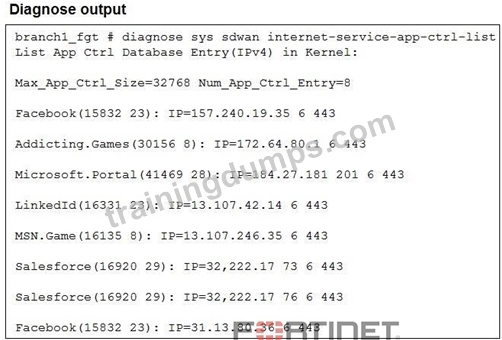
Refer to the exhibits. You connect to a device behind a branch FortiGate device and initiate a ping test. The device is part of the LAN subnet and its IP address is 10.0.1.101.
Based on the exhibits, which interface uses branch 1_fgt to steer the test traffic?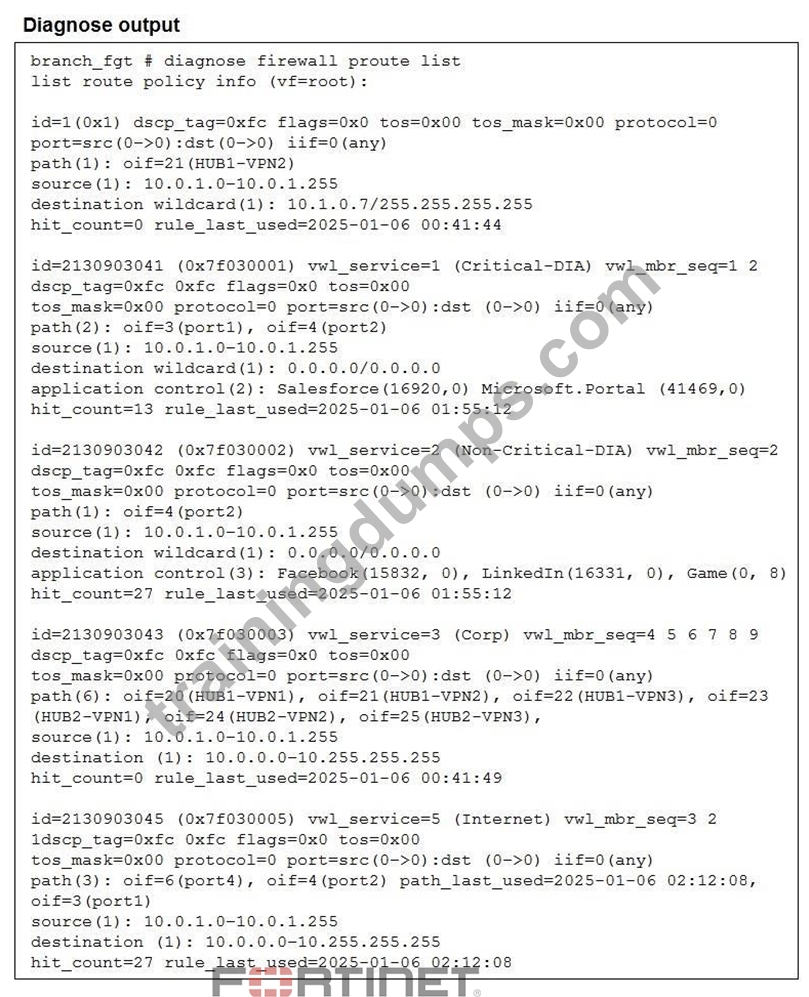
- A. port2
- B. port4
- C. HUB1-VPN1
- D. port1
Answer: A
Explanation:
The ping target IP 157.240.19.35 matches an App Control entry for Facebook (ID 15832).
According to the diagnose firewall route list output, this application is handled by vwl_service=2 (Non-Critical-DIA), which routes traffic via oif=4 (port2). Therefore, FortiGate steers the Facebook test traffic through port2.
NEW QUESTION # 51
Refer to the exhibit. You want to configure SD-WAN on a network as shown in the exhibit. The network contains many FortiGate devices. Some are used as NGFW, and some are installed with extensions such as FortiSwitch, FortiAP or FortiExtender. What should you consider when planning your deployment?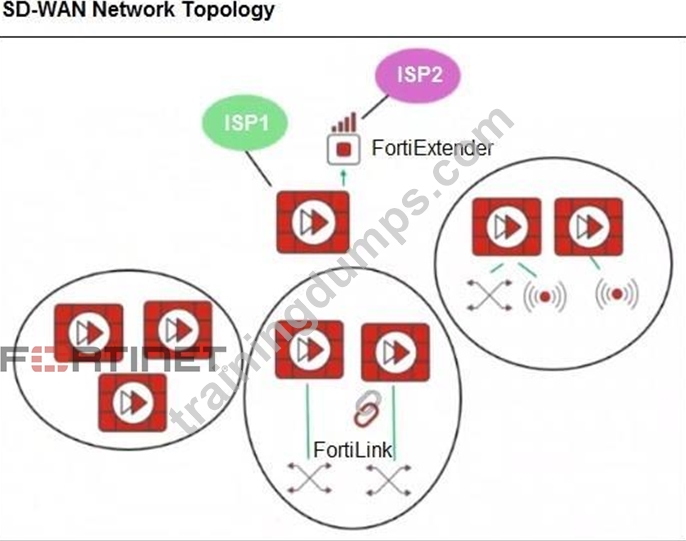
- A. You must use FortiManager to manage your SD-WAN topology.
- B. You can build an SD-WAN topology that includes all devices. The hubs can be FortiGate devices with FortiExtender.
- C. You must build multiple SD-WAN topologies. Each topology must contain only one type of extension.
- D. You can build an SD-WAN topology that includes all devices. The hubs must be devices without extensions.
Answer: B
Explanation:
FortiGate devices with FortiExtender can act as hubs in an SD-WAN topology. FortiGate supports SD-WAN integration across diverse setups - including those using FortiSwitch, FortiAP, and FortiExtender - as long as the topology and roles are properly defined.
NEW QUESTION # 52
Refer to the exhibits. You use FortiManager to manage the branch devices and configure the SD- WAN template. You have configured direct internet access (DIA) for the IT department users.
Now. you must configure secure internet access (SIA) for all local LAN users and have set the firewall policies as shown in the second exhibit.
Then, when you use the install wizard to install the configuration and the policy package on the branch devices, FortiManager reports an error as shown in the third exhibit. Which statement describes why FortiManager could not install the configuration on the branches?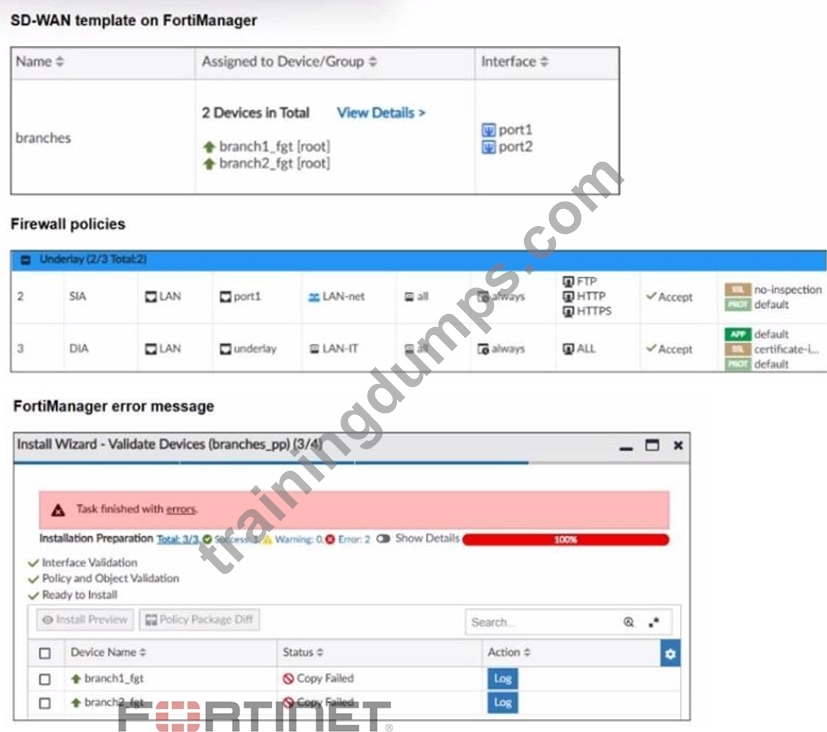
- A. You cannot install firewall policies that reference an SD-WAN member.
- B. You must direct SIA traffic to a VPN tunnel.
- C. You cannot install firewall policies that reference an SD-WAN zone.
- D. You cannot install SIA and DIA rules on the same device.
Answer: A
NEW QUESTION # 53
The SD-WAN overlay template helps to prepare SD-WAN deployments. To complete the tasks performed by the SD-WAN overlay template, the administrator must perform some post-run tasks.
What are two mandatory post-run tasks that must be performed? (Choose two.)
- A. Assign an sdwan_id metadata variable to each device (branch and hub)
- B. Create policy packages and assign them to the branch devices.
- C. Assign a hub id metadata variable to each hub device.
- D. Configure routing through the overlay tunnels created by the SD-WAN overlay template.
- E. Configure SD-WAN rules
Answer: B,E
NEW QUESTION # 54
Refer to the exhibit. An administrator configures SD-WAN rules for a DIA setup using the FortiGate GUI. The page to configure the source and destination part of the rule looks as shown in the exhibit. The GUI page shows no option to configure an application as the destination of the SD-WAN rule Why?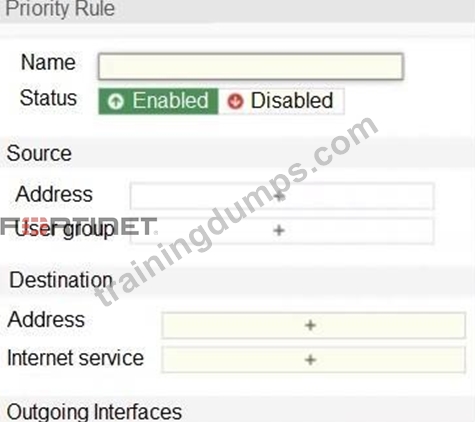
- A. You cannot use applications as the destination when FortiGate is used for a DIA setup.
- B. FortiGate allows the configuration of applications as the destination of SD-WAN rules only on the CLI.
- C. You must enable the feature first using the GUI menu System > Feature Visibility.
- D. You must enable the feature on the CLI.
Answer: C
Explanation:
To configure applications as destinations in SD-WAN rules via the GUI, the Application Control feature must be enabled in System > Feature Visibility. Once enabled, the GUI displays the application-based options.
NEW QUESTION # 55
Within the context of SD-WAN, what does SIA correspond to?
- A. Local Breakout
- B. Remote Breakout
- C. Secure Internet Authorization
- D. Software Internet Access
Answer: B
Explanation: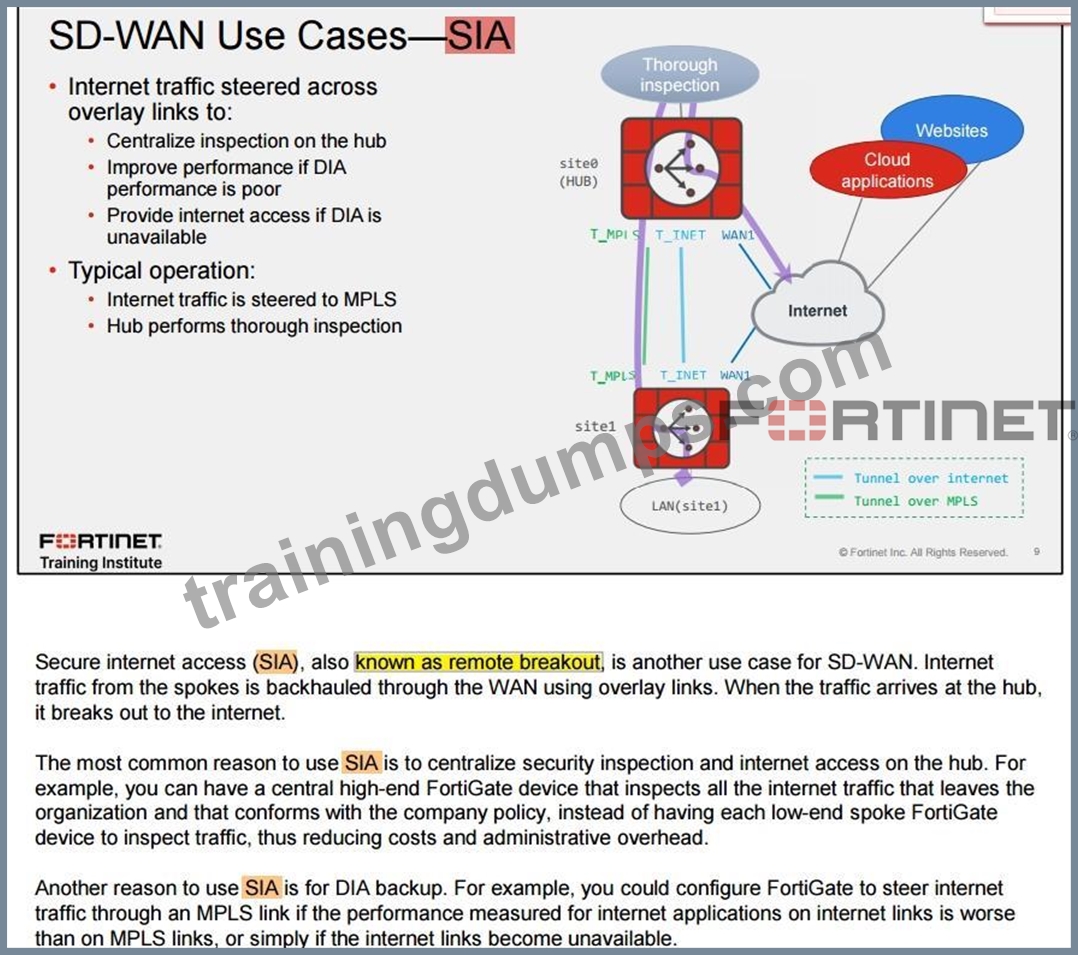
NEW QUESTION # 56
SD-WAN interacts with many other FortiGate features. Some of them are required to allow SD-WAN to steer the traffic.
Which three configuration elements that you must configure before FortiGate can steer traffic according to SD-WAN rules? (Choose three.)
- A. Routing
- B. Firewall policies
- C. Traffic shaping
- D. Security profiles
- E. Interfaces
Answer: A,B,E
NEW QUESTION # 57
You manage an SD-WAN topology. You will soon deploy 50 new branches. Which three tasks can you do in advance to simplify this deployment? (Choose three.)
- A. Create policy blueprint.
- B. Create a ZTP template.
- C. Create model devices.
- D. Define metadata variables value for each device.
- E. Update the DHCP server configuration.
Answer: A,B,C
NEW QUESTION # 58
......
Fortinet FCSS_SDW_AR-7.4 Exam Syllabus Topics:
| Topic | Details |
|---|---|
| Topic 1 |
|
| Topic 2 |
|
| Topic 3 |
|
| Topic 4 |
|
| Topic 5 |
|
Try Free and Start Using Realistic Verified FCSS_SDW_AR-7.4 Dumps Instantly.: https://www.trainingdumps.com/FCSS_SDW_AR-7.4_exam-valid-dumps.html
FCSS_SDW_AR-7.4 Actual Questions - Instant Download 75 Questions: https://drive.google.com/open?id=10qnFMO0CyfGuOENP-6FPg1EbyTL6aUIV
