

2025 CBAP Question Bank: Free PDF Download Recently Updated Questions
CBAP Certification Exam Dumps with 499 Practice Test Questions
IIBA CBAP (Certified Business Analysis Professional) certification exam is a globally recognized certification for business analysts. Cetified business analysis professional (CBAP) appliaction certification exam is designed to test the knowledge and skills of experienced business analysts who are seeking to enhance their professional credentials. The CBAP certification exam is administered by the International Institute of Business Analysis (IIBA).
Achieving CBAP certification can be a significant career milestone for business analysis professionals. Cetified business analysis professional (CBAP) appliaction certification demonstrates to employers and clients that the individual has a deep understanding of the principles and practices of business analysis, and has the skills and experience necessary to perform at a high level. In addition, CBAP certification can lead to increased job opportunities, higher salaries, and greater professional recognition within the industry. The CBAP Certification Exam is a rigorous and challenging program, but it can be a valuable investment in your career as a business analysis professional.
NEW QUESTION # 283
Some of the requirements in the solution must be completed because of laws and regulations in your industry.
Management would like you, the business analyst, to rank the requirements according to the relevant laws.
What type of requirements prioritization is management having you complete?
- A. Risk ranking
- B. Regulatory ranking
- C. Business value ranking
- D. Constraint ranking
Answer: B
Explanation:
Section: Volume A
Explanation/Reference:
NEW QUESTION # 284
You are the business analyst for your organization. Management has asked that you create a method to store the project requirements including those under development, under review, and the requirements which have been approved. What is management asking you to create?
- A. A change management system
- B. A project scope statement
- C. A repository
- D. A requirements register
Answer: C
Explanation:
Explanation/Reference:
Explanation:
NEW QUESTION # 285
Jane is the business analyst for her organization and she is completing passive observation to identify improvement opportunities in the workflow. She notices that some of the employees perform certain customer-facing activities in a different format than the other workers. Is this a problem that can be addressed as part of an improvement opportunity?
- A. It can be a problem as the enterprise environmental factors always call for consistency in all processes.
- B. It is not a problem unless the customer complains. If Jane has not noticed the customers complaining then the process should be left along.
- C. It is not a problem unless there is a drop in sales so it should be left alone.
- D. It can be a problem as customers could become confused or frustrated because of the different approaches to the work.
Answer: D
NEW QUESTION # 286
A major manufacturer of popular beverages has appointed a local distributor to serve a specific territory. The demand for the beverages has a pronounced seasonal pattern. The distributor performs well overall, but is repeatedly unable to keep up with fulfilling many customer orders during peak demand periods. The distributor's current delivery capability is stretched to deliver 60 tons of merchandise per day whereas the season's peak demand periods need a daily delivery capability of up to 100 tons.
The distributor is under pressure to fully meet the year-round market demand in order to stay in business. The distributor's management wants to identify and consider more cost-effective options as resorting to adding more trucks and drivers would not be economically feasible.
A business analyst (BA) has spent several days observing and measuring the warehouse activities to understand the situation and to gain insights into possible solutions. The delivery workflow is a four-step process: (1) picking the orders and assembling them on trays, (2) bringing the trays to the loading bay, (3) loading the orders into trucks, and (4) delivering the orders to customers. As the following table illustrates, overall performance depends is dependent on five major resources: (1) the workers who pick the orders and load them into trucks, (2) the tallyers who check the orders, (3) the drivers, (4) the trucks, and (5) eight loading bays (LBs).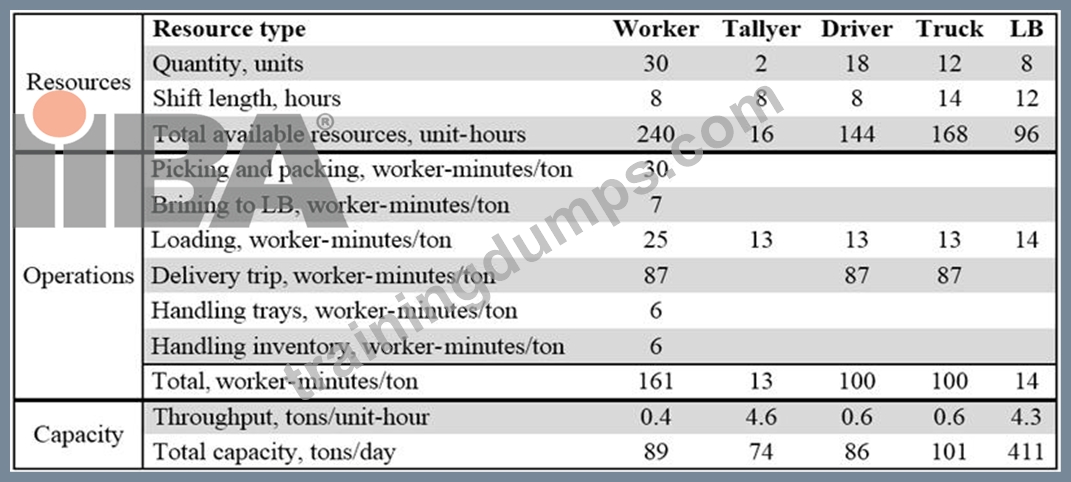
If the driver's average throughput is 0.6 tons/hour, how many hours per day would 15 drivers have to work to deliver 100 tons of merchandise?
- A. 0
- B. 1
- C. 2
- D. 3
Answer: D
NEW QUESTION # 287
A company wants to develop a product roadmap to guide future development efforts. The product owner asks a business analyst (BA) to lead the analysis effort. Feature suggestions have been compiled from customer support calls. Which of the following should the BA do first?
- A. Prioritize the features in the backlog
- B. Determine the value of each feature
- C. Confirm the feature requests
- D. Compare the implementation costs of each feature
Answer: B
NEW QUESTION # 288
Henry is the business analyst for his organization. Management has created a pre-determined budget of
$450,000 for his solution. Henry has identified the project requirements but now wants to prioritize them based on timeboxing and budgeting. Henry examines the cost of the requirements and begins removing the requirements from the allowed list in order to meet the $450,000 budget. What timeboxing or budgeting approach is Henry using?
- A. All out
- B. Selective
- C. Parametric
- D. All in
Answer: D
Explanation:
Explanation/Reference:
Explanation:
NEW QUESTION # 289
You are the business analyst for your organization. Management has asked that you create a method to store the project requirements including those under development, under review, and the requirements which have been approved.
What is management asking you to create?
- A. A change management system
- B. A project scope statement
- C. A repository
- D. A requirements register
Answer: C
NEW QUESTION # 290
Mark is the business analyst for his organization. Mark and his business analysis team have used the whiteboard to record the documentation as the result of requirements elicitation. What must be done with this information if Mark uses a whiteboard?
- A. The regulator must approve the writings on the whiteboard.
- B. The business analyst must transfer the information to another medium before the whiteboard is erased.
- C. The business analyst must document the white board information and get all participants' approval of the recording.
- D. The scribe must include the white board information as part of the minutes.
Answer: B
Explanation:
Explanation/Reference:
Explanation:
NEW QUESTION # 291
You have completed the requirements documentation and the stakeholders have signed off on the requirements. Now the requirements are advancing into a project as your organization has chartered a project based on the identified requirements. What stakeholder is now responsible for assessing the solution scope to determine the project scope?
- A. Project sponsor
- B. Project manager
- C. Key stakeholders
- D. Business analyst
Answer: B
Explanation:
Explanation/Reference:
Explanation:
NEW QUESTION # 292
A business analyst (BA) is working on a payment system (PS) implementation. A set of systems which should interact with a new system has been identified. The business analyst defined that a user with role of
"Supervisor" in the PS must pass a two-factor authentication before an execution of the functions: "Change system parameters" and "Set up new supervisor." A user must have the role of "Supervisor" to use the standard functions "Send mail notification" or "Send SMS notification".
The BA defined the following use cases:
*"Change system parameters"
*"Setup new supervisor"
*"Send mail notification"
*"Send SMS notification"
*"Send notification"
*"Pass a two-factor authentication"
The BA wants to create a Use Case diagram.
Which technique should be used to define a communications protocol between the PS and other systems?
- A. Concept modelling
- B. System analysis
- C. Vertical prototyping
- D. Interface analysis
Answer: D
Explanation:
Explanation
Interface analysis is a technique that identifies and specifies the information that is exchanged between systems or system components. It defines the communications protocol, data format, and timing of the information exchange. Interface analysis is useful for designing and documenting the interactions between the PS and other systems. It can also help to identify potential issues or risks related to the integration of the systems.
Vertical prototyping is a technique that creates a working model of one or more aspects of a solution, such as the user interface, functionality, or performance. It is used to validate the requirements and design of the solution, and to obtain feedback from stakeholders. It is not directly related to defining the communications protocol between the systems.
Concept modelling is a technique that defines the terms and concepts relevant to a domain or a problem. It establishes a common vocabulary and understanding of the domain among the stakeholders. It is not focused on the technical details of the system interactions.
System analysis is a broad term that refers to the process of studying and understanding the current or desired state of a system. It involves identifying the system components, functions, inputs, outputs, and relationships.
It is not a specific technique for defining the communications protocol between the systems. References:
[A Guide to the Business Analysis Body of Knowledge (BABOK Guide), Version 3], Chapter 10:
Techniques, pp. 402-403, 414-415, 420-421, 424-425.
[Business Analysis for Practitioners: A Practice Guide], Chapter 5: Requirements Analysis and Design Definition, pp. 123-124, 133-134, 140-141, 144-145.
NEW QUESTION # 293
What is the term used to describe the cost of the solution after the solution has been implemented in production by a vendor?
- A. Lifecycle maintenance fees
- B. Total ownership costing
- C. Sustainability fees
- D. Total cost of ownership
Answer: D
NEW QUESTION # 294
Which of the following document is created first after project is awarded and statement of work is handed over to the project manager?
- A. Work breakdown structure (WBS)
- B. WBS dictionary
- C. Project scope statement
- D. Project charter
Answer: D
Explanation:
The project charter is the document that is created first after the project is awarded and the statement of work is handed over to the project manager. The project charter is a high-level document that formally authorizes the initiation of the project and defines the project vision, objectives, scope, deliverables, stakeholders, roles and responsibilities, assumptions, constraints, risks, and success criteria. The project charter also identifies the project sponsor, the project manager, and the project budget and schedule. The project charter provides the direction and guidance for the project and serves as a reference point for future decisions and changes. The project charter is usually created by the project sponsor or the customer, in collaboration with the project manager and the business analyst, and approved by the key stakeholders. References: [IIBA BABOK Guide v3], section 5.1.1, page 161; CBAP / CCBA Certified Business Analysis Study Guide, chapter 6, page
233; CBAP Sample Questions, question 243.
NEW QUESTION # 295
An insurance company wants to increase sales by 15% and customer retention by 10% within 1 calendar year.
Various strategies to achieve this were considered and a restructure to the existing pricing model is selected to help achieve these goals.
A business analyst (BA) works with stakeholders such as actuaries, product specialists, sales staff, risk managers, and underwriters who agree to applying varying levels of discounts to customers based on:
- Total annual premium the customer has with the company (Financial worth)
- Time with the insurance company (Loyalty)
Various financial models are considered but the stakeholders agree that an initial applicable discount is determined based on the customer's overall premium: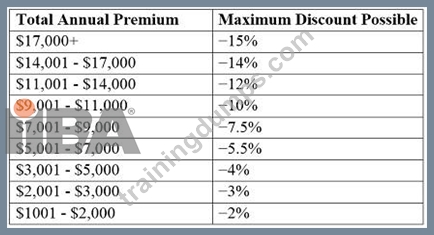
The percentage of the maximum possible discount available to the customer is adjusted based on time with the company: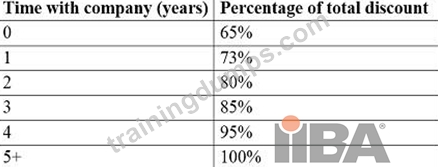
If within the first six months, customer retention increased by 5 % and sales increased by 6%, then when will the desired sales and retention goals be achieved assuming the trend continues at the same pace?
- A. Sales - 18 months; Retention - 1 year
- B. Sales - 2 years; Retention - 18 months
- C. Sales - 2.5 years; Retention - 2 years
- D. Sales - 3 years; Retention - 1 year
Answer: A
NEW QUESTION # 296
Which of the following defines the deliverable the customer is expecting?
- A. Product scope statement
- B. Project network diagram
- C. Project charter
- D. Procurement management plan
Answer: A
NEW QUESTION # 297
Which of the following graphical presentations of a project plan is most appropriate for presenting to upper management?
- A. Scatter chart
- B. Critical Path Method
- C. Pareto Chat
- D. Pie chart
Answer: B
Explanation:
Explanation/Reference:
Explanation:
NEW QUESTION # 298
A project is implemented using a predictive approach. Unfortunately, a lot of change requests (CR) have been raised. A project manager (PM), who should approve each change request, is overworked.
What could the business analyst (BA) propose to make things better?
- A. Revisit the Business Analysis Governance approach
- B. Approve the CRs independently for the PM
- C. Decline CRs because of the approach
- D. Transfer responsibility from the PM to a project's sponsor
Answer: A
Explanation:
Explanation
Business Analysis Governance is the set of processes, rules, and decision-making rights that define how business analysis work is performed and how business analysis deliverables are approved and managed. It also defines the roles and responsibilities of the business analysis stakeholders and how they collaborate and communicate. In a predictive approach, change requests are usually subject to formal approval and impact analysis, which can be time-consuming and burdensome for the project manager. The business analyst could propose to revisit the Business Analysis Governance approach and suggest ways to streamline or simplify the change management process, such as delegating some approval authority, prioritizing or grouping change requests, or adopting a more adaptive approach that allows for more flexibility and feedback.
References: CBAP / CCBA Certified Business Analysis Study Guide, 2nd Edition, Chapter 2: Business Analysis Planning and Monitoring, p. 59-60; BABOK Guide v3, Chapter 2: Business Analysis Planning and Monitoring, Section 2.5: Plan Business Analysis Governance, p. 40-41.
NEW QUESTION # 299
Which one of the following diagrams when properly laid out is always laid in a left to right display to properly reflect the chronology of all project work?
- A. Time-scaled schedule network diagram
- B. Influence diagram
- C. Project schedule network diagram
- D. Arrow diagramming method
Answer: C
NEW QUESTION # 300
......
The CBAP exam covers a broad range of knowledge areas related to business analysis, including business analysis planning and monitoring, elicitation and collaboration, requirements management and communication, enterprise analysis, and solution assessment and validation. CBAP exam consists of 120 multiple-choice questions and takes three and a half hours to complete.
New CBAP Exam Dumps with High Passing Rate: https://www.trainingdumps.com/CBAP_exam-valid-dumps.html
IIBA CBAP Actual Questions and Braindumps: https://drive.google.com/open?id=14EwQiyHsqWY6gsOtL8JPYhxQat6KbD-m
